Tuesday, January 21, 2014

Osisko Mining Corp.’s board has come out swinging against Goldcorp Inc.’s hostile takeover bid- CEO Sean Roosen


Osisko Mining Corp.’s board has come out swinging against Goldcorp Inc.’s hostile takeover bid, urging shareholders to reject the “financially inadequate” $2.6 billion offer from the Vancouver giant while the company seeks out a better deal.
Chief executive Sean Roosen urged investors Monday not to tender shares to the Goldcorp bid, launched last week, while the board “aggressively pursues” alternatives for the junior that owns and runs the coveted Canadian Malartic mine in northwestern Quebec.
Roosen, who built Malartic into one of the world’s largest gold mines, said on a conference call that companies with a high quality, single asset have substantially outperformed giant diversified firms such as Goldcorp, whose shares have fallen 23 per cent in the last five years as Osisko’s doubled.
“Goldcorp’s best days are behind it, and we are at a brand new mine with our best days in front of us,” said Roosen.
The all-Canadian takeover bid is the largest in the struggling global gold sector in over a year, during which the bullion price tumbled 30 per cent and companies closed mines and slashed costs to combat falling share prices.
The Goldcorp offer “fails to recognize the strategic value” of Canadian Malartic, which “was developed, built, commissioned and ramped up by Osisko over the past 10 years and would be extremely difficult, time-consuming and costly to replicate,” the firm said in a lengthy statement
Montreal-based Osisko also released preliminary operational and financial results for 2013, which show the mine produced 475,277 ounces at a cash cost of $760 an ounce, and in the most recent quarter 137,321 ounces at $713 per ounce.
The mine, which opened in 2011, has 10 million ounces of reserves and is expected to be in full production for at least 16 years.
“The Goldcorp offer has been opportunistically timed to occur before Canadian Malartic enters what Osisko expects will be its most productive years,” the company said.
Roosen advised investors to hold out for a better offer since there are very few quality gold assets in the world like Malartic in the more mining-friendly Abitibi gold belt. He boasted Osisko is one of the few miners “that can ever claim to have built a mine ahead of schedule and on budget.”
Tendering Osisko shares to the current Goldcorp offer, which expires Feb. 19, “may preclude the possibility of a superior alternative transaction emerging,” the company warns investors on its website.
Osisko shares have traded well above the $5.95 implied value of the Goldcorp offer since the stock-and-cash proposal was first announced Jan. 13, indicating investors think Goldcorp or another suitor will sweeten the deal.
Analysts have said Goldcorp will have to raise its offer if it wants to close the deal.
Goldcorp chief executive Chuck Jeannes was not immediately available for comment Monday.
He has said Canadian Malartic would transform Goldcorp into “a true Canadian mining champion” and rank among the company’s most important operations if the takeover is successful.
Joseph Fazzini of Dundee Capital Markets called the mine “a cherished and coveted asset for Canadians” -- many of whom are invested in Osisko through the Canada Pension Plan and the Caisse de depot et placement du Quebec, Canada’s second largest pension fund.
Osisko’s CEO pointed out that Goldcorp’s primary asset, the Penasquito mine in Mexico, has “under-delivered” and is more a base metal than bullion producer, while Osisko is a pure gold play.
Goldcorp was once one of the largest shareholders in Osisko, but sold its 10.1 per cent stake in the company in 2011 for $13.75 a share for a total of about $530 million.
Since then, the world’s second-largest gold producer said it had been in regular discussions to try to strike a friendly deal with Osisko until late last year.
Related:
Thursday, January 16, 2014

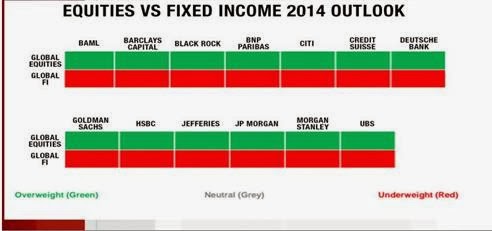
Every single major investment dealer is overweight equities and underweight bonds...where have you invested your money?

Market Outlook:
Three themes for 2014 are: 
-Tapering is not tightening, U.S. economic re-acceleration and synchronized global economic recovery.
-Biased to equities over bonds.
-Largest o/w in U.S. and then EAFE equities

 The table shows each of the major investment dealer firms and whether they are o/w or u/w equities and bonds. The key is that every single major investment dealer is o/w equities and u/w bonds. I cannot imagine that the consensus has ever been this aligned. The question is “what are the market/investment implications 
of this?”

www.bnn.ca

Tuesday, January 7, 2014

Kevin Warren Zietsoff Banned For Life For Ponzi Scheme

TORONTO – An Ontario man who defrauded investors, many of them friends and family, of more than $15 million in a long-running Ponzi scheme has been banned from securities trading for life.
In a 76-page settlement ruling released Tuesday, the Ontario Securities Commission also permanently banned Kevin Warren Zietsoff from acting as a director or officer of any company or as an investment fund manager.
Zietsoff, 41, has previously admitted to losing more than $10 million of money he had taken from friends, family and acquaintances between January 2006 and December 2012.
The other $5 million was returned to investors as so-called interest payments that kept up appearances for the scheme.
Victims included Zietsoff’s elderly parents, who lost their life savings of $2.5 million, and his estranged wife, who lost $300,000 from an RRSP, and recently declared bankruptcy.
The scheme came to light in January 2013 when Zietsoff turned himself in to the RCMP, who were unaware of it prior to his confession. Zietsoff has since pled guilty to one count of fraud over $5,000.
In documents filed as evidence in the Ontario Court of Justice, Zietsoff said he borrowed and invested money he raised from 59 people in Ontario and Arizona, where his parents had a home, although he was not registered with the OSC to do securities trading.
“Over time, he presented himself as a successful trader with a no-risk investment strategy that paid guaranteed returns. In fact, his gains were significantly and consistently overtaken by losses,” according to the securities commission.
“Although the investors’ money was often soon lost in trading, Zietsoff frequently assured them that their investments were safe and maintained that illusion by making interest or capital payments, often in cash, from other investors’ money.”
Zietsoff admitted that he had convinced investors that he had created a unique “positive expectancy system” that were “low-risk” or “risk-free” and would result in hefty interest payments.
“To many investors, Zietsoff portrayed himself as successful, when he was not,” said the commission.
“His actual lifestyle was different from what his investors believed. While they saw him flying across North America delivering large interest payments, in reality, he was being supported by his parents and wife. He stated that he did not use the defrauded funds to live a lavish lifestyle.”
When questioned by investors after the interest payments stopped, Zietsoff gave them various excuses, including that assets were tied up in bankruptcy proceedings, linked to short-selling of Arizona real estate, invested in Greek debt and invested in U.S. currency.
None of these explanations were true, the OSC said.

Monday, January 6, 2014

its 2014 Traders Back To Business!

Traders get back to business
The chase by Greg Bonnell:

This is the week we get back to business. Trading volumes will start to pick up as traders get back to work and take in some big events. There's a meeting of the European Central Bank, Alcoa releases its latest numbers on Thursday (still the unofficial kick-off to earnings season? Debate amongst yourselves). Then on Friday, the all-important jobs reports here and in the U.S.
But I get ahead of myself; we have Monday and the wicked weather it brings to contend with. Don't you wish you could live in a virtual world, free of cold and snow, where the currency you invested in has once again jumped in value? Bitcoin has broken above $1,000 US again (it's been there before), this time on news that online gaming company Zynga will accept the cryptocurrency. If I had made a fortune in the run-up of Bitcoin last year (which I did not), I'm not sure I'd be spending it on virtual cows and sheep in Farmville, but to each his own.
The annual Consumer Electronics Show (CES 2014) kicks off in Vegas today, and BNN's very own Michael Hainsworth will be reporting from the scene on the latest and greatest in all that excites you about the tech world. Nobody knows tech like Michael, and I'm anxious to see what he uncovers down there. We're probably breaking a cardinal rule, but what happens in Vegas over the next three days will not stay in Vegas, it's coming to you on BNN. For live coverage, click here http://www.bnn.ca/Special-Coverage/consumer-electronics-show.aspx.
The Dow and S&P 500 futures are pointing to a modest opening in the green today. The first two days of trading in 2014 were a bit lackluster, but two days does not a trend make. In the early trade, we're looking at China's services purchasing-managers' index. It declined to 50.9 in December from 52.5 in November, and the Shanghai Composite Index closed at its lowest level since August.
We're also casting our gaze on Washington, where a Senate vote to confirm Janet Yellen as the next chairman of the Fed is expected; and the expectation is that Yellen will breeze on through. Ben Bernanke exits the role on Jan. 31 after overseeing unprecedented stimulus in the form of bond buying in the wake of the financial crisis.
Shares of Kirkland Lake Gold (KGI-T) are on our radar after the mining company announced a strategic review, including a possible sale of the company and the resignation of it deputy chairman. KGI's shares are down more than 50% in the past 12 months.
T-Mobile (TMUS-N) is buying some prime spectrum from Verizon Wireless, with a pricetag of about $2.4 billion US. The deal is seen as giving both companies coverage capabilities in regions where they're lacking, as it also amounts to a spectrum swap. And perhaps it makes T-Mobile a more attractive acquisition target as well.
T-Mobile is buying 700 MHz spectrum, the same type up for grabs in Canada at next week's auction. This country's big three telecom companies have said the rules around the auction - which limit the amount of that prime spectrum they can bid on - provides an unfair advantage to new entrants. On Friday, we learned that Telus lost a court battle in which it challenged those rules.
That's all that's in my head at the moment, so best keep it on BNN all day to see what comes next.
Cheers,
Greg