Sunday, October 27, 2013

Opinion Of Ivan Lo The Equedia Letter


Redistributed
Ivan Lo
The Equedia Letter

The strive for growth is written in our DNA.Often, we strive for this growth at any cost.

When a nation is presented with the option of growth with the push of a button, it takes that action.

American government, corporations, and banks have taken advantage of this "button" all over the world for many years. They offer money to developing countries who are striving for growth and stability in return for "favours" that range from trade agreements to resource access.  

The "end" result for the borrowers is never-ending debt; working even harder to pay back a loan that can never be repaid.

 
Instead of achieving economic growth - as promised by the lenders - these borrowing nations turn into the puppets of its lenders. They're no longer working to achieve growth in their own economies, but are rather forced into the growth and profits of its lenders.

Let me explain.

Let's say you borrowed $100 at 10% so that your business could achieve 15% growth in revenue. However, your forecast was wrong and your revenues end up growing only 5%.

Now you owe an extra 5% for the interest on the loan, of which you don't have. 

Since you want to keep your business running, you have only two options: Either run out of money, or borrow more.

This is an extremely simplified example of how powerful banks and nations have taken advantage of developing countries all over the world.

But if you think this scheme has only been forced onto developing nations, think again; it's been forced onto all of us, including the world's most powerful nation, the United States of America.

America at the Mercy of Debt 

The U.S. national debt to GDP is above 100%. That means the nation owes more money than the value of everything it produces in a year.

While this debt burden is due in part by the large deficits incurred to mitigate the effects of the financial crisis, and the poor recovery following the aftermath, we should note that America has been over spending for many years.

The bulk of this overspending started during the early 1970's when the government started to significantly increase spending without a corresponding increase in tax revenue; a product of the Nixon Shock - a series of economic measures enacted by United States President Richard Nixon in 1971. More importantly, it included unilaterally canceling the direct convertibility of the United States dollar to gold which ended the existing Bretton Woods system of international financial exchange and ushering in the era of freely floating currencies that remains to the present day (see America's Gold Wiped Out.)  

In other words, it represented the move to a fiat currency backed by nothing more than promises (see How the Government Borrows Money.)

As I said earlier, when a nation is given the opportunity to grow with the push of a button, it takes it.

Since America pushed this button in the 1970's, the reigns have yet to be pulled back.

This trend has only gotten worse.

America is now spending significantly more, while bringing in less. Take a look: 
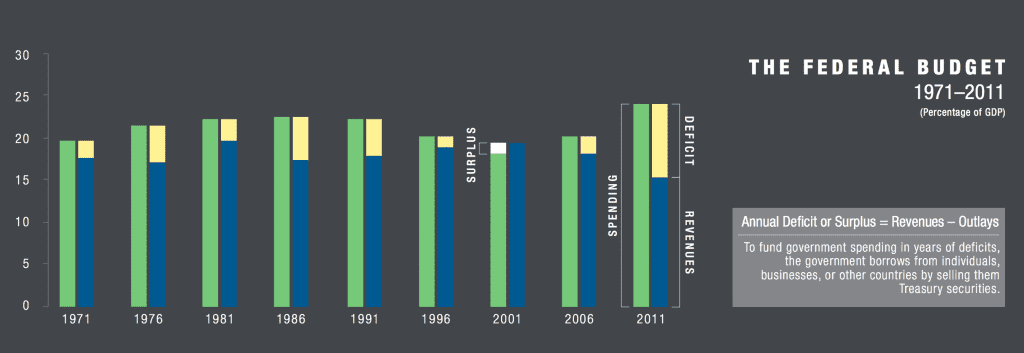
Source: Congressional Budget Office


Despite the above projections that show revenues and outlays will grow in-synch over the next few years (but still running a heavy deficit), we have to note that most of the increase in deficit spending over the years - and moving forward - can be attributed to increases in Medicare:
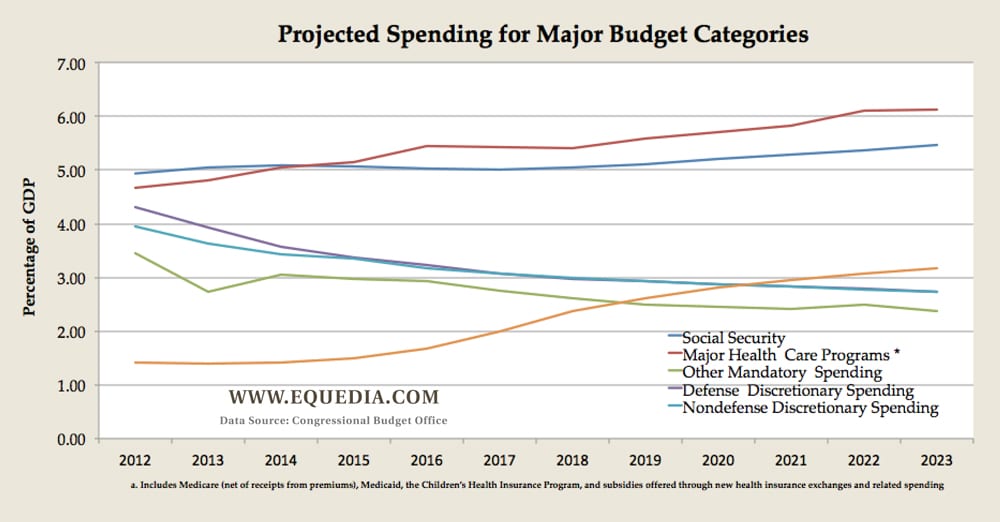
 
I am not going to debate the pros and cons of Obamacare and turn this into a political debate.

If you have comments on Obamacare, you can LEAVE IT HERE.

Borrowing from Peter to Pay Paul 

Obama promises cost-savings over the long haul under Obamacare, but that is something that can be seriously debated.

What cannot be debated is that Obamacare is going to cost taxpayers a lot more upfront, which in turn will add to the deficit and the national debt quickly.

The below chart shows the interest payments of America's outstanding debt, which includes the monthly interest for: U.S. Treasury notes and bonds, Foreign and domestic series certificates of indebtedness, notes and bonds, Savings bonds, Government Account Series (GAS), State and Local Government series (SLGs) and other special purpose securities.
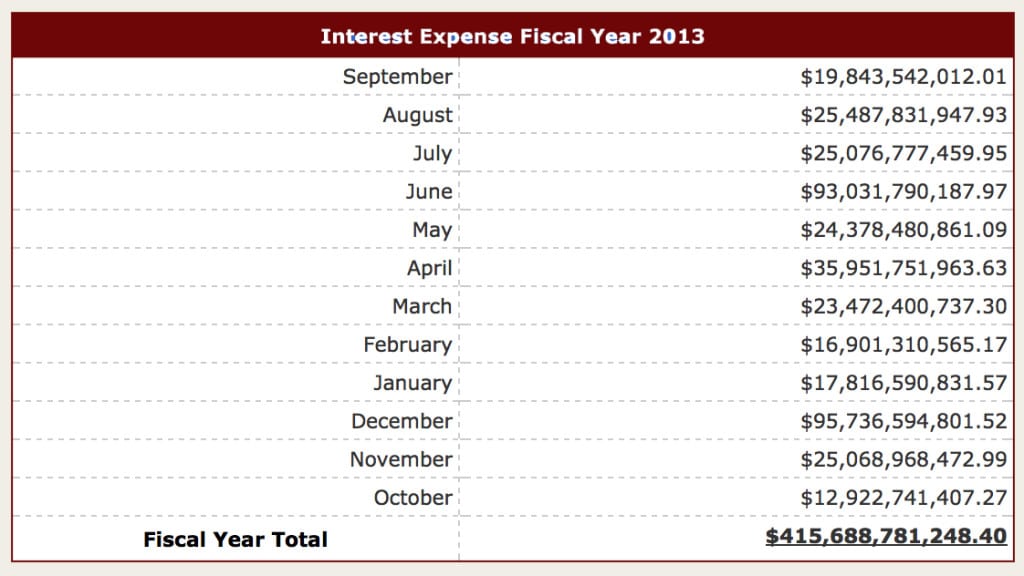
 
In the last 12 months America has paid nearly half a trillion dollars in interest alone.

If interest rates were any higher, this number could soon reach the trillion-dollar mark within the next few years. That's why America will do everything in its power to keep rates low.

As I mentioned last week, the government's main source of income is tax revenue. On a federal level, the U.S. government is estimated to collect about $2.7 trillion this year, of which $1.9 trillion comes from income tax (not including sales taxes and property taxes, and social insurance taxes such as Social Security, unemployment and hospital taxes.)  

That means 22% of the income tax an American pays goes directly to servicing America's debt.  

In other words, nearly a quarter of all federal income tax revenue goes directly to paying only the interest on loans.   

How do you feel about this? Share your thoughts HERE.  

At the rate America is borrowing and spending, no amount of taxes will solve the growing debt issue.

Furthermore, raising taxes would significantly affect output; higher taxes equals less growth, and less growth equals less taxes.

Like the developing nations of the world who borrow from America and other wealthier sources, we too are trapped in this debt bubble.

America's debt ceiling will continue to climb every year, and simple mathematics tell us that America will need to keep borrowing to continue moving forward.

And since the real demand for U.S. debt continues to shrink (see a Shocking 2011 Cover-Up), there is only one private institution that can provide funds for America's growing debt: the Fed.

In other words QE has become the norm.

So where does that leave the market?

A Highly Leveraged Market

A while ago, I talked about how NYSE debt margin has skyrocketed to record levels (see The Monarchs of Money.)  

"Margin debt amounted to $379.5 billion in the month of March. The highest margin debt amount previously was $381.4 billion back in July 2007. That means the amount of money people are borrowing to buy stocks are now back at pre-2008 levels."

In September, the NYSE margin debt level reached a record-breaking $401.2 billion.  

Take a look this chart:
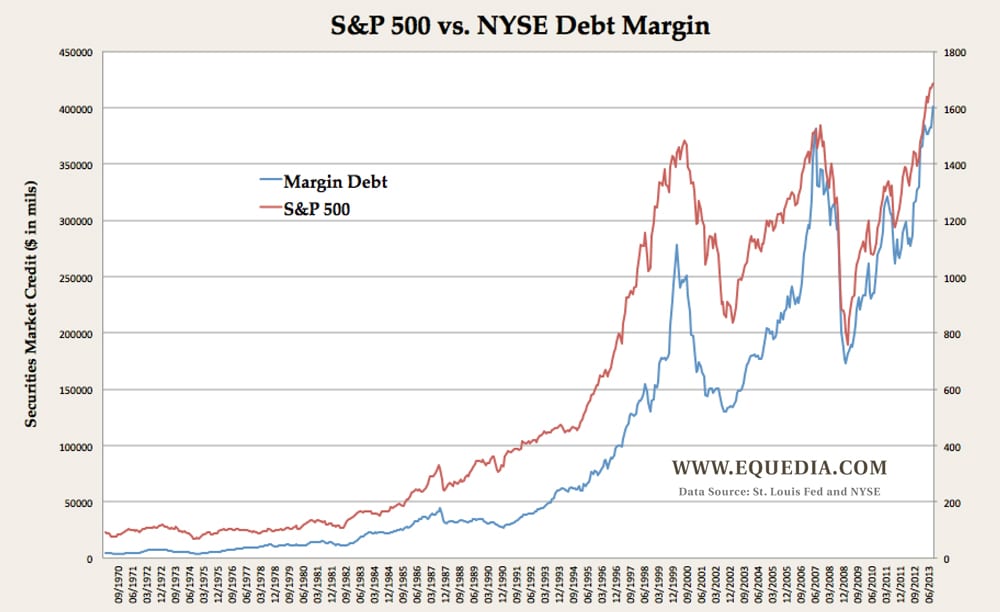
 
Going back to the 1970's (and beyond), margin debt levels never surpassed the S&P 500, relative to this chart overlay.  

But when the margin debt level crossed the S&P 500 back in 2007...well, we all know what happened in 2008.

Since 2007, the distance between the S&P 500 and NYSE margin debt level lines in this chart have been very close. This shows us that the amount of leverage in the stock market has never been higher, and that the rise in the S&P is closely associated with the amount of "borrowing to buy stock" taking place.

It also means the market is walking a very fine line. Any sudden drops could force margin calls that could slam the market down extremely fast.

However, I suspect that if that were to happen, we'll likely see a trading halt across many stock exchanges in order to prevent a major crash. Then it will be blamed on the algo-softwares not being able to handle all of the trades, as the banks and cohorts collaborate to prevent the margin calls from slamming the market back down.

Remember, there's already been many instances where trading has been halted to prevent the market from turning (see The Truth Behind the NASDAQ Glitch.

I present you the above chart to show you the fine line we've been walking since 2008, and how close we have been to falling down. However, I still predict that we will see the S&P move to 1800 before the end of the year, barring any major economic shock.

Just because we're walking a fine line, doesn't mean that line is not pointing up.

Equedia Network Corporation is also a distributor (and not a publisher) of content supplied by third parties and Subscribers. Accordingly, Equedia Network Corporation has no more editorial control over such content than does a public library, bookstore, or newsstand. Any opinions, advice, statements, services, offers, or other information or content expressed or made available by third parties, including information providers, Subscribers or any other user of the Equedia Network Corporation Network of Sites, are those of the respective author(s) or distributor(s) and not of Equedia Network Corporation. Neither Equedia Network Corporation nor any third-party provider of information guarantees the accuracy, completeness, or usefulness of any content, nor its merchantability or fitness for any particular purpose.  

Wednesday, October 23, 2013

CGI Blamed By Obama...BUT CGI wasn't in charge of the integration work


National Bank’s Mr. Thompson, who said he spoke to the company about the issue recently, said the problems were related to “integration” work after CGI had finished the project and handed it off to a federal agency called the Centers for Medicare & Medicaid Services. “I don’t think CGI should be taking the blame for this,” Mr. Thompson said. “They built the application to the spec. The spec was approved and they’ve been paid. And they weren’t in charge of the integration work.”

Obamacare woes threaten CGI's stature
IAIN MARLOW and BERTRAND MAROTTE
 
TORONTO and MONTREAL — The U.S. President is not happy with Canada’s largest technology company.

A U.S. unit of Montreal-based CGI Group Inc., a global technology services giant with annual revenues of $10-billion, is the main contractor behind the problem-plagued, Web-based insurance exchange that plays a key role in the Affordable Care Act, commonly known as Obamacare.
The website, which is meant to help uninsured Americans search for medical coverage at decent rates, has lagged and crashed as millions of people try to search through and sign up for plans. The crisis, if it continues, could deliver a reputational hit to CGI, as well as illustrates the complicated nature of the large, complicated government contracts that make up a sizable share of the company’s business.

U.S. President Barack Obama said Monday there is “no excuse” for the technical problems that have plagued the site.

“The problem has been that the website that’s supposed to make it easy to apply for, and purchase, the insurance is not working the way it should for everybody,” Mr. Obama said at a news conference at the White House. “There’s no sugar-coating it. The website has been too slow, people have been getting stuck during the application process ... Nobody’s more frustrated by that than I am, precisely because the product is good.”
CGI Group has so far managed to avoid much of the blame, but it could eventually suffer reputational damage if these high profile problems continue, Raymond James analyst Steven Li said in an interview. Another analyst, National Bank Financial’s Kris Thompson, said he thinks many in the technology services industry would be aware that CGI Group built the product to the proper “specs,” and that the current problems do not indicate broader problems within the Canadian company – which has grown sizably over the past couple of years through acquisitions.
Government contracts, such as the project for Mr. Obama’s health-insurance marketplace, constitute a large part of CGI’s business: As of July, 2013, CGI said on its website that it supported more than 2,000 government organizations and that it had worked with 95 federal government departments, agencies and crown corporations – and partnered with “most” of Canada’s provinces. A spokesman for CGI did not return multiple requests for comment.

Mr. Li, in an interview, said CGI has not suffered any serious damage since the system went live on Oct. 1, but added that public goodwill may not last. “The longer it drags on, the higher the risk that CGI will take a reputational hit,” he said. “But it would take a month or two for that to happen. If this is fixed in the next couple of weeks, there will be no issue for CGI.”

National Bank’s Mr. Thompson, who said he spoke to the company about the issue recently, said the problems were related to “integration” work after CGI had finished the project and handed it off to a federal agency called the Centers for Medicare & Medicaid Services. “I don’t think CGI should be taking the blame for this,” Mr. Thompson said. “They built the application to the spec. The spec was approved and they’ve been paid. And they weren’t in charge of the integration work.”
Mr. Obama said about half-a-million people so far have applied for heath care on federal and state exchanges. He did not mention by name CGI or any other service providers that worked on setting up the exchange. “No one is madder than me about the fact the website isn’t working as it should, which means it’s going to get fixed,” he joked.
CGI won the contract for designing and developing the technology architecture of the new marketplace. The platform, to which several other companies have also contributed, is managed by an arm of the U.S. Department for Health and Human Services.

Bank of Canada is keeping its trendsetting interest rate at one per cent

OTTAWA—The Bank of Canada is keeping its trendsetting interest rate at one per cent and signalling it will likely stay low longer than previously anticipated.
The bank says in a new forecast that the Canadian economy will be considerably weaker over the next few years and take longer to return to full capacity.

Repost For Education and Discussion analyst upgrades and downgrades

This blog is posted to share under the provisions of "Fair dealing" offers some exceptions to the Copyright Act's general prohibition on copying. Fair dealing allows limited and non-commercial copying for the purposes of research or private study, criticism, review, and news reporting. 

Today's analyst upgrades and downgrades
Darcy Keith and Eric Atkins
Inside the Market’s roundup of some of today’s key analyst actions. This file will be updated during the trading day. For breaking analyst actions prior to market open every day, read our Before the Bell morning report.
Desjardins Securities analyst Benoit Poirier upgraded Canadian National Railway Ltd. to "buy" from "hold," commenting that the company's "stellar" third-quarter results have given him confidence that there will be further stock gains.
Mr. Poirier, and at least four other analysts, also raised their price targets on the railway.
CN Rail's adjusted earnings per share of $1.72 (Canadian) sailed past Street expectations for $1.62, and revenues also beat forecasts.
"In light of the strong quarter, including excellent operating metrics and market share gains, as well as the positive longer-term outlook, we believe there is additional potential upside to CN’s share price at current levels," Mr. Poirier said in a research note.
"Overall, we are impressed with the company’s ability to grow volume and improve operating metrics in the current economic environment. In our view, the market should take a more constructive view on CN in light of the company’s notable growth opportunities and strong balance sheet," he added.
Raymond James analyst Steve Hansen was a little more cautious in his assessment, even while increasing his price target. "While we continue to view CN as a core, long-term holding backed by a solid growth prospects, we reiterate our market perform rating due to the stock's lofty current valuation," Mr. Hansen said.
Canaccord Genuity analyst David Tyerman echoed those thoughts in maintaining a "hold" rating: "CN is trading at a slight premium to its historic average on P/E and EV/EBITDAR bases and slightly above the sector and broader market valuations. None of this is dramatically out of line, but we think CN’s current valuation limits the share price upside potential," he said.
Targets: Desjardins Securities raised its price target to $119 (Canadian) from $102. Raymond James raised its price target to $118 from $115. Canaccord Genuity raised its target to $109 from $105. RBC Dominion Securities raised its target to $123 from $120 and maintained an "outperform" rating. Credit Suisse raised its price target to $105 (U.S.) from $100.
========
Citing concerns about the stock's increasingly high valuations - as well as the negative sentiment that could arise over an upcoming U.S. House hearing on the botched Obamacare website - Desjardins Securities downgraded CGI Group Inc. to "hold" from "buy."
Desjardins analyst Maher Yaghi made no change to his price target, but noted that the stock's healthy gains over the past year have left "shrinking potential upside for investors."
"Although our view is that CGI’s fundamentals are solid, we note that share price appreciation has pushed valuations higher. The spread between CGI’s valuation relative to peers has narrowed over the past few months. CGI is  currently trading at 8.4x next year EV/EBITDA. Relative to high-growth companies like Accenture (8.7x next year EV/EBITDA), spreads are nearing historical lows," he said in a research note.
Meanwhile, CGI's U.S. unit, CGI Federal, will testify Thursday at a House of Representatives hearing on the bug-filled implementation of the Patient Protection and Affordable Care Act website. So far, the Department of Health and Human Services has turned down the committee's invitation to participate in the hearing and will only answer the committee's questions next Wednesday.
"While we do not view CGI as the culprit behind the failure of the website, given that the company will be answering questions without the presence of CMS (content management system) representatives during the hearing, we expect the tone of the hearing to be accusatory and short on concrete reasons for the failure, which could increase the negative perception of the stock," Mr. Yaghi said.
Target: Mr. Yaghi maintained a $40 (Canadian) price target.
========
The expected sale of Maple Leaf Foods Inc.’s “prized asset,” Canada Bread Co. Ltd., has prompted CIBC World Markets analyst Mark Petrie to upgrade the stock to "sector outperformer" and raise his price target.
Maple Leaf said on Monday it is considering selling its 90-per-cent stake in the bakery company, whose brands include Dempster’s. The Globe and Mail reported the same day that private equity companies are interested in Canada Bread, which has a steady cash flow and dominant market share but sales that have flattened. The Globe also reported food companies from China, Brazil and the United States are interested in buying the main meat business, which is in the middle of a five-year restructuring.
Maple Leaf shares have risen by about 15 per cent since the news was reported.
Maple Leaf chief executive officer Michael McCain said the meat business is not for sale, and sources told the Globe any deal would wait about 18 months for the restructuring to be completed.
In August, Maple Leaf sold its profitable animal parts and biofuel division, Rothsay, to pay down debt. Mr. Petrie said in a research note he was surprised Canada Bread is now on the auction block and believes it sets the stage for the sale of the prepared meats business.
Mr. Petrie said the sale of Canada Bread could bring Maple Leaf $1.6-billion. With the $1.8-billion value of the meat business, he says Maple Leaf’s implied share value is $20, with a $1 discount to reflect the risk a Canada Bread deal fails.
Target: Mr. Petrie raised his share price target to $19 from $14. The average share price outlook is $18, according to analysts surveyed by Bloomberg.
========
RBC Dominion securities cut its price target on Brookfield Canada Office Properties to $30 (Canadian) from $33 and maintained a "sector perform" rating.
TD Securities initiated coverage on Potash Corp. with a "hold" rating and $32 (U.S.) price target.
M Partners downgraded Wajax to "hold" from "buy" and maintained a $39 price target.
UBS raised its price target on Whole Foods Markets to $71 (U.S.) from $60 and maintained a "buy" rating.
UBS downgraded United Natural Foods to "neutral" from "buy" but raised its price target to $73 (U.S.) from $67.
Wedbush downgraded Broadcom to "neutral" from "outperform" and cut its price target to $27 (U.S.) from $33.
JPMorgan upgraded DuPont to "overweight" from "neutral" and raised its price target to $67 (U.S.) from $60.
Credit Suisse downgraded Weight Watchers International to "neutral" from "outperform" and cut its price target to $44 (U.S.) from $45.
BMO Nesbitt Burns raised its price target on Freeport-McMoran to $35 (U.S.) from $30 and maintained a "market perform" rating.
BMO Nesbitt Burns raised its price target on Methanex to $63 (U.S.) from $57.50 and maintained an "outperform" rating. Raymond James raised its target to $63 from $58.
Merrill Lynch initiated coverage on AOL with a "buy" rating and $47 (U.S.) price target.
BMO Nesbitt Burns cut its price target on Coach to $65 (U.S.) from $70 and maintained an "outperform" rating.
BMO Nesbitt Burns raised its price target on Kimberly-Clark to $105 (U.S.) from $96 and maintained a "market perform" rating.
BMO Nesbitt Burns raised its price target on Polaris to $155 (U.S.) from $140 and maintained an "outperform" rating.
Canaccord Genuity upgraded The Finish Line to "buy" from "hold" and raised its price target to $28 (U.S.) from $23.
Canaccord Genuity downgraded Matador Resources to "hold" from "buy" and maintained a $21 (U.S.) price target.

Source