Friday, November 7, 2008

When USA Prints Money This Is The Possible Result


As the US house of representatives voted to increase the dollar supply by $700B, many are wondering what effect this will have on energy prices.
History is full of tragic examples where helicopter money triggered rampant inflation and widespread economic hardship. Let's take a look at some of these examples in the light of today:

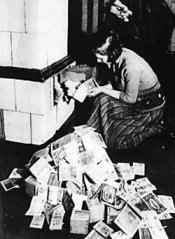
Crushed by World War One's debt, the Weimar republic kept printing money and giving it directly to consumers and businesses to buy votes and help them cope with ever increasing prices.Within a few years the Mark had devaluated so much that a postage stamp cost fifty billion Mark and everyone's life savings had been wiped out. Mark bills were worth less than the paper they were printed on. As the famous picture above illustrates, in the face of galloping energy prices, it had become cheaper to heat one's house by burning money than coal. Although one US dollar is still worth more than the paper it is printed on, as of 2008 one US penny contains 2 cents worth of metal.

Although oil prices seem high today, they are kept artificially low because many oil-producing nations such as Saudi Arabia peg their currencies to the US dollar. When the dollar is devaluated, these countries currencies and national economies are threatened by inflation and this is an incentive for them to let their currencies float and appreciate. In 2006 Kuwait unpegged its currency from the US dollar and as other oil-producing nations follow suit, expect energy prices to rise.

Currently oil is bought and sold on the world market in dollars, so everyone needs to first buy dollars in order to buy oil. We have reported on a trend for oil-producing countries to sell oil in Euros instead of Dollars.
As more oil-producing nations fear the dollar is becoming "funny money" and demand payment in Euros, the world's need for Dollars will be greatly reduced. This is basic supply/demand economics.
Simply put, the average American household is already too much in debt and this scares banks from lending any money. Giving $700B to these banks will not change the fact that lending to bad debtors is a risky venture. It is safer for banks to invest this money in commodities (oil and gold) which do keep up with inflation than to issue loans that cannot be repaid. So expect this bailout package to give a speculative boost to oil prices.

TLM Houses Accumulation

Talisman Energy Inc. (Talisman) is an independent, Canada-based, international upstream oil and gas company whose main business activities include exploration, development, production, transportation and marketing of crude oil, natural gas and natural gas liquids (NGLs).

The Company's segments where there are ongoing explorations, developments and production activities are North America, United Kingdom, Scandinavia, Southeast Asia and Other (comprising North Africa, Trinidad and Tobago, Colombia, Peru and Qatar).

Talisman's aggregate production for the year ended December 31, 2007 was approximately 452,000 barrels of oil equivalent per day (boe/d), consists of approximately 189,000 boe/d from North America, 117,000 boe/d from the United Kingdom segment, 33,000 boe/d from the Scandinavia segment, 92,000 boe/d from Southeast Asia and 21,000 boe/d from the rest of the world.

As of March 5, 2008, Talisman had acquired a 93.3% interest in RSX Energy Inc.
3400, 888 - 3 Street S.W. Calgary, AB T2P 5C5 Canada +1-403-2371234 (Phone)+1-403-2371902 (Fax)

Company website:
http://www.talisman-energy.com News Releases,
Investor Relations, Financial Information, Corporate History/Profile,
Executives, Products/Services, Employment Opportunities


Thursday, November 6, 2008

Stock market rout continues

Stock market rout continues

STEVE LADURANTAYE
Thursday, November 06, 2008
North American markets racked up deepening losses Thursday, as weak earnings and bleak economic data reminded investors that hard times are ahead regardless of who won the U.S. election.

“The markets seemed to shrug off the conclusion of the U.S. presidential election to continue the fickle nature of the moves we have seen recently,” said Ian Griffiths, a trader at CMC Markets. “There seems to be no respite in the volatility.”

The Dow Jones industrial average ended 4.85 per cent lower, or 443.48 points, to 8,695.79.

On Wednesday, the blue chip index posted its worst post-election session in history, plummeting by 5.1 per cent, or 486.01 points, as investors worried the financial crisis would worsen by the time President-elect Barrack Obama takes over the White House in January.

The broader S&P 500 lost 5.03 per cent, or 47.89 points, to 904.88. In Toronto, the S&P/TSX fell 3.36 per cent, or 331.79 points , to 9,555.41, as oil fell $4.53 (U.S.) to $60.77.

“Every day we are seeing wild swings in either the markets, oil or currency,” said Sloan Levett, the director of wealth management at Fuller Landau LLP in Toronto. “On any given day, at least one of those things is moving wildly.”

A slew of companies reported disappointing results, including Manulife Financial, which saw profit fall by $574-million (Canadian). In the U.S., Cisco Systems warned a soft economy could cut its sales by 10 per cent in the coming months.

Meanwhile, the European Central Bank cut its key lending rate by 50 basis points, to 3.25 per cent, while the Bank of England slashed its rate by 1.5 percentage points, to 3 per cent. Stocks temporarily rallied, but slunk back as investors continued wary of owning equities on the eve of a likely recession.

“There has been a very marked deterioration in the outlook for economic activity at home and abroad,” the Bank of England reminded investors as it cut its rate.

In economic news, new claims for unemployment insurance in the United States dropped slightly last week, the Labour Department reported Thursday morning. However, the number of people receiving benefits reached its highest level in 25 years.

Initial claims for jobless benefits dropped by 4,000 to a seasonally adjusted 481,000 for the week ending Nov. 1, above estimates of 480,000. Any figure above 400,000 is seen as recessionary. Meanwhile, 3.84-million people continued to get unemployment insurance – the highest level since 1983.

“The real juice of this report lies within the continuing claims component,” commented TD Securities economics strategist Ian Pollick. “ While we know that a regulatory-driven change in early August permanently elevated the level of the data, the massive jump from the prior week continues to suggest that it is taking much longer for people to find jobs, which does worry us.

There was some unexpected good news in Canada, as the value of building permits jumped 13.4 per cent in September, and non-residential construction rose 41.7 per cent. Economists had expected a 1 per cent drop in the value of building permits.

“Looking closely at this data, it is clear to see that the housing sector remains under pressure and it is non-residential activity that continues to prop up building activity,” TD Securities senior economics strategist Charmaine Buskas said. “As Canada's economy continues to unwind, that, too, will start to give way to weaker activity. But for now, building activity will remain resilient, thanks to the lopsided additions suggested by non-residential permitting activity.”

© Copyright The Globe and Mail

CONNACHER OIL AND GAS CLL News

CONNACHER OIL AND GAS
(T-CLL)
$1.84 -0.02
Somehow I thought this day might have seen a little
joy, maybe even some celebration...not hiding in a bun-
ker wondering how many 400 point down days the Dow
and TSX might have for us and worry if oil even has a
future!

We are referring to the long, anticipated final an-
nouncement by the Alberta’s Cabinet that Connacher’s
Algar SAGD project has been given the go-ahead. Esti-
mates suggest that $120 million of the $350 million pro-
ject has already been spent or committed, but now they
go full-boar ahead.


Jenny Mikhareva of Macquarie Securities writes in a
report today, “Connacher now has all the necessary
regulatory approvals to proceed with construction of
Algar, it’s second 10,000 barrel a day SAGD project at
Great Divide.” \


“We expect the company to begin preparing the site
for construction immediately….and to start construction
of the plant around year end 2008.”
She writes,

“The plant should take roughly 300 days
to build and about one month to commission and then
three months for steam to be going into the ground with
first bitumen production anticipated around March
2010.”

She points out something very important given the
credit crisis, “The project is fully funded, with the com-
pany having roughly $395 million available in cash and
credit.”

Mikhareva has a $5.00 target on the stock writing,
“The company is an attractive investment due to its ex-
isting production and cashflow base; significant, well-
defined growth going forward; its risk mitigating inte-
grated strategy; and a track record of successful project
execution.”

Meanwhile, GMP Securities has a $4.50 target on
Connacher (down from $6.25) and Raymond James has
a $5.75 12-month target (down from $7.25).
Oh, please! Let one of them be right...any one of
them

David Pescod Canaccord