Buffett makes his move
RTGAM
Warren Buffett, the world's greatest investor and the one person who can seemingly move markets with a quick telephone call, was at the forefront of stock market activity on Tuesday morning after he offered a second level of insurance to troubled bond insurers MBIA Inc., Ambac Financial Group Inc. and FGIC Corp. If the rescue effort - worth up to $800-million (U.S.) - is accepted, it could give the insurers a AAA credit rating.
His move, reported by CNBC after he called the station's Squawk Box, acted like a vote of confidence for investors, who rallied stocks higher in Europe and pushed up stock index futures for major U.S. stock market indexes. In Europe, major indexes were up nearly 2 per cent. The U.K.'s FTSE 100 was 1.8 per cent in afternoon trading (local time), led by banking giant HSBC Holdings PLC. Germany's DAX index was up 1.9 per cent.
In the United States, S&P 500 futures rose 0.6 per cent. Meanwhile Japan's Nikkei 225 was relatively flat in overnight trading and Hong Kong's Hang Seng index was up 1.4 per cent.
In Canada, investors will likely be reacting to the Buffett news when markets open, even though Mr. Buffett has supposedly received . But this will also be digesting Monday's BlackBerry service interruption, which may weigh on Research In Motion Ltd.
Copyright 2001 The Globe and Mail
Tuesday, February 12, 2008
Warren Buffett, the world's greatest investor makes his move
BWR+ Hudbay= Top Picks

UBS has a "neutral" rating on Inmet with a share price target of $86 (Canadian). Among the copper and zinc producers, it rates HudBay Minerals Inc. and Breakwater Resources Ltd. as "top picks." Both are projected to have cash balances in excess of 30 per cent of their current market capitalization by the end of 2008, UBS said.
Inmet profit expected to dip
RTGAM
Here's Allan Robinson's At The Bell which you'll find in tomorrow's newspaper:
The share price of Inmet Mining Corp. has slumped as investors worry about the prospects of a global slowdown, although base metal prices remain healthy and cash balances in the sector continue to build.
Inmet, which mines copper, zinc and gold, is scheduled to release its fourth-quarter results today.
Analysts forecast that it earned $1.92 a share, down from $2.02 a year earlier, according to Thomson First Call. The company's 2007 profit is estimated at $9.23 a share.
Inmet's shares closed yesterday at $66.29 on the S&P/TSX. Its market capitalization is $3.25-billion and at last report it had $815-million in cash, or $16.88 a share.
What to keep an eye on
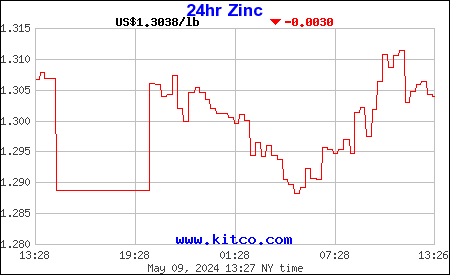
Inmet's results are expected to be adversely affected by the strong Canadian dollar and a steep drop in the price of zinc, which traded yesterday at $1.11 (U.S.) a pound, down from $1.40 in October.
"Beyond the financial results, analysts will continue to focus on the ramp-up schedule for the Cayeli mill expansion [in Turkey] and the status of construction at Cobre Las Cruces [in Spain]," said UBS Securities Canada Inc. analyst Tony Lesiak.
Inmet and its partners are also reviewing the Petaquilla copper project in Panama after the latest budget forecast the capital cost had doubled to $3.5-billion. Inmet mines gold at the Troilus mine in Quebec and owns 18 per cent of the Ok Tedi copper mine in Papua New Guinea, and operates the Pyhasalmi copper and zinc mine in Finland.
UBS has a "neutral" rating on Inmet with a share price target of $86 (Canadian). Among the copper and zinc producers, it rates HudBay Minerals Inc. and Breakwater Resources Ltd. as "top picks." Both are projected to have cash balances in excess of 30 per cent of their current market capitalization by the end of 2008, UBS said.
The average share price target among 12 of the 14 analysts following Inmet is $90.89 a share, according to Bloomberg.
The big picture
World demand for metals remains strong and that is resulting in high metal prices, which are needed to justify new projects, said Martin Murenbeeld, chief economist for Dundee Wealth Management Inc.
"Accordingly, central banks run serious risks by tightening monetary policy in hopes of suppressing the rise in commodity prices," he said.
Copyright 2001 The Globe and Mail
Monday, February 11, 2008
Pescod Talks Zinc And More
Stocks boosted by tech, energy
Rising energy prices and renewed interest in technology stocks propelled North American stocks higher Monday, shaking off some early doldrums and trumping continued credit-market worries.
The Toronto Stock Exchange's S&P/TSX composite index rose 141.58 points, or 1.1 per cent, to 13,130.92, closing above the 13,000 mark for the first time in a week. In New York, the Dow Jones industrial average moved into positive territory after a down morning to close up 57.88 points, or 0.5 per cent, at 12,240.01. The S&P 500 gained 7.84 points, or 0.6 per cent, to 1339.13, while the tech-heavy Nasdaq composite rose 15.21 points or 0.7 per cent to 2,320.06.
Technology stocks were the story of the day, as merger buzz drew investors to the sector, which looked ripe for some buying after dropping almost 15 per cent since the beginning of the year. The TSX information technology sub-index gained 2.3 per cent, led by big gains at Celestica (up 5.4 per cent) and Research in Motion (up 5.2 per cent).
Ironically, one of the companies that had helped fuel the interest in techs Monday - Nortel Networks Corp. - actually lost 1.1 per cent on the day. Before the market opened, the Wall Street Journal reported that Nortel and Motorola Inc. were in talks for a possible merger of their wireless infrastructure operations. But the story didn't develop further during the day, and some analysts suggested that such a deal might not be immediately beneficial to Nortel's stock price, as it could result in integration costs and possibly further restructuring charges. Motorola rose 2.8 per cent in New York.
Yahoo Inc. also drew interest to the tech sector, as its board rejected Microsoft Corp.'s hostile takeover bid. The move could leave the door open for a proxy battle or bidding war for the online giant, which sparked hopes among investors that a broader round of consolidation in the industry could be afoot.
Energy stocks rose 2 per cent in Toronto, while U.S. energy giant Exxon Mobil Corp. was the biggest contributor to the S&P 500's gains, as crude oil prices jumped $1.87 (U.S.) to $93.64 a barrel in New York. Venezuelan President Hugo Chavez threatened to stop oil shipments to the United States in retaliation for court orders freezing certain assets of the country's state-owned oil company, all part of an ongoing dispute over compensation to U.S. oil companies for the government's nationalization of a major oil project last year. Cold weather in the norhteast and a U.S. refinery outage also contributed to the rising price.
The markets largely shrugged off negative news on the credit front. Insurance giant American International Group Inc. said it may have understated some of its credit losses, raising the likelihood that the company faces further writedowns in the neighbourhood of $5-billion stemming from the U.S. subprime mortgage meltdown. AIG's stock plunged almost 12 per cent, wiping out more than $15-billion in market capitalization, but the market's negative reaction to the news remained largely confined to AIG and a few other insurers.
Copyright 2001 The Globe and Mail


Sunday, February 10, 2008
no sector or market, either foreign or domestic to hide in at the moment
The markets were either trading sideways or down all week after a ground shaking service sector report sent stocks plummeting. At Pinnacle Digest we believe the retail sector can be used to gage and monitor the health of an economy.
January was a very telling month for the health of the United States economy and its consumer, which in terms of economic growth is the cornerstone to the economy. Retail chains across the country have recently reported their worst monthly sales results in almost five years. We have learned that a number of major chains are preparing for a slow down as they plan to close hundreds of stores and cut thousands of jobs. It has been reported that since December, major chains have announced plans to close at least 900 locations. The International Council of Shopping Centers has predicted that 5,770 retail locations will close this year. This represents a 25% increase over 2007, and the highest increase since 2004. Wal-Mart Stores Inc. is a perfect example of a retail chain showing distinct signs of slowing. Wal-Mart has reported that same-store sales rose only 0.5% in January compared to a year earlier. This is far below its expectation of a solid 2% gain. In the fiscal year ended February 1st Wal-Mart US same-store sales rose just 1.4%. This is the lowest increase in nearly 30 years, since they began releasing this information to the public. Being the world's largest retailer, Wal-Mart can clearly represent the fading consumer sentiment within the marketplace. We will be watching their sales very closely as the United States teeters on the brink of a full blown recession. As these figures strike fear into the hearts of many investors, it only strengthens our belief that this is an opportune moment to buy stocks which have excellent growth and demand potential in their respective sectors.
In recent years North American investors have enjoyed substantial returns from outsourced foreign markets. Stocks outside of the United States have outperformed the Dow Jones Industrial Average time and again and have done so for the fifth year in a row. According to a Morgan Stanley Capital International Index report, emerging markets increased almost 37% last year.
Investors hoping to scurry under that same shelter of foreign markets and continued global expansion have been sorely disappointed this year. In 2008, all markets have been singing the same song and it's not a happy one.. yet. There is a strong consensus that the economic turmoil originating in the United States is spreading across the globe. Let's have a look at the global indices and see how they compare to the Dow Jones Industrial Average which is down just over 7.8% this year.
It is quite clear that there is no sector or market, either foreign or domestic to hide in at the moment. With that stated, we believe the best investors in the world are positioning themselves for the turnaround of the economy.
It is very difficult to pick market bottoms, even when using history as a guide. Using the S&P 500 as a benchmark, let's have a look at the numbers. Many financial companies and homebuilders within this index have hit rock bottom prices in the last four months. The stock market and index has not taken as bad of a beating. The S&P 500 is down about 14.8% since its October peak. Since World War II, on average, the index dropped 26% from its peak during a recession time period. So if we are in or headed for a recession, the S&P 500 would have to drop another 200 points or just over 10% more. Pinnacle Digest believes we are in a mid-cycle slowdown and that the markets will not be spiraling downward for much longer.
Mr. Warren Buffett has a unique view on the US economy which we all need to take into consideration.
Mr. Buffett at this moment is a 'Huge Bull' on the U.S. economy. He recently stated that, "I am a huge bull on the American economy." Friday morning a member of our team here at Pinnacle Digest came across an interview Warren Buffett participated in this week with the National Post of Canada, on a recent trip to Toronto. When asked about the US economy Buffett explained that, compared to 1982 when short-term interest rates were 21% "this is not a tough period." Buffett went on to state that, "We do not have an unavailability of credit to people who've got reasonable credit demands, and its not expensive. We're not in a credit crunch for those who have sound deals." When asked how bad things could get, he did confess he had no idea, but stated, "It could be pretty bad but we always come out of it."
With so many opinions, figures and negative signs spewing from the economy and government officials, the market is fluctuating greatly at the moment. Investors are in an environment of uncertainty and doubt but we believe that within the next few months they will witness the best buying opportunities of the decade.
PinnacleDigest.com
