Phantom Alert For Your GPS In Canada and USA

Thursday, April 30, 2009

Why Mens Toolboxes Are Big and Heavy - Look whats Inside

Why Men Have Large Tool Boxes
Its what we store inside that counts
Click The Video Below


CLL-T Ready To Run Thru 1.50


Get Them Now Or Pay A Lot More 

Earnings Report Will Be Released Soon!


OPTI Canada Announces First Quarter 2009 Results


OPTI Canada Announces First Quarter 2009 Results


04:00 EDT Tuesday, April 28, 2009

TSX: OPC


CALGARY, April 28 /CNW/ - OPTI Canada Inc. (OPTI) announced today the Company's financial and operating results for the quarter ended March 31, 2009.

The Long Lake Project (the Project) is the first to use OPTI's integrated OrCrude(TM) process. Our proprietary process is designed to substantially reduce operating costs compared to other oil sands projects while producing a high quality, sweet synthetic crude.

"We are pleased to have successfully produced and sold our first upgraded premium synthetic crude this quarter, and to have demonstrated that our technology works," said Chris Slubicki, President and Chief Executive Officer. "We expect that improvements being made to the water treatment system will significantly enhance steam injection, and therefore bitumen production in the second quarter and lead to a substantial ramp-up in PSC(TM) production."


<<>

Includes $369 million pre-tax asset impairment provision related to working interest sale to Nexen. (2) Capital expenditures related to Phase 1 and future phase development. Capitalized interest, hedging gains/losses and non-cash additions or charges are excluded. (3) Common shares outstanding at March 31, 2009 after giving effect to the exercise of common share options would be approximately 203 million common shares. >>


PROJECT STATUS


In the first quarter of 2009, OPTI reached a significant milestone with the production and sale of first PSC(TM) from the Long Lake Project. We have recently produced approximately 15,000 barrels per day (bbl/d) gross of on-spec, high quality PSC(TM), upgraded from low-value bitumen. All major process units in the Upgrader are operational, and preparation is underway to transition gasifier feed from vacuum residue to ashphaltenes, the final step in OrCrude(TM) commissioning. Synthesis gas from the Upgrader has been used in SAGD operations, decreasing operating costs by reducing the requirement for purchased third-party natural gas. During the initial operating period, we expect periods of downtime but anticipate that the stability of operations will continue to improve. Upgrader reliability is improving with 4 days of operation in February, 16 days of operation in March and 20 days of operation to date in April. We expect Upgrader capacity during ramp-up will be capable of processing all of the forecasted SAGD volumes and we expect the Project to reach full capacity of approximately 58,500 bbl/d of PSC(TM) and other products by late 2010.

The Long Lake reservoir continues to perform as expected given the amount of steam that has been injected into the reservoir. Steam generation has been limited by the ability to treat water during the ramp-up period. At full production, approximately 90 to 95 percent of the water injected into the reservoir is recycled. During ramp-up, it is necessary to add cold source water to the recycled hot produced water in order to increase our overall steam volumes over time. Temperature limitations in the water treating system have limited the ability to materially increase steam volumes. A number of changes to the water treating system have been implemented, which include adding supplementary heat to the hot lime softeners and improvements to the filtration system. We expect this will increase steam injection rates and bitumen production.

Steam generation in the first quarter totalled approximately 66,000 bbl/d day, with bitumen production averaging approximately 13,400 bbl/d. With certain changes to the water treating system recently implemented, recent steam volumes have averaged approximately 80,000 bbl/d. As a result, bitumen volumes have begun to ramp-up and April volumes to April 25 averaged approximately 16,000 bbl/d. Given steaming constraints, allocation of steam is necessary and accordingly only 40 of 81 well pairs are presently in production mode. With inconsistent steam injection the average steam to oil ratio (SOR) for these wells ranges between 4.0 and 5.0. We continue to expect a long term SOR of 3.0. As further improvements are made to the water treatment system and steam generation increases, all remaining wells will be brought on. We expect SAGD volumes to increase consistently from current production to full capacity of 72,000 bbl/d by late 2010. During the SAGD ramp-up period in 2009 and 2010, we also expect to process up to 10,000 barrels per day of third party bitumen.


COMPLETION OF ASSET SALE AND DEBT FACILITY AMENDMENT


On January 27, 2009, OPTI announced that we had significantly enhanced our liquidity with the completion of the sale of a 15 percent working interest in our joint venture assets to our partner Nexen for $735 million. Effective January 1, 2009 , OPTI has a 35 percent working interest in all joint venture assets, including Phase 1 of the Project, all future phase reserves and resources, and future phases of development. All Project and operating employees who accepted offers from Nexen were transitioned effective April 1, 2009.


CORPORATE UPDATE


OPTI also announced today the appointment of Kiren Singh to Vice President and Treasurer. Ms. Singh, who joined OPTI in 2008 as Treasurer, has over 20 years of experience in corporate and project finance and corporate insurance with Canadian and international energy leaders including Mobil and ExxonMobil. Ms. Singh holds an MBA from the University of Calgary and a Chartered Financial Analyst designation.

As a result of OPTI's ongoing corporate transition to that of a non-operating entity, Bill King, formerly VP Development, is no longer with the company. OPTI's senior management consists of: Chris Slubicki, President and Chief Executive Officer; Travis Beatty, VP Finance and CFO; Joe Bradford, VP Legal and Administration and Corporate Secretary; Kiren Singh, VP and Treasurer; and Al Smith, VP Marketing.


Markets Ready To Rally

Set for rally

RTGAM

Stock market indexes continued to march higher on Thursday, on expectations that the worst is over for the global economy and corporate earnings.


U.S. stock index futures were up sharply with about an hour before markets open, suggesting that stocks will rise at the start of trading. Futures for the Dow Jones industrial average were up 108 points. Futures for the broader S&P 500 were up 13 points. Both indexes rallied more than 2 per cent on Wednesday.


In Europe, the U.K.'s FTSE 100 was up 1.9 per cent and Germany's DAX index was up 2.4 per cent in afternoon trading. In Asia, after a one-day break on Wednesday, Japan's Nikkei 225 surged 3.9 per cent in overnight trading.


The U.S. Labor Department reported that initial jobless claims for the week ended April 24 decreased slightly to 631,000, better than the 640,000 claims that economists had been expecting and slightly below the previous week's claims - adding to the impression that things are getting "less bad." However, continuing claims rose close to 6.3 million, suggesting that recently laid off worker are having a tough time finding work.


"The past few weeks claims data are beginning to look increasingly like a peak," said Ian Shepherdson, chief U.S. economist at High Frequency Economics, in a note. "What is not clear, though, is whether this peak represents a correction after the very rapid leap in claims after the Lehman failure or a real cyclical turning point."


Meanwhile, incoming first-quarter earnings continue to decline sharply but have generally come in better than expected. Dow Chemical Co.'s earnings fell 97 per cent, but beat analysts' estimates. Starbucks Corp.'s earnings fell 77 per cent, but also topped expectations.


The Wall Street Journal noted that about two-thirds of the companies in the S&P 500 that have reported first-quarter earnings have beaten analysts' expectations, according to Thomson Reuters.

Copyright 2001 The Globe and Mail

Wednesday, April 29, 2009

TLM-T Surged 1.00 per share today 6.97%

Talisman Energy Announces Agreement to Sell Cutbank Complex Mid-Stream Assets for $300 Million


15:06 EDT Wednesday, April 29, 2009

CALGARY, ALBERTA--(Marketwire - April 29, 2009) - Talisman Energy Canada (Talisman) has entered into an agreement to sell its Cutbank Complex mid-stream assets in west central Alberta for total proceeds of approximately C$300 million to Pembina Gas Services Limited Partnership, a subsidiary of Pembina Pipeline Corporation of Calgary.

The sale of the Cutbank Complex includes working interests in three interconnected sweet gas processing facilities (the Cutbank, Musreau and Kakwa Gas Plants) nine compressor stations and more than 300 kilometres of gathering lines. The complex has an aggregate existing processing capacity of 360 mmcf/d.

The sale is subject to regulatory approval, with an expected closing date of June 2, 2009.

Talisman Energy Inc. (TSX:TLM) (NYSE:TLM) is a global, diversified, upstream oil and gas company, headquartered in Canada. Talisman's three main operating areas are North America, the North Sea and Southeast Asia. The Company also has a portfolio of international exploration opportunities. Talisman is committed to conducting business safely, in a socially and environmentally responsible manner, and is included in the Dow Jones Sustainability (North America) Index. Talisman is listed on the Toronto and New York Stock Exchanges under the symbol TLM. Please visit our website at www.talisman-energy.com.

FOR FURTHER INFORMATION PLEASE CONTACT:

Talisman Energy Inc. - Media and General Inquiries
David Mann, Vice-President,
Corporate & Investor Communications
(403) 237-1196
(403) 237-1210 (FAX)
Email: tlm@talisman-energy.com
Website: www.talisman-energy.com

Major stock market indexes surged + Pescod Speaks

Hope wins

RTGAM

Major stock market indexes surged soon after the U.S. Federal Reserve released its monetary policy statement on Wednesday afternoon - but handed back all of those gains, and more, in the final hour of trading, paring the day's gains.


Still, those gains were impressive, especially when you consider that the World Health Organization moved closer to declaring the swine flu outbreak a pandemic and the Commerce Department reported that the U.S. economy contracted by 6.1 per cent in the first quarter, which was a far worse decline than economists had been expecting.


Despite the bad news, and the late-day stock market decline, the Dow Jones industrial average closed at 8185.73, up 168.78 points, or 2.1 per cent, as investors continued to bet that the economy had bottomed out and was showing signs of improvement. The broader S&P 500 closed at 873.56, up 18.4 points, or 2.2 per cent.


Both indexes had been up as much as 3 per cent soon after the Fed released its statement, in which it said that the "economy has continued to contract, though the pace of contraction appears to be somewhat slower" - a sign to many investors that the worst may be over.


Financials were strong, with Citigroup Inc. up 8 per cent and Bank of America Corp. up 6.5 per cent. In other moves, Walt Disney Co. rose 7.7 per cent and Boeing Co. rose 4.4 per cent.


In Canada, the S&P/TSX composite index closed at 9416.31, up 68.28 points, or 0.7 per cent. There, a number of energy stocks rose after the price of crude oil moved to $50.97 (U.S.), up $1.05. Talisman Energy Inc. rose 7 per cent after it reported a lower profit in the first quarter. Canadian Oil Sands Trust rose 5 per cent.


Among financials, Manulife Financial Corp. rose 2.1 per cent and Bank of Nova Scotia rose 2 per cent, but Bank of Montreal fell 1 per cent.


TMX Group Inc., which operates the Toronto Stock Exchange, fell 10.2 per cent after investors apparently weren't pleased when it reported earnings of 58 cents (Canadian) a share, up from 49 cents a share last year. Research In Motion Ltd. was also a notable laggard, falling 3.9 per cent.

Copyright 2001 The Globe and Mail


Tuesday, April 28, 2009

Rising U.S. consumer confidence and further signs of a stabilizing housing market

Flu gets bumped

RTGAM


Rising U.S. consumer confidence and further signs of a stabilizing housing market helped offset concerns at the outset of trading on Tuesday, leaving major North American stock market indexes little changed for the day.


The Dow Jones industrial average closed at 8016.95, down 8.05 points, or 0.1 per cent. The broader S&P 500 closed at 855.16, down 2.35 points, or 0.3 per cent.


Both indexes had begun the day looking vulnerable to a steep selloff after the Wall Street Journal reported that government stress tests had left regulators convinced that Bank of America Corp. and Citigroup Inc. would require more capital. Bank of America fell 8.6 per cent and Citigroup fell 5.9 per cent.


As well, rising concerns about swine flu had hit indexes in Europe and Asia, with investors concerned that the already weak global economy could be hurt even more if travel restrictions were imposed.


However, those concerns fell largely by the wayside after the Conference Board's consumer confidence index jumped unexpectedly in April, even though the survey was likely done before anyone had even heard of the swine flu. As well, the S&P Case-Shiller home price index showed that U.S. home prices deteriorated at a slower pace in February.


International Business Machines Corp. rose 2 per cent, Kraft Foods Inc. rose 1.9 per cent and Exxon Mobil Corp. rose 1.4 per cent.


General Motors Corp. fell 11.3 per cent a day after the struggling auto maker presented its latest plan for avoiding bankruptcy protection. This suggests that investors are having second thoughts about whether the plan - which would leave the U.S. government as the controlling shareholder - will work.


In Canada, the S&P/TSX composite index closed at 9348.03, down 46.77 points, or 0.5 per cent. Gold producers were weak after the price of gold fell to $893.60 (U.S.) an ounce, down $14.60. Barrick Gold Corp. fell 2.9 per cent and Goldcorp Inc. fell 2.5 per cent.


Energy stocks were also generally weak, even though the price of crude oil recovered from a deep dip earlier in the day, ending at $49.92 a barrel, down just 22 cents. Canadian Oil Sands Trust fell 6 per cent and Canadian Natural Resources Ltd. fell 3.2 per cent.


Financials were mixed. Canadian Imperial Bank of Commerce rose 1.2 per cent but Manulife Financial Corp. fell 1.6 per cent.

Copyright 2001 The Globe and Mail

Pescod Talks Oil


Monday, April 27, 2009

North American stock market indexes dipped back into negative territory by Monday's close as investors again turned antsy


Concern rises

RTGAM

After early afternoon gains, North American stock market indexes dipped back into negative territory by Monday's close as investors again turned antsy over uncertainties surrounding the swine flu outbreak and its rising death toll.


The Dow Jones industrial average closed at 8025, down 51.29 points, or 0.6 per cent. The broader S&P 500 closed at 857.51, down 8.72 points, or 1 per cent.


Airline stocks were hit particularly hard on concerns that flights will be cut back as the flu spreads around the world. Southwest Airlines Co. fell 9.4 per cent and AMR Corp., the parent of American Airlines Inc., fell 13.3 per cent.


Food stocks, especially those with a strong meat flavour to them, were also hit on concerns about the relationship between the flu and pork exports. Tyson Foods Inc. fell 8.8 per cent.


However, these components represent a relatively thin slice of the stock market, which suggests that the declines for the day were also related to concerns about the economy and stock valuations now that the market has bounced impressively from its lows in early March. Among financials, Wells Fargo & Co. fell 5.1 per cent and Citigroup Inc. fell 3.8 per cent.


In other moves, Microsoft Corp. fell 2.4 per cent, DuPont fell 4.5 per cent and Alcoa Inc. fell 3.8 per cent. Pfizer Inc. rose 2.4 per cent and Procter & Gamble rose 0.9 per cent.


General Motors Corp. leapt 20.7 per cent after investors approved of the auto maker's latest plan to stave off bankruptcy protection, which includes phasing out the Pontiac brand, streamlining the number of name plates, reducing the number of U.S. dealerships and cutting jobs and labour costs. GM will also try to convince bond holders to exchange $27-billion (U.S.) worth of debt into common shares.


In Canada, the S&P/TSX composite index closed at 9418.40, down 131.08 points, or 1.4 per cent. Energy stocks were weak after the price of crude oil fell to $50.14 (U.S.) a barrel, down $1.41. Canadian Natural Resources Ltd. fell 2.3 per cent and EnCana Corp. fell 2.5 per cent.


Among financials, Manulife Financial Corp. fell 3.3 per cent and Bank of Nova Scotia fell 3.1 per cent.

Copyright 2001 The Globe and Mail

Time To Buy PDP Before They Sell Off Argentina PLUS Columbia=$$$

Petrolifera's La Pinta well reaches 10,600 feet

2009-04-17 17:18 ET - News Release

Mr. Gary Wine reports

PETROLIFERA PROVIDES CORPORATE AND OPERATIONAL UPDATE

Petrolifera Petroleum Ltd. has provided the following progress update on operations and corporate activities.

Colombia

The La Pinta 1 exploration well, which is currently being drilled on Petrolifera's 100-per-cent-owned Sierra Nevada licence in Colombia, was at a depth of approximately 10,600 feet as of April 16, 2009. It is now anticipated the well will be drilled to a final total depth of approximately 11,000 feet. Petrolifera continues to be encouraged by results encountered during the drilling of the La Pinta 1 well, based on hydrocarbon mud log shows and the interpretation of intermediate logging runs. The drilling of the well is significantly behind the originally anticipated schedule, due to problems which were encountered, firstly while attempting to run the 9-5/8ths-inch intermediate casing in the upper section of the wellbore and subsequently, challenges arising from instability in the lower section of the well. The former problem in the upper part of the well was resolved and the instability in the lower section of the wellbore now appears to be under control. Due to the downhole instabilities, it has been decided to attempt to complete the well at a depth of 11,000 feet instead of the originally planned depth of 13,000 feet. An application in this regard has been submitted to ANH, the Colombian government agency that regulates such activity and a decision is anticipated shortly. Petrolifera's management believes that all the geological objectives of the well, and contractual obligations of the licence will be met with the well terminating at a depth of 11,000 feet. Further evaluation is anticipated to occur by testing, after the well is logged and the bottom portion of the wellbore is cased.

Peru

On April 16, 2009, Petrolifera was awarded block 133, which is contiguous with the western boundary of the company's block 107 in the Ucayali basin onshore Peru. Block 133 comprises approximately 979,000 acres. The work commitments on this block for the first period (18 months) primarily comprise geological field studies and, as such, are not capital intensive. This licence represents important protection acreage for Petrolifera in relation to its planned activities on block 107 in future years.

In May, 2009, in accordance with the contract terms of block 107, Petrolifera will be relinquishing approximately 1.6 million acres, or approximately one-half of the original 3.2 million acres which comprise block 107. Petrolifera believes it will be retaining the most prospective acreage under block 107, based on its interpretation of the 950-kilometre (km) 2-D seismic program acquired over the acreage by the company in 2007 and 2008. After the required relinquishment and the award of block 133, Petrolifera will control approximately 4.5 million acres in Peru.

Argentina

As recently announced, Petrolifera recently commenced drilling on its 100-per-cent-owned Gobernador Ayala II (GA II) concession, located in La Pampa province, Argentina. As of mid-April, 2009, Petrolifera has drilled and completed five wells on the block and is very encouraged by the results to date, based on hydrocarbon shows and limited testing results. Petrolifera anticipates drilling up to an additional five wells on this block before the expiry of the exploration phase. A request has been submitted to the government of La Pampa to convert the GA II concession from an exploratory to a production status.

Corporate

The company's annual meeting will be held in Calgary on May 6, 2009, on which date its results for the three months ended March 31, 2009, will be released. A conference call to discuss first quarter 2009 results will be scheduled for the following morning, May 7, 2009, and call in information will be included in the news release.

The company's annual report for 2008 has been mailed to all shareholders of record and has been posted on its website.

The company's disposition process with respect to its Argentinean interests is continuing on schedule.

We seek Safe Harbor.

Your Monday Morning Funny

A PLANE IS ON ITS WAY TO TORONTO, WHEN A BLONDE IN

ECONOMY CLASS GETS UP, AND MOVES TO THE FIRST CLASS

SECTION AND SITS DOWN.


THE FLIGHT ATTENDANT WATCHES HER DO THIS, AND ASKS

TO SEE HER TICKET.


SHE THEN TELLS THE BLONDE THAT SHE PAID FOR ECONOMY

CLASS, AND THAT SHE WILL HAVE TO SIT IN THE BACK


THE BLONDE REPLIES, "I'M BLONDE, I'M BEAUTIFUL, I'M

GOING TO TORONTO AND I'M STAYING RIGHT HERE."


THE FLIGHT ATTENDANT GOES INTO THE COCKPIT AND TELLS

THE PILOT AND THE CO-PILOT THAT THERE IS A BLONDE

BIMBO SITTING IN FIRST CLASS, THAT BELONGS IN

ECONOMY, AND WON'T MOVE BACK TO HER SEAT.


THE CO-PILOT GOES BACK TO THE BLONDE AND TRIES TO

EXPLAIN THAT BECAUSE SHE ONLY PAID FOR ECONOMY

SHE W ILL HAVE TO LEAVE AND RETURN TO HER SEAT.


THE BLONDE REPLIES, "I'M BLONDE, I'M BEAUTIFUL, I'M

GOING TO TORONTO AND I'M STAYING RIGHT HER E."


THE CO-PILOT TELLS THE PILOT THAT HE PROBABLY SHOULD

HAVE THE POLICE WAITING WHEN THEY LAND TO ARREST

THIS BLONDE WOMAN WHO WON'T LISTEN TO REASON.


THE PILOT SAYS, "YOU SAY SHE IS A BLONDE? I'LL

HANDLE THIS, I'M MARRIED TO A BLONDE. I SPEAK BLONDE."


HE GOES BACK TO THE BLONDE AND WHISPERS IN HER EAR,

AND SHE SAYS, "OH, I'M SORRY." AND GETS UP AND GOES

BACK TO HER SEAT IN ECONOMY..


THE FLIGHT ATTENDANT AND CO-PILOT ARE AMAZED AND

ASKED HIM WHAT HE SAID TO MAKE HER MOVE WITHOUT

ANY FUSS.


"I TOLD HER, "FIRST CLASS ISN'T GOING TO TORONTO ".

Sunday, April 26, 2009

Obama's Bank Stress Test: Government Plot or Apophenia

Earlier this year, Tim Giethner presented a plan on how the administration is going to "fix" the banking system by subjecting the country's 19 biggest banks to a series of dire what-if scenarios that assume ballooning unemployment and further GDP contraction: the Stress Test

The Treasury Department's end game is to weed out banks that need more capital and to give Americans more transparency and accountability in the banking system. That would separate the weak from the strong and put the latter group of banks in the position to repay money they got under the Troubled Asset Relief Program (TARP).

The consensus has been that banks for the most part won't need more capital, with a few exceptions.

The banks whose balance sheets look the weakest under those scenarios will have six months to raise new capital. If they can't, they can convert their TARP preferred investment into common shares or raise new capital from the government under stringent terms.

Over the last week, I have heard many arguments and viewpoints on the Stress Test. Some argue that because much of the results in this test would remain 'hidden" from public view, it defeats the purpose of the transparency and accountability goal of the stress test. Many arguments have been made stating that the test is not only useless, but may do more harm than good.

But has anyone ever considered the Stress Test as a government tactic to gain further ownership and control of the US banks in order to form Obama's new democratic government?

Let's face it, the US government is known for using wordplay, distraction and diversion tactics to gain trust and then unleash its hidden agenda.

Just think about it.

In order to pass the Stress Test, banks will have to clear the hurdle of a three per cent tangible common equity (a measure of financial strength that divides the value of outstanding stock by assets).

Based on the tangible common equity (TCE) to risk-weighted assets in the first quarter, the stress-test banks that have already reported their profits should clear the 3% hurdle.

But here's the problem. The government's stress test is based on an assumption that unemployment will peak at 10%. Under these circumstances, it appears that most of the banks under this test should past.

Given recent numbers however, and based on the forecasts by many different analysts, the unemployment rate could very well reach past 10% and grow to as high as 12% from now until the end of 2010. Under these numbers, many of the banks, including Bank of America, Wells Fargo, BB&T, PNC Financial, SunTrust Banks, Regions Financial, Capital One and U.S. Bancorp may not pass the 3% TCE.

They basically have two simple choices if they don't pass, both of which ultimately give the government a bigger stake in the US banks:

1) Convert their TARP preferred investment into common shares

Or

2) Receive new capital from the government

Citigroup, for example, has chosen door number one and in doing so will give the government a 36% stake. Keep in mind the administration has said that no bank will "fail" the test; those with big holes that need filling will have them filled at government expense.

So here we have a test from the government to weed out the bad banks, yet no bank under this test will fail. So if no one fails, what is the point of having a test?

It looks to me like the government is using the stress test as an excuse to gain further ownership of the big banks and thus begins their movement toward further control and ownership under Obama's democratic government.

So is the Stress Test an act to raise accountability and trust from the banks or Obama's government plot to gain further control and stake for his democratic government?

Call it apophenia, but I choose the latter.
Best regards,

Ivan Lo
Equedia Network Corporation

Friday, April 24, 2009

Pescod Chats Plus Seven weeks of gains on TSX


Seven weeks of gains on TSX

RTGAM


After a collective swoon at 2 p.m. on North American markets following the U.S. Federal Reserve's update on its stress tests for the country's banks, investors took a deep breath and jumped right back in to drive stocks higher by the end of the day.

The Dow Jones industrial average gained 1.5 per cent, or 119.23 points, to 8,076.29. The broader S&P 500 gained 1.68 per cent, or 14.31, to 866.23. Both indexes fell on the week - 0.68 per cent and 0.39 per cent, respectively - ending their win streaks at six weeks.

The financial subindex of the S&P 500 dipped briefly into the red after the test's methodology was revealed, but quickly recovered to post a 2.44 per cent gain on the day. On the Dow, American Express gained 20.22 per cent, Bank of America gained 2.95 per cent and Citigroup lost 0.62 per cent.

The Toronto Stock Exchange did manage to post a gain on the week, making it seven straight weeks. The S&P/TSX rose 1.49 per cent, or 139.98 points, to 9,549.48. Miners gained 3.8 per cent, with financials 1.1 per cent higher.

Copyright 2001 The Globe and Mail

Thursday, April 23, 2009

Revenue Canada refuses to pay for million-dollar mistake

Revenue Canada refuses to pay for million-dollar mistake

Taxpayer led to believe Harper government would compensate him for losses

Last Updated: Thursday, April 23, 2009 | 12:38 PM PT

Records lost by auditor, businessman says

Leroux said his tax troubles began in 1996, when an auditor from the tax agency showed up to look at the books. The auditor took Leroux's business receipts and other records, he said, then misplaced those records at the CRA office.

"He told me someone had put them on the pile that was to be shredded," Leroux said.

Without receipts to show his business expenses, numerous CRA audits over several years concluded Leroux owed almost $900,000 in personal income tax, plus over $100,000 in GST, including interest and penalties.

Leroux had to sell his business, Irvin's RV Park and Campground, in Valemount, B.C.

Forced to sell all his assets

That touched off a chain of events, Leroux said, that forced the sale — at reduced prices — of his business, his home and other assets, valued at approximately $4 million.

"I lost my house, I lost my business, I lost my land, I lost my income, I lost my savings — I lost it all," Leroux said. "Why? Because [the CRA] wouldn't admit to their mistakes. They would sooner destroy me and try to bury me out there than admit they did wrong."

"I've said to him the whole way, I will fight with you," said Moore, his wife. "This is wrong. They can't take it away and not even apologize. They can't take it away and not be held accountable."

Submit your story or join our blog: www.cbc.ca/bc/features/gopublic/

After Leroux's tax bill was cancelled, his MP, 16-year veteran B.C. caucus chair Harris, stepped in and took his case to Ottawa.

Correspondence shows that in 2006, Harris had several discussions with then minister of national revenue Carol Skelton — a member of Prime Minister Stephen Harper's cabinet — urging her to arrange compensation for his constituent's losses.

At first, Skelton assured Harris that if Leroux filed a lawsuit against the government, an out-of-court settlement could be arranged, the documents suggest.

In a letter to the minister, Harris repeated what she had led him to believe: "I was told that 'CRA does not have a mechanism to proactively pay damages … however if Mr. Leroux launches a court challenge with a statement of claim, the department could … settle out of court.' "

In an email to Leroux, Harris wrote: "I am convinced that things are going as we were promised…. [The minister] wants the outcome of your case to be an example of how Revenue Canada must be held accountable for its abuses of Canadians."

'All hell is going to break loose': Conservative MP

Later in 2006, when there was no sign of a settlement in the works, Harris wrote this angry email to the minister's assistant:

"I am livid. This whole episode is the most inhumane treatment I have ever witnessed in my life. And I cannot believe that our own government would treat Canadians in this manner. Mr. Leroux is an honest, principled individual who had been driven to the brink many times by Revenue Canada. If Revenue Canada mount even the slightest objection to the statement of claim filing this week I ASSURE YOU AND THE MINISTER THAT ALL HELL IS GOING TO BREAK LOOSE. This is bulls--t!"

Conservative MP Dick Harris calls the Canada Revenue Agency's treatment of the B.C. couple 'inhumane.'

'No compensation will be paid': CRA

Internal CRA emails written by assistant commissioner Rod Quiney in August 2006, obtained by Leroux under the federal access to information law, summarize the agency's position in his case:

"I believe we have been very fair and have in all respects provided the appropriate respect for his position and appropriate redress [by cancelling the debt]," Quiney wrote.

"No compensation will be paid," he concluded.

Leroux is thoroughly disappointed in the Harper government he supported.

"The people we elected to look after this stuff and protect us, they're not there, because the bureaucrats who did all of this stuff are instructing the politicians on what to do."

Roller Coaster Day Up, down, then up

The close: Up, down, then up

RTGAM


After a see-saw session, major North American stock market indexes ended Thursday near their highs for the day after investors overcame their early reservations toward two dismal economics reports and instead focused on fairly upbeat earnings reports.


The Dow Jones industrial average closed at 7957.06, up 70.49 points, or 0.9 per cent - after scooting between positive and negative territory an amazing 15 times. The broader S&P 500 made a similar meandering journey, closing at 851.92, up 8.37 points, or 1 per cent.


Bank of America Corp. rose 6.8 per cent and JPMorgan Chase & Co. rose 4.1 per cent. However, General Motors Corp. fell 4.1 per cent over ongoing concerns about its survival and Home Depot Inc. fell 1.6 per cent.


The market had shown early signs of rising after Apple Inc. and eBay Inc. reported better than expected quarterly earnings on Wednesday evening, only to surrender those gains after two economic reports challenged the notion that the economy is bottoming out.


First, initial jobless claims rose 27,000 for the week ended April 18, to 640,000 - in line with economists' expectations but breaking a two-week winning streak in which claims were lower than expected.
As well, sales of existing homes fell 3 per cent in March after a slight increase in February had inspired hopes among investors that lower mortgage rates would bring buyers back to the market.


After the market closed, three heavyweights reported their quarterly results. Amazon.com Inc. reported a 24 per cent rise in its earnings, sending the shares up 1.2 per cent in after market trading. Microsoft Corp. reported a 32 per cent drop in its earnings, but the shares were up 3.3 per cent in after market trading. As well, American Express Co. reported a 56 per cent drop in its earnings. The shares rose 3.7 per cent in after market trading.


In Canada, the S&P/TSX composite index closed at 9412.97, up 133.82 points, or 1.4 per cent.


Energy stocks were particularly active after a number of blue-chip energy companies in North America reported first quarter results that were well-received. Canadian Natural Resources Ltd. rose 3.5 per cent and Suncor Energy Inc. rose 3.5 per cent.


Financials were also strong, with Bank of Nova Scotia up 2.5 per cent and Toronto-Dominion Bank up 2.1 per cent.

Copyright 2001 The Globe and Mail

----------------------------------------------------


After the Bell

Wednesday, April 22, 2009

Another Day Of Rally - Did You Make Money?

Monday, April 20, 2009

Markets Tumble On Profit Taking Buy CLL

Anonymous Accumulation Of CLL And So Should You
Buy When The Pros Buy Low Not When The Sheep Buy High

Manipulating The Stock Up To 1.51 in the last few weeks, cashing out and then now they are buying up shares again today
Same Old Market Games, Nothing Caused CLL To Go Up and Now They Cash Out
Well I was a buyer at these levels getting ready for the next bullrun.


After the Bell


The close: Very ouch

RTGAM


Suddenly, bullish investors have some explaining to do. After six weeks of fairly steady gains, North American indexes were dealt body blows on Monday, delivering their worst one-day setbacks since the remarkable stock market rally began in March.


The Dow Jones industrial average closed at 7841.73, down 289.60 points, or 3.6 per cent. The broader S&P 500 closed at 832.39, down 37.21 points, or 4.3 per cent - marking the biggest setback for the index since March 5.


Of course, there was no shortage of voices suggesting that the rally - the best since 1938 - was at risk of falling back to more moderate levels, simply because stocks tend to do that. Others suggested that the grim realities of the U.S. economy were bound to make the rally look far too optimistic.


However, this setback was marked by a violent retreat from U.S. bank stocks, suggesting something more specific at work here: Investors didn't like what they saw in Bank of America Corp.'s first quarter earnings, released before markets opened on Monday.


The shares tanked 24.3 per cent, despite reporting earnings of $4.2-billion (U.S.), after investors concentrated instead on rising credit loss provisions and the chief executive's warning that the bank faces "extremely difficult challenges." In other financial moves, Citigroup Inc. fell 19.5 per cent and Wells Fargo & Co. fell 16.1 per cent.


International Business Machines Corp. fell 0.8 per cent before it released its first quarter earnings after markets closed. Earnings were $1.70 a share, above expectations for $1.66 - but the shares fell 2.4 per cent in after hours trading.


In Canada, the S&P/TSX composite index closed at 9126.15, down 311.50 points, or 3.3 per cent. It was the index's sharpest drop since March 2.


Financials followed the U.S. lead, handing back some of the amazing gains of the past six weeks. Manulife Financial Corp. fell 7.8 per cent, Royal Bank of Canada fell 3.8 per cent and Toronto-Dominion Bank fell 5.4 per cent.


Energy stocks were also weak after the price of crude oil fell about 9 per cent. Suncor Energy Inc. fell 7.3 per cent.


Gold producers were among the few bright spots in the market, after the price of gold surged nearly $17 an ounce, to about $885. Goldcorp Inc. rose 7 per cent and Barrick Gold Corp. rose 7.9 per cent.

Copyright 2001 The Globe and Mail

Sunday, April 19, 2009

Real Estate And The Recession...

All developers are scrambling and offering major discounts on pre-sale homes giving up homes for up to 40% off their original asking price. And many first time home buyers are jumping at the chance and lining up early for their spot at making a bid for these drastically reduced luxury condos.

Click to PlayIf you consider the battles and bid wars that many home buyers had to endure in the previous years, these offerings are their golden ticket to affordable housing.

This scenario is happening all over N. America and is even more apparent in the US. Sellers are using tactical advantages and mind games to lure more buyers into our currently depressed market by listing housing prices for well below market value to trigger bidding wars. And it's working.

But should buyers be jumping the gun? Let's take a look at both the Canadian and US housing market.

According to TD Economics, Canadian house prices have further to fall, while overbuilding in the residential market will prevent the sector from making a quick recovery from the current downturn in sales, prices and construction.

They also expect the average Canadian house price to fall to about $246,000 in 2009, down 24% from the peak of $324,000 in 2007. As of February, the average nation-wide house price stood at $282,000, down 13% from its peak. Based on those figures alone, it would appear that we still have another 11% decline to go.

The report also found house prices had been overshooting their fundamental value by about 9% since 2005 as speculation drove up prices and encouraged overbuilding, which I am sure every Canadian witnessed or participated in.

TD said Calgary and Edmonton had accumulated "worrisome" inventories of unsold single family homes, while the overhang of supply in Saskatoon's was at a historical high. Montreal also had a growing inventory of unsold condos and apartments.

Although Toronto and Vancouver have so far avoided a major oversupply in inventories, TD said the large number of condos under construction in both cities raised the possibility of mounting oversupply this year.

As housing prices correct, the excess supply of housing in the market will continue to weigh on the sector throughout 2009.

However, Canada should avoid a housing crash like the US because the oversupply of housing is much smaller.

TD estimates the overhang of residential homes in the Canadian market is equal to about three month's supply, compared to about 10 months in the United States - where conditions are much worse and likely to fall even further.

In RealtyTrac's US Foreclosure Market Report™ for Q1 of 2009, an astonishing one in every 159 U.S. housing units received a foreclosure filing during the quarter. Foreclosure filings were reported on 341,180 properties in March, a 17% increase from the previous month and a 46% increase from Mar 2008.

According to Moody's Economy.com, home value declines in Los Angeles for example, still have a long way to go. Based on historical balances of employment, housing sales, income, lending availability, foreclosures and vacancy rates, all dating back to 1982, home prices in the Los Angeles metro area still have 29% further to fall.

Total foreclosures are likely to be significantly higher in 2009 than they were in 2008, even with the mitigating effects of the Obama housing plan in the US. We also have to keep in mind that new home developments also compete with existing houses, whose inventories are still at very high levels.

Major lenders like Fannie Mae, Freddie Mac and JP Morgan have just recently lifted their foreclosure moratoriums which could signal the swelling of more cheap foreclosed homes this spring and summer.

The best real estate deals, it seems, are yet to come.

So take your time. This recession isn't going away tomorrow.


Best regards,

Ivan Lo
Equedia Network Corporation
www.equedia.com

Thursday, April 16, 2009

Genuity raises Bankers Petroleum price target to C$3.20 from C$2.90


HUGE Pent Up Demand 1 Million Shares On The Bid Side 


Thomas Weisel #1 Buyer Again Today

Huge 200k Share Crosses


Thomas Weisel Is Still Accumulating


Thomas Weisel Bought and holds 4.2 Million Shares In The Last 30 Days


Look At The bidders on this?
This is going to explode!


CURRENT RATING

http://www.cnbc.com/id/30242190

April 16 (Reuters) - * Genuity cuts Addax Petroleum to hold from buy * Genuity raises Vast Exploration to buy from hold * Genuity raises Addax Petroleum price target to C$33 from C$28 * Genuity raises Bankers Petroleum price target to C$3.20 from C$2.90 * Genuity raises Niko Resources price target to C$78 from C$65 * Genuity raises Petrominerales price target to C$12 from C$10.70 * Genuity raises Pacific Rubiales price target to C$7.80 from C$6.60 (Bangalore Equities Newsroom; +91 80 4135 5800; within U.S. +1 646 223 8780) COPYRIGHT Copyright Thomson Reuters 2009. All rights reserved.


Wednesday, April 15, 2009

BNN Interview With Harry S. Dent Today


Harry S. Dent
Harry Dent: Review & Customer Comments


Harry S. Dent Jr. is a well known author and prominent market forecaster. Over the years he's provided a long track record of hypotheses and predictions, some of which have been extremely accurate while others off the mark, but as the saying goes hindsight is always 20/20.

Born in 1950 in Berkeley, California Harry Dent maintained a stellar scholarly record throughout his life, graduating from USC at the top of his class. He would then go on to complete his MBA from Harvard Business School as a Baker Scholar.

Throughout his career as an economic researcher Harry Dent developed his own system, The Dent Method, for analyzing market directions. His approach focuses on interpreting consumer spending data collected throughout the maturation period of a family. This takes into account the spending habits of a person from their youth to retirement factoring in life stages of having children, buying a house, etc.

Using this formula he was able to accurately predict the slowdown in the Japanese economy at the end of the eighties, and the Dow's growth in the early nineties. He details his use of this method and a combination of other demographic statistics to reach his conclusions in many of his books.

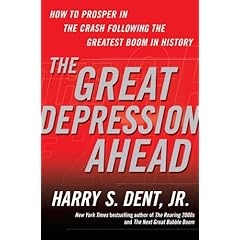
Harry S. Dent's notable titles include "The Roaring 2000s," "The Next Great Bubble Boom," and most recently, "The Great Depression Ahead." In his latest book Dent explains why we haven't seen the worst yet, and predicts a larger drop in stocks and real estate and even higher unemployment rates up till 2013.

The great thing about Harry Dent's books and method is that he gives you a macro view of the economy and really delves deep into demographics for his supporting evidence. Thus, even if you don't agree with his predictions you can see the trends that he's using to formulate his argument.

Conversely, as with any other market forecaster his advice should be taken with a grain of salt. Dent has had his share of missed calls, notably his 2000 prediction of the DOW reaching 40k. Despite this I think there is a lot to be learned from his approach and his research into consumer spending habits.

This is a good example of why it's important to understand that there's no one investor out there with all the answers. It's up to you to learn as much as you can through a variety of resources in order to understand the big picture of trading. I would recommend using Harry's tips in conjunction with additional trading resources in an ongoing educational process.

One great tool that I personally use is INO TV, a site where you can view the trading systems of the world's top analysts. These are the exact same strategies they teach at their seminars where a seat would cost $2,000 -$3,000.

Catch CLL Before the Run To 1.30 Technicals Ready To Break Out


Tuesday, April 14, 2009

Time To Sell OPC And Buy CLL? You Decide 1 Will Be Aquired Soon!


Goldman is goldmine

RTGAM


Despite better-than-expected first-quarter results from Goldman Sachs Group Inc. after the close of trading on Monday, major stock market indexes were relatively unchanged on Tuesday morning - suggesting that buying the rumour, selling the fact is a well-entrenched strategy these days.


U.S. stock index futures were only slightly higher with about an hour before markets open, suggesting that stocks will rise at the start of trading. Futures for the Dow Jones industrial average were up 19 points and futures for the broader S&P 500 were up 3 points - tame moves given that the Goldman Sachs earnings provide more evidence of stability returning to Wall Street.


The bank reported a profit of $1.8-billion (U.S.), or $3.23 a share, which was about twice the profit that analysts had been expecting. The report came a week after Wells Fargo & Co. pre-announced its first quarter results, with a profit expectation that was also well above analysts' forecasts.


In other earnings news, health care products heavyweight Johnson & Johnson reported that its net earnings fell 2.5 per cent in the first quarter, to $3.5-billion or $1.26 a share. Despite the dip, in part due to a rising U.S. dollar that hurt overseas sales, the per-share profit beat analysts' expectations.


Still, there was some glum news, which may be hanging over stocks: The U.S. Commerce Department reported that consumer sales fell 1.1 per cent in March, an unexpected dip following a 0.3 per cent gain in February, which suggests that rising unemployment continues to hit consumer spending and may prolong the recession.


In Europe, the U.K.'s FTSE 100 was up 0.7 per cent and Germany's DAX index was up 1.7 per cent in afternoon trading. In Asia, Japan's Nikkei 225 fell 0.9 per cent in overnight trading.

Copyright 2001 The Globe and Mail

Monday, April 13, 2009

Canwest shares worthless,


TheStar.com -

 Business - Canwest shares worthless, analysts say
April 13, 2009
Wojtek Dabrowski
Reuters

Shares of Canwest Global Communications are essentially worthless and should be avoided by investors as Canada's biggest media company fights to restructure its massive debt amid a severe advertising downturn, analysts said Monday.

Canwest has another debt deadline looming Tuesday, by which time it must pay $30.4 million (U.S.) in interest to holders of its 8 per cent senior subordinated notes. The payment was originally due March 15, but the company missed it.

If it doesn't pay Tuesday, the investors can demand the repayment of about $761 million of outstanding principal on the notes. This could further exacerbate the crisis facing the company.

"Given the significant liquidity challenges facing the company, we see no residual value in the shares of Canwest," BMO Capital Markets analyst Tim Casey wrote in a note to clients.

While critical, the looming interest payment is only the tip of the iceberg for Winnipeg, Manitoba-based Canwest, which has a debtload of about $3.7 billion (Canadian), some of it dating back to its 2000 acquisition of newspaper assets from Hollinger International.

The company is in talks with both the noteholders and its banks to restructure its debtload and recapitalize its balance sheet. Meanwhile, lenders have clamped down on the amount of credit they are willing to advance to the company.

"Based on these major liquidity challenges, it seems unlikely to us that Canwest can continue in its current form," Casey wrote, adding that timely and successful asset sales also seem unlikely.

The recession continues to severely depress the advertising market, which is the lifeblood of Canwest's stable of newspapers and television stations. It has also dampened the appetites of potential buyers of Canwest's assets.

Canwest owns a chain of Canadian daily newspapers, including the flagship National Post, as well as Canada's Global TV network. It also has television operations in Australia, through its stake in Network Ten.

Last week, Canwest posted a net loss of $1.44 billion for the three months ended Feb. 28. This included a $1.19 billion writedown related mostly to its publishing operations.

"We see no compelling reason to own, let alone buy Canwest shares, which we would continue to avoid," National Bank Financial analyst Adam Shine wrote in a note.

Analysts have previously said that Canwest could file for bankruptcy protection, but the company thus far has continued to negotiate with its creditors rather than involve the courts.

"We continue to believe there is significant risk Canwest is forced into bankruptcy protection or to sell assets at unfavourable prices or a massive debt restructuring," GMP Securities analyst Jason Jacobson wrote to clients.

"Either way, we believe Canwest equity value is very limited." His target price on the shares is zero.

A Canwest spokesman had no comment on the status of the creditor talks Monday.

A HISTORY OF DEBT

Canwest is considering selling five conventional TV stations and has agreed to sell its stake in sports broadcaster Score Media. It has already sold the New Republic magazine in the United States to a group of private investors.

However, no large-scale asset sale that would make a significant dent in Canwest's debtload has materialized so far.

A big part of its debt dates back to the $3.2 billion newspaper acquisition from Hollinger International in 2000.

The deal made Canwest the country's biggest publisher of daily newspapers. It included 13 big-city dailies as well as 126 community newspapers, Internet assets and a 50 per cent stake in the National Post. The company later bought full control of the Post.

In 2007, Canwest expanded its television holdings by partnering with an affiliate of U.S. investment bank Goldman Sachs to buy specialty-TV group Alliance Atlantis Communications for $2.3 billion.

Canwest is controlled by the Asper family of Winnipeg. In November, it cut 560 jobs at its newspapers and television stations to slash costs and cope with the advertising slowdown.

Canwest shares were down 1.5 cents at 30.5 cents on the Toronto Stock Exchange Monday.

Pescod Talks Wavefront Energy


Is A Change In Trend Approaching?

Is A Change In Trend Approaching?


By David Grandey
All About Trends

We've had a nice 6-week rally that has seen many stocks make significant short-term moves. And while we've been impressed with the market's resistance toward pulling back with any kind of meaningful significance, we're starting to notice some things that we haven't seen in the past 6 weeks.

First and foremost, the Dow completed a double top Friday. A double top is often an early warning sign that a change in trend is near - in this case from up to down.

For those of you that have been following this column for a while, you can see that the chart of the Dow below is a classic All About Trends short-sell set-up. The red lines show the double top. The green line is the upward trend line. If this were a stock, it would be on our short-sell watch list and we'd be going short when the Dow breaks the green upward trend line to the downside.


******************

This 2,309-Year-Old Phoenician Edge Still Builds Fortunes...Fast

On Oct. 6, My Readers Cashed Out 168.75% Gains on a 7 DAY OLD PLAY

Here's how you can get started with your own fast, easy gains, starting this Monday night.

******************

Secondly, there are a lot of stocks that are extremely short-term overbought and extended - many of them are 30-40% extended from their 50-day moving averages. We've spent the better part of the weekend looking at lots of charts and we really only have one stock that we'd consider taking a long position in. So even if you want to be long here, the market is telling us to sit tight and wait for stocks to set- up again.

And finally, we've noticed a lot of stocks closed in the lower half of their trading ranges Friday. This is what market technicians call churning. Yes, the indexes were up, but when you look under the surface, many stocks had a tough time holding onto their gains Friday. What this means is that the "smart money" was selling into the rally.

With all of this said, the percentages favor a pullback. I know we've been talking about this for a while, but the amount of evidence is piling up on that side of the fence now.

However, we don't see a lot of good short-sell set-ups out there yet. This doesn't necessarily mean we shouldn't be looking to go short. It's more of how many stocks are so overextended that they need some time to start forming set-ups. Take a look at the charts of NTES and GMCR - two stocks that are leading the market higher.


They have done nothing but go straight up - we want to see some structure form them first - such as a double top where we have a clear area of resistance to give us a point to trade. For example, is GMCR going to keep going up when it is 12 points extended from its 50-day? Probably not, but if it does, where would it stop? The chart isn't giving us the answer either. Now scroll up for a look at the Dow chart - here we have a double top-- which tells us that the Dow is likely to stop advancing at that level.

Sincerely,

David Grandey

AMAZING TECHNOLOGY FROM JAPAN


AMAZING TECHNOLOGY FROM JAPAN

Look closely and guess what they could be...

AMAZING TECHNOLOGY FROM JAPAN

Looks like pens with hidden cams , right?

AMAZING TECHNOLOGY FROM JAPAN

Nope, wrong

Any wild guesses ??

You've just seen something that will replace your PC in the near future.

AMAZING TECHNOLOGY FROM JAPAN

AMAZING TECHNOLOGY FROM JAPAN


You've just seen the future of the Laptop. In the revolution of miniature computers, the scientists are ahead with bluetooth technology.

This is the forthcoming computers you can carry within your pockets.

This 'pen sort of instrument' produces both the monitor as well as the keyboard on any flat surfaces from where you can carry out functions you would normally do on your desktop computer.

AMAZING TECHNOLOGY FROM JAPAN


Six stocks to watch this week

MADLEN READ

NEW YORK — It's the earnings, stupid.

Optimism that the fortunes of financial companies like Citigroup were improving sparked a four-week rally beginning March 10 that drove the Standard & Poor's 500 index up 25 per cent. But now investors will find out exactly how companies across all industries performed during the first three months of the year. Those quarterly results will determine whether the surge was the beginning of a bull market, or just a blip.

After all, the market's last promising rally was derailed not by jobs data or an emergency federal bailout but by forecasts from companies that make everything from computer chips to tin cans to movies.

The S&P 500 jumped 182 points, or 24 per cent, to 934 between Nov. 20 and Jan. 6. The next day, technology bellwether Intel Corp., aluminum producer Alcoa Inc. and media giant Time Warner Inc. all issued grim earnings guidance. The S&P dropped 28 points, or 3 per cent, that day and hasn't returned to its early January levels since.

The current rally also began with a company announcement. This time, beleaguered and bailed out Citigroup Inc. said March 10 it was profitable for the first two months of the year. The S&P 500 gained 43 points, or 6 per cent, that day to 719. The index closed Thursday at 857, and markets were closed on Good Friday.

The S&P could rise more, and even turn positive for 2009, if earnings reports for the first quarter show a strengthening economy. Alcoa, the first big company to report their results each quarter, announced a loss of $497-million (U.S.) on Tuesday evening. But investors were pleased about the aluminum company's efforts to cut expenses by $2-billion a year, and the shares are up 14 per cent since.

Wells Fargo & Co., meanwhile, said Thursday it expects record first-quarter earnings of $3-billion, about 50 per cent more than the same period a year ago. The shares surged $4.72, or 32 per cent, to $19.61 that day.

“We've got this incredible possibility that the market has turned a corner — that's it's not just a bear market rally or a head-fake,” said Arthur Hogan, chief market analyst at Jefferies & Co. “Earnings are going to let us know whether the market has gotten ahead of itself, or is justified in its new valuation of stocks.”

Here are six companies that will report earnings this week. Each, in its own way, provides a snapshot of the economy.

General Electric Co.

Why it's important: GE has a stake in almost every major sector of the economy. It builds turbines for power plants and high-tech medical machines. Jetliners use GE engines. When homeowners remodel, GE's stainless steel ovens and refrigerators anchor their kitchens. And many people still screw GE light bulbs into their living room lamps. GE is also a barometer of the health of the financial world through its lending arm GE Capital.

When it will report: Friday.

What the experts say: The consensus of analysts surveyed by Thomson Reuters is that GE will earn 21 cents per share in the first quarter on sales of $39-billion. That's down from profit of 43 cents per share on revenue of $42-billion a year ago.

You'll know the economy is improving if: GE sells more of its giant energy-generating windmills. That could be a sign that the $787-billion stimulus plan passed by Congress earlier this year, which includes money for alternative energy, is starting to kick in.

You'll know the economy is not improving if: GE Capital isn't making money. Test models developed by the Federal Reserve to help financial companies gauge their health show GE Capital will at best break even this year.

The quote: “We are in a recession and, at times like these, it is difficult to predict how bad and for how long” GE's CEO Jeff Immelt said in a recent letter to shareholders.

Intel Corp.

Why it's important: Intel is a barometer of spending on personal computers and servers. When computer makers buy more of Intel's chips, it indicates they believe demand from consumers and businesses is strong. Orders have cratered in recent months. Intel's profit has plunged to its lowest levels since 2001.

When it will report: Tuesday.

What the experts say: Analysts expect net income of 2 cents per share, down from 25 cents per share a year ago. They expect sales to fall nearly 30 per cent to $6.96-billion.

You'll know the economy is improving if: They excel in areas other than the Atom, a small chip for mini-laptops called “netbooks,” smart phones and other gadgets. Atom chips are less expensive than the more powerful Intel processors found in full-size computers. Demand for the Atom has been brisk, suggesting people are buying cheaper machines than standard PCs.

You'll know the economy is not improving if: The gross profit margin falls below Intel's forecast for the low 40 per cent range. The figure measures the proportion of revenue left over after subtracting the cost of making Intel's chips and other products. Intel incurs expenses for running its factories at less than full capacity. A low number means Intel factories are even less full than expected and PC demand is humdrum.

The quote: “If anything, even though things are down, I would think they're going to be one of the positive spots in the electronics industry,” said Jim McGregor, chief technology strategist for market researcher In-Stat.

Johnson & Johnson

Why it's important: J&J is the world's most diverse health care products company, making everything from contraceptives to baby formula to advanced drugs harvested from living cells. That broad base means it captures a large slice of consumer spending. People are normally reluctant to cut back on health care spending.

When it will report: Tuesday.

What the experts say: What the experts say: Analysts expect earnings of $1.22 per share on more than $15.4-billion in revenue, down from $1.26 per share last year on sales of $16.19-billion.

You'll know the economy is improving if: Sales of both prescription drugs and consumer goods rise. People worried about losing their job and health insurance cut back on doctor visits, elective surgery and prescription medicines. Investors should consider the demand for consumer goods, not just the revenue.

You'll know the economy is not improving if: Sales of prescription drugs continue to fall. That indicates consumers are scrimping on expenses usually seen as crucial. In the fourth quarter, J&J observed consumers were becoming more frugal, and sales of items like contact lenses and diabetes test strips had fallen.

The quote: “It's probably going to be a couple more quarters before you see it in their numbers, even if the economy's already turned,” Gabelli & Co. analyst Jeff Jonas said.

Citigroup Inc.

Why it's important: The nation's largest bank is involved in everything from residential mortgages to commercial real estate to credit cards. Any recovery in Citigroup would bode well for the broader financial industry, and the market knows it: Stocks began a four-week rally after CEO Vikram Pandit said last month that January and February were profitable.

When it will report: Friday.

What the experts say: Analysts predict a sixth straight quarterly loss — this time, of 36 cents per share. In the first quarter last year, Citigroup lost $5.1-billion, or $1.02 a share.

You'll know the economy is improving if: There is any sign of improvement in credit. It's a given that Citigroup will see more debtors fail to make their payments; the question is whether the rise in defaulting loans is starting to moderate.

You'll know the economy is not improving if: Loan defaults are accelerating at a much faster pace than expected.

The quote: “Historically, losing money is a bad thing. But now, if you're losing less money, it's a good thing,” said Kris Niswander, associate director of financial institutions at SNL Financial. “We're looking for any glimmer of hope that can be found.”

Sherwin-Williams Co.

Why it's important: This paint and wall-covering company gets nearly half its sales from its remodeling and repainting business. Another 10 per cent comes from new housing and new building construction. As the economy slowed down — and housing sales and renovations with it — Sherwin's business contracted sharply.

When it will report: Thursday.

What the experts say: Analysts surveyed by Thomson Reuters expect it to earn 21 cents per share on revenue of $1.62-billion. That's below last year's 64 cents per share on revenue of $1.78-billion.

You'll know the economy is improving if: Sales of paint for new homes and remodelings rebound, even slightly. That means consumers are more willing to make discretionary purchases.

You'll know the economy is not improving if: Sales in outside the U.S., which began sinking at the end of last year, fall more than anticipated. That means the economy could be depressed for longer than expected.

Quote: “Since they're heavily tied to things like consumer spending and the repair and remodel market, they're still definitely going to be pretty pressured through 2009,” said Morningstar analyst Anthony Dayrit.

CSX Corp.

Why it's important: As a railroad company, CSX transports everything from cars and car parts to heating oil. When consumers feel pinched or homes are sitting empty, those things aren't moving.

When it reports: Tuesday, April 14

What the experts say: Analysts expect profit of 53 cents per share, excluding one-time charges. That's 34 per cent lower than the year-ago quarter.

You'll know the economy is improving if: Shipping volume picks up. Volume tends to improve before the broader economy, as manufacturing lines start moving again. The lead time can be anywhere from a few months to a year.

You'll know the economy isn't improving if: Shipments of core commodities such as lumber and automobiles, chemicals and agricultural products remain sluggish — that means demand is still frozen. The Association of American Railroads said total volume in the first week of the second quarter fell 19.1 per cent from a year earlier, comparable with previous weeks this year.

The quote: “We are model;ing for CSX's volumes to turn positive in the fourth quarter, along with the general economy,” Longbow Research analyst Lee Klaskow said.

© Copyright The Globe and Mail

Tuesday, April 7, 2009

Opti And Nexen To Be Bought Next? UUUUbet!


Nexen Inc. and Opti Canada Inc. may be among Canadian oil companies targeted for takeovers as a price collapse triggers a rush by larger producers to amass holdings in the biggest crude deposits outside Saudi Arabia.

Potential suitors like Royal Dutch Shell Plc and Exxon Mobil Corp. can buy reserves cheaper than they can discover them after a global recession eroded energy demand and market values of smaller producers plummeted, said Sampat Prakash, who advises oil companies on acquisitions at Deloitte Consulting LLP.

For possible sellers, rising costs and the credit crunch make it difficult to fund oil-sands developments, some of which were made unviable by a US$95 drop in crude prices from 2008’s record high. Producers as small as Opti, with a market value of about $239-million (US$194-million), can offer suitors stakes in large crude deposits free from threat of nationalization.

"Opti won’t be around by the end of the year," said Will Lee, an analyst at CIBC World Markets Inc. in Calgary. "There’s a huge motivation for oil companies to get together now."

Nexen and Opti, both based in Calgary, own the $6.5-billion Long Lake tar-sands project. Nexen, valued at $12.1-billion, also has the Buzzard field in the North Sea and a piece of Syncrude Canada Ltd., the world’s biggest oil-sands producer.

Opti has lost 93% of its market value in the past year, and former Scotia Waterous banker Christopher Slubicki will take over as chief executive officer this month. Opti rose 4.3% to $1.22 at 12:11 p.m. on the Toronto Stock Exchange, and Nexen climbed 1 cent to $23.29.

Some takeovers may involve Canadian producers combining with each other, as with Suncor Energy Inc.’s agreement to buy Petro-Canada for $19.3-billion, announced March 23. The deal provides the scale and cost savings Suncor needs to shoulder the massive investments needed to compete with the likes of Shell in oil-sands development, CEO Rick George said.

The thick crude permeating Canada’s oil sands is bitumen, a low-grade petroleum that is solid as hockey puck at 52 degrees Fahrenheit (11 Celsius). Producers use mechanical shovels or steam to extract bitumen, which is processed into synthetic crude before it can be refined into gasoline or diesel.

To do all of that profitably, new oil-sands developments will need oil prices of US$80 a barrel, more than 50% above current levels, said Andy Byrne, an analyst at IHS Herold in Norwalk, Connecticut.

Canadian energy companies dropped 32% in the past year as petroleum prices tumbled, steeper than the 25% decline for the largest U.S. oil producers. The high-cost tar sands account for 97% of the nation’s oil reserves.

Opti Chief Executive Officer Sid Dykstra, who will step down on April 28, declined to discuss whether a sale of the company is in the works. Nexen Chairman Francis Saville referred an inquiry to spokeswoman Carla Yuill, who declined to comment.

Target companies probably will be more amenable to takeover offers than they would have been during the 6 1/2-year bull run for oil that ended in mid-2008, said Richard Wyman, an analyst at Canaccord Capital Corp. in Calgary.

"In the current financial and commodity environment, a lot of producers no longer have access to capital," Mr. Wyman said. "That’s one reason there are so many companies ripe to be plucked."

Start-up companies that acquired leases in the heart of the tar sands during the boom years probably are actively seeking buyers or partners, said John Brussa, chairman of Penn West Energy Trust, a Calgary-based oil and natural-gas producer. Without outside funding, many leaseholders have no hope of ever extracting the crude beneath their feet, he said.

"I suspect some of those will be looking for dance partners," Mr. Brussa said. "Those are the ones I think you will see some transactions in. They are mostly startup types of players that don’t have the capital to take projects forward."

The potential payoff for buyers is huge: The four major tar-sands deposits in Alberta and Saskatchewan contain enough crude to supply every refinery in the U.S. for 33 years. At current prices, the 174-billion barrels of crude buried in the Canadian landscape is worth about US$9-trillion.

The oil sands are attracting interest from Paris to the Persian Gulf. France’s Total SA on March 27 extended its $617-million offer for UTS Energy Corp. to April 16 after UTS dismissed the bid as inadequate. Abu Dhabi National Energy Co. is pursuing oil-sands acquisitions in Canada, according to two people involved in the search.

Investments in the region are bets that energy demand and prices will rebound as recessions end, said Brian Youngberg, an analyst at Edward Jones & Co. in Des Peres, Missouri.

"The larger oil companies are looking for bargains," said Satya Das, founder of Cambridge Strategies Inc., an Edmonton- based strategic advisory firm to energy companies and governments. "There are dozens of smaller companies holding leases that hold millions of barrels of oil but which don’t have access to the capital needed to extract them."

Major oil producers such as Irving, Texas-based Exxon Mobil and Shell, Europe’s largest oil company, are stepping up investment in Canada after 1990s-era ventures in places such as Venezuela and Russia fell victim to nationalization or crushing increases in taxes and royalties, said Wyman of Canaccord.

Exxon Mobil CEO Rex Tillerson said in a presentation last month that he prefers joint ventures with state oil companies to takeovers. Shell will look for acquisition opportunities in "the same businesses we are in now," Marvin Odum, the company’s U.S. chief, said in a March 3 interview.

Shell spent about $14-billion combined on two Canadian deals in the past two years. The Hague-based company bought the stock of Calgary-based Shell Canada Ltd. that it didn’t already own in 2007 and acquired Duvernay Oil Corp. last year.

Husky Energy Inc., the Calgary-based energy producer controlled by Hong Kong billionaire Li Ka-shing, is keeping open the option of oil-sands acquisitions even after plunging crude prices prompted the company to slash capital spending by US$1-billion this year.

"It’s a volatile industry and it’s a volatile market right now," Husky spokesman Graham White said in a March 31 interview. "There’s so much going on right now in terms of volatility that it makes sense to take a step back and reassess, but plans can change."

Other potential acquirers include India’s Oil & Natural Gas Corp. and Beijing-based China Petroleum & Chemical Corp., Asia’s biggest refiner, said Das of Cambridge Strategies.

China Petroleum & Chemical, known as Sinopec, acquired a 10% interest in the Northern Lights oil-sands project in northern Alberta from Total, the Paris-based seller said in an April 1 statement. Sinopec and Total units now share 50-50 ownership of Northern Lights.

Sinopec spokesman Huang Wensheng couldn’t be reached for comment on the company’s acquisition prospects in Canada. Oil & Natural Gas Chairman R.S. Sharma declined to comment.

Among companies identified by analysts as possible takeover targets is Oilsands Quest Inc., which halted work on a project this month after its money ran out, according to a filing.

In the past year, the Calgary-based company issued almost 24 million new shares to raise cash. No new projects will begin without joint-venture partners, additional borrowing or new share sales, the company said.

"It’s too soon to say" whether efforts to raise capital or find partners will succeed, company spokesman Paul O’Donoghue said. He declined to say whether Oilsands Quest is up for sale.


How Would You Fix The Economy In The USA?

This was an article from the St. Petersburg Times Newspaper on Sunday.
 
The Business Section asked readers for ideas on "How Would You Fix the Economy?"
 
I thought this was the BEST idea..... I think this guy nailed it...
 
 
Dear Mr. President,
 
Patriotic retirement:
 
There's about 40 million people over 50 in the work force -pay them $1 million
 
apiece severance with the following stipulations: 
 
1) They leave their jobs. Forty million job openings - Unemployment fixed.
 
2) They buy NEW American cars. Forty million cars ordered - Auto Industry fixed.
 
3) They either buy a house/pay off their mortgage - Housing Crisis fixed.
 
 
Can't get any easier than that!

Canada's market is opening up earlier than some others around the globe for a number of reasons.

Bonds boom as credit tap slowly opens

Sales total $5.7-billion since start of March; global companies buy into market           

From Tuesday's Globe and Mail

CAPITAL MARKETS REPORTER

Canadian companies are selling bonds at the fastest pace in a year and the debt market is opening to a wider swath of borrowers, signalling a further thawing in the credit freeze.

Amid the worst credit market conditions in a generation, Canada's bond market is more open than perhaps any in the world. The country is not just drawing local borrowers, but global companies like Thomson Reuters PLC that could choose to tap other markets.

There have been 13 corporate bond sales totalling $5.7-billion in just five weeks since the beginning of March, including a $750-million sale by Thomson. That's a significant pickup from the sluggish pace of sales since mid-2008.

"That [market] really has exploded open in the last few weeks in Canada," said Eric Lascelles, chief economics and rates strategist at TD Securities Inc.

There is still less credit to go around because of the credit crunch, and companies facing serious trouble due to the recession will have to pay more to borrow - if they can find a lender at all. But for solid borrowers, things are looking up.

The renewed access to credit may also take pressure off the Bank of Canada, which has signalled a willingness to step in if needed and support corporate bonds by buying debt.

The change is clear in the list of sellers. Issuers are now not just companies viewed as ultrasafe, like pipelines, and financial firms that need cash no matter how rough the markets.

In addition to Thomson, cable company Shaw Communications Inc. and mall owner RioCan Real Estate Investment Trust have sold bonds.

"For a while there it was open to only a select group of issuers, and now it seems to be broadening," said Mark Chandler, a fixed-income strategist at RBC Dominion Securities Inc.

The improvement isn't confined to longer-term corporate borrowing. Some bank borrowing costs have steadied at levels not far from precrisis costs, which is feeding into a recent drop in mortgage rates.

And rates in the so-called money market, where companies borrow for weeks at a time, have stabilized.

All of which may take the pressure off Bank of Canada Governor Mark Carney.

By just suggesting that he is open to the idea of buying corporate debt - known as "quantitative easing" - Mr. Carney may encourage more companies to try borrowing via bonds, helping to reopen the market further.

"My preference would be the Bank of Canada not have to engage in quantitative easing and have it come back naturally," Mr. Lascelles said.

Canada's market is opening up earlier than some others around the globe for a number of reasons.

The country's solid banking system means there is less competition with massive government and bank bond offerings, such as those that are occurring in the U.S. to raise money for bailouts.

There's also a growing understanding on the part of investors about how companies will fare in the recession, and the outlook for the economy, while gloomy, at least doesn't seem to be getting markedly worse by the day.

For many investors, bonds seem a better bet in the current recession than stocks because in the event a company fails, bondholders usually get more back than stock holders.

On the corporate side, treasurers are now more able to get a good sense of what they will pay to borrow in the bond market.

"Before, you weren't certain what was a good price because you didn't really know where things were trading," Mr. Chandler said.

Still, companies would be wise to act while the markets are open, Mr. Lascelles said. In mid-2008, when conditions in the bond market eased, companies that didn't take advantage regretted it when markets shut down again later in the year.

Those that did "were probably thanking their lucky stars," he said.

3 Penny Stocks I Dont Own Ready to Explode? You Decide!


Monday, April 6, 2009

Alleged fraud, Weizhen Tang Ponzi Scheme the "Chinese Warren Buffett"

Toronto investor hit with U.S. fraud charge
April 06, 2009
Reuters

WASHINGTON–U.S. securities regulators charged a Toronto-based fund manager, who describes himself as the "Chinese Warren Buffett" and his hedge fund with operating a multimillion dollar investment fraud, the Securities and Exchange Commission said Monday.

The SEC, which obtained an asset freeze to halt the alleged fraud, charged Weizhen Tang and his Canadian-based hedge fund with operating a Ponzi scheme, where funds from new investors were used to pay purported profits to other investors.

Since as early as 2004, Tang has raised as much as $75 million from more than 200 investors for his hedge fund called the Oversea Chinese Fund Limited Partnership, the SEC said.

Tang told investors in February 2009 that, in an effort to conceal substantial trading losses and attract new investors to his hedge fund, he posted false profits on investors' account statements and used funds from new investors to pay out at least $8 million in "fake" profits to others, the SEC said.

Attempts to reach Tang at Weizhen Tang Corp were unsuccessful. In a public letter to partners posted on Weizhen Tang's website, Tang said: "I did not steal everyone's funds."

"For my investment partners, February 27 of 2009 was a most shocking, heart-breaking and grieving day," Tang wrote in the letter. "It was also a day of tremendous pain to myself, one that I had feared so much but eventually it arrived. Because of the sin that I had committed, I have hurt you badly. I'd like to extend my deepest apologies."

According to the SEC's complaint, Tang targeted members of the Chinese American community and solicited U.S. investors to directly and indirectly invest in the hedge fund.

Since at least November 2007, the SEC alleges, Tang raised capital for his hedge fund from U.S. investors by offering and selling limited partnership interests in WinWin Capital Limited Partnership, a Texas based venture that he controls. WinWin Partners' sole business is investing partnership capital in the Oversea Chinese Fund, the complaint said.

The SEC alleges Tang sent e-mails to investors to persuade them to trust him with even more of their money and allow him to continue trading on their behalf. Within the last two weeks, Tang has informed investors he is actively raising an additional $1 million to "recoup" investor losses and creating new business entities, bank accounts and brokerage accounts to circumvent action by the SEC and Canadian regulator the Ontario Securities Commission.

Edwin Tomko, a lawyer representing WinWin-related entities said his clients are cooperating with the SEC and the court-appointed receiver.

OPTI and CLL Up Big Today

North American stocks ended down on Monday

Ford revs

RTGAM


North American stocks ended down on Monday on renewed concerns about the stability of the financial system and the start of earnings season - but managed to rebound substantially from their lows earlier in the day.


The Dow Jones industrial average closed at 7975.85, down 41.74 points, or 0.5 per cent. Earlier, it had been down about 155 points. The broader S&P 500 closed at 835.42, down 7.08 points, or 0.8 per cent, marking a similar improvement toward the end of the trading day.


Financials were weak, after a downbeat analyst report from Mike Mayo of  Calyon Securities. Citigroup Inc. fell 4.6 per cent and JPMorgan Chase & Co. fell 3.7 per cent. Alcoa Inc., which reports its first quarter results on Tuesday, fell 3.2 per cent.


However, there were winners. Defence contractors did well after the U.S. Defence Secretary outlined a plan to shift priorities toward unconventional conflicts. Lockheed Martin Corp. rose 8.9 per cent on government plans to cut work on the F-22 fighter jet but buy more of the F-35s.


Ford Motor Co. surged 16 per cent after the struggling auto maker managed to restructure its debt, reducing its obligations by $10-billion (U.S.) using a combination of cash and shares and cutting its interest costs by $500-million a year. General Motors Corp. rose 8.1 per cent.


In Canada, the S&P/TSX composite index closed at 9016.17, down 49.59 points, or 0.6 per cent. Earlier in the day, the index had been down by about 145 points on weakness in energy stocks, gold miners and financials.


Among the banks, Royal Bank of Canada finished the day down 0.7 per cent and Toronto-Dominion Bank fell 2 per cent. However, insurers did well: Manulife Financial Corp. rose 1.9 per cent and Sun Life Financial Inc. rose 0.8 per cent.


Commodity producers were generally weaker after the price of crude oil fell to $51.05 (U.S.) a barrel, down $1.46; gold fell to $872.80 an ounce, down $24.50. Among energy stocks, Canadian Oil Sands Trust fell 1.6 per cent, but Talisman Energy Inc. rose 1.8 per cent. Among gold producers, Barrick Gold Corp. fell 4.6 per cent and Goldcorp Inc. fell 1.8 per cent.


Meanwhile, Research In Motion Ltd. finished with another fine gain after it surged about 20 per cent on Friday following and upbeat quarterly report. On Monday, the stock rose another 7.2 per cent, contributing more than 30 points to the benchmark index.

Copyright 2001 The Globe and Mail

Josef Schachter On BNN

Schachter Asset Management Inc. provides oil and gas research coverage for small to mid-cap energy companies to Maison Placements Canada for their institutional clients. The principal of SAMI has over 35 years of experience in investment management. Before he set up his own investment advisory business, Mr. Schachter was Richardson Greenshields' Market Strategist from 1991-1996 and was also a Director of RGCL and a member of its Investment Policy Committee. He holds the Chartered Financial Analyst and Certified Management Accountant designations, and is a past Chairman of the Canadian Council of Financial Analysts.

Josef is a frequent guest on BNN TV and CBC Business World. He is a frequent speaker at corporate and investor conferences such as the World Outlook Financial Forum. He is regularly quoted in news and financial reporting publications and was awarded the Business Edge's "Stock Picker of the Year" in 2003, 2004 and 2007.

If you would like Josef Schachter to be a keynote speaker at conferences, please contact Brenda Asplund at 403 233 8483 or via e-mail.

Please feel free to contact us at:

Schachter Asset Management Inc.
Suite 220, 101 - 6th Avenue SW
Calgary, Alberta
T2P 3P4 Canada
Ph: (403) 264-5777
Fax: (403) 264 8874 


BNN takes your calls and emails on energy stocks.

http://watch.bnn.ca/#clip158236

OIL-TSX  Past Pick 
(A Top Pick Sept 11/07. Down 75%.) Announced results for the 3rd quarter and did on average about 12,000. Had maintenance on one of their platforms. 14,000 BOE's a day in July, 0 BOE’s in August and in September came on with about 20,000. Have to come up with $100 million.

Bankers Pet Rising Accumulation Continues

Josef Schachter talks about BNK-T On BNN Today

Target $2.50


Bankers Petroleum files NI 51-101 Reserves disclosure
BNK-T BANKERS PETROLEUM LTD
3/27/2009 12:40:00 AM
CALGARY, Mar 26, 2009 (Canada NewsWire via COMTEX News Network) --

Proved and Probable 10% NPV exceeds $1 Billion

Bankers Petroleum Ltd. ("Bankers" or the "Company") (TSX: BNK, AIM: BNK) is pleased to announce that it has filed its 2008 Reserves disclosure information with the applicable securities regulatory authorities. The NI 51-101 disclosure documents consist of the F1 - Statement of Reserves Data and Other Oil and Gas Information, the F2 - Report of Independent Qualified Reserves Evaluator and the F3 - Report of Management and Directors on Oil and Gas Disclosure.

The evaluations of the Albanian properties were conducted by RPS Energy Canada Ltd. (Patos Marinza oilfield) and by DeGolyer and MacNaughton Canada Limited (Kucova oilfield). At December 31, 2008, the reserves have increased in all three categories (proved, probable and possible), along with the corresponding valuations, as shown below. On a Proved plus Probable basis, the 2008 finding and development costs for the Albanian properties represented $5.55 per barrel, inclusive of the 2008 expenditures and change in future capital.

Subsequent to the Company's February 13, 2009 News Release announcing the preliminary reserve amounts, the final assessment for the Patos Marinza oilfield increased slightly, primarily in the "Proved" and the "Proved plus Probable plus Possible" categories. The combined "Proved plus Probable" category has remained consistent at 180 million barrels having an after-tax 10%-discounted valuation of $1 billion.

In the Patos Marinza oilfield, the original-oil-in-place resource estimate increased 140% to 4.7 billion barrels. The reserves growth is primarily attributable to increased resource levels, improved well performance and the Company's 2008 vertical and horizontal development drilling successes. All of Patos Marinza's 2008 reserves estimates are from primary recovery methods.

The Kucova oilfield, acquired in 2008, has an original-oil-in-place resource estimate of 300 million barrels. This property is currently in the evaluation stage that will lead to creation of a development plan.

Source


Sunday, April 5, 2009

Oil falls on U.S. jobless data

MARK WILLIAMS

The Associated Press

April 3, 2009 at 4:19 PM EDT

COLUMBUS, Ohio — Oil prices dipped Friday after the U.S. government reported that the nation's unemployment rate rose to the highest rate since late 1983 as employers eliminated 663,000 jobs.

Benchmark crude for May delivery fell 13 cents (U.S.) to settle at $52.51 barrel on the New York Mercantile Exchange.

With the U.S. and other nations hemorrhaging jobs, demand for gasoline and other fuels has plummeted. The unemployed are not commuting, factories are not producing as many consumer goods, and heat or electricity at millions of homes has been shut off.

“We are swimming in oil,” analyst Stephen Schork said. “We are swimming in oil because production is strong and demand is weak ... and it is going to remain that way in the short run.”

Still, Mr. Schork acknowledges that more people are buying into oil markets on “any positive thread.”

On Thursday, the same futures contract rose $4.25 to settle at $52.64 on word that the world's major powers would provide $1.1-trillion in loans and guarantees to developing countries.

In London, Brent prices rose 72 cents to settle at $53.47 a barrel Friday on the ICE Futures exchange.

Even with the jump in prices Thursday, benchmark U.S. crude ended the week essentially flat.

“We're getting a well-deserved pullback ahead of the weekend,” said Jim Ritterbusch of Ritterbusch and Associates.

The U.S. Labour Department reported Friday that the nation's unemployment level is now at 8.5 per cent. If part-time and discouraged workers are factored in, the unemployment rate would have been 15.6 per cent in March, the highest on records dating to 1994.

Since the recession began in December, 2007, the economy has lost a net total of 5.1 million jobs, with almost two-thirds of the losses occurring in the last five months.

The number of unemployed people climbed to 13.2 million in March. In addition, the number of people forced to work part time for “economic reasons” rose by 423,000 to 9 million. Those are people who would like to work full time but whose hours were cut back or who were unable to find full-time work.

Oil prices in recent weeks have begun to follow Wall Street, however, and stocks have been rising for three weeks. The stock market has historically bottomed out before the economy.

Crude futures began to rise at the beginning of March, rising about $10 from a low of close of $40.15 on the first trading day of the month.

Still, oil inventories are at 16-year highs, suggesting an extraordinary lack of appetite for energy.

Phil Flynn of Alaron Trading Corp. said that, for now, optimism about the economy has trumped concerns of oversupply. He also said actions taken by central banks in the U.S. and Europe could push the dollar lower, and thus push oil prices higher. Oil is traded in U.S. currency and foreign investors can buy more when the dollar drops.

“Right now the oil market has made it clear that supplies are way down on the list of what's moving the market right now,” he said.

Investors bought into oil despite some very bearish supply numbers released by the government.

Prices at the pump, meanwhile, fell 0.4 cents a gallon overnight to $2.041, according to auto club AAA, Wright Express and Oil Price Information Service. Prices are 10.8 cents higher than a month ago, but $1.248 below last year's prices.

In other Nymex trading, gasoline for May delivery rose 2.26 cents to settle at $1.4924 a gallon and heating oil rose less than a cent to settle at $1.4460 a gallon. Natural gas for May delivery rose 1.9 cents to settle at $3.801 per 1,000 cubic feet.

Playing Ball with Resources

Nobody likes resource companies these days. Heck, nobody likes the markets at all.

But I think it's time for anybody with a sense of reality to once again consider looking at resource plays as a way to reap the incredible opportunities that this market has in store for risk-tolerant and patient investors.

Since last year, I am sure that all of your senses have gravitated towards the sentiment that the resource sector, especially the juniors of the Canadian exchanges, will not last another year. I am sure you have heard that many are stuck with projects that are too big for their companies to handle. I am sure you have seen corporations go belly up right under your nose. I have too. I speak with these companies each and every day.

But have you heard the other side of the story?

Traditional sources of financing have been near impossible for corporations. Remember the days when banks would force upon you every possible loan available? I do. That was last year. But things are different now. Banks have undergone a dramatic overhaul and are now terrified to even mention the word loan.

For most corporations, it doesn't matter how good your cash flow, revenue, forecasts, or your balance sheet might be. It doesn't matter if you have been in business for 50 years and have never missed a loan payment. Even the billions upon billions of government bailout funds and depressed central bank rates all across the world are not enough to get the credit flowing again. And you know what? It doesn't seem to be that big of a deal.

Not to the resource companies, anyway.

In the past few months, natural-resource players have raised well over $40 - $45 billion from outside the regular banking system. Most of the funds, from private investors and investment banks, have been accumulated through private placement bought deals and these astronomical financing figures are still pouring into both the smallest of the small caps and the largest of the large caps.
Need proof?

In February, Kinross raised $400 million (bought deal), then used $150 million to buy 20% of Harry Winston Diamond Corp. Cameco raised $460 million (bought deal) and BHP Billiton creatively raised $3.25 billion through corporate bonds. The list goes on. Even Gold Wheaton, a company trading at less than $0.25 has raised $200 million in the last few months.

Early February, practically every mining junior corporation I spoke with were worried about raising cash. Now many of them have held successful fundraisers over the last 60 days. In less time to follow a full season of your favourite sitcom, the one industry everyone shunned is now at the forefront of cash infusion from private lenders and big time investment players.

The money being poured into the resource sector is obviously coming from the successful and notably wealthy players of our markets. No doubt they see the natural resource sector as the goose that lays the golden eggs and as a force field to deflect the dangers against the battalion of the U.S Treasury's printing presses.

It's not only the big investment players coming out to swing their bats. Let's not forget the biggest player of them all: China.
Over the last few months, China has been buying up everything natural resource from Copper and Iron miners to Canadian Oil Sands.

According to a statement on their central government's Web site from Commerce Minister Chen Deming, China will send more commercial missions overseas to make purchases and investments this year. During a recent purchasing tour in February to Germany, Switzerland, Spain and the U.K., Chinese companies spent more than $13 billion. According to the 21st Century Business Herald, the US is the next stop as the Chinese ministry sends a business group on a buying trip to the U.S. later this month.

These investments may not all be in the form of resource-specific plays, but the underlying tones based on their recent actions suggests to me that resource is a big part of their focus.

The big players in the investment business have all come to play ball on the resource sector's home court. Do you want to be sitting in the nosebleeds when the game begins or do you want a spot in the starting line up?

Best regards,

Ivan Lo
Equedia Network Corporation
www.equedia.com

Friday, April 3, 2009

Thomas W Accumulating BNK U Should Too


Thursday, April 2, 2009


 Bankers Petroleum files NI 51-101 Reserves disclosure
BNK-T BANKERS PETROLEUM LTD 
3/27/2009 12:40:00 AM
CALGARY, Mar 26, 2009 (Canada NewsWire via COMTEX News Network) --

Proved and Probable 10% NPV exceeds $1 Billion

Bankers Petroleum Ltd. ("Bankers" or the "Company") (TSX: BNK, AIM: BNK) is pleased to announce that it has filed its 2008 Reserves disclosure information with the applicable securities regulatory authorities. The NI 51-101 disclosure documents consist of the F1 - Statement of Reserves Data and Other Oil and Gas Information, the F2 - Report of Independent Qualified Reserves Evaluator and the F3 - Report of Management and Directors on Oil and Gas Disclosure.

The evaluations of the Albanian properties were conducted by RPS Energy Canada Ltd. (Patos Marinza oilfield) and by DeGolyer and MacNaughton Canada Limited (Kucova oilfield). At December 31, 2008, the reserves have increased in all three categories (proved, probable and possible), along with the corresponding valuations, as shown below. On a Proved plus Probable basis, the 2008 finding and development costs for the Albanian properties represented $5.55 per barrel, inclusive of the 2008 expenditures and change in future capital.

Subsequent to the Company's February 13, 2009 News Release announcing the preliminary reserve amounts, the final assessment for the Patos Marinza oilfield increased slightly, primarily in the "Proved" and the "Proved plus Probable plus Possible" categories. The combined "Proved plus Probable" category has remained consistent at 180 million barrels having an after-tax 10%-discounted valuation of $1 billion.

In the Patos Marinza oilfield, the original-oil-in-place resource estimate increased 140% to 4.7 billion barrels. The reserves growth is primarily attributable to increased resource levels, improved well performance and the Company's 2008 vertical and horizontal development drilling successes. All of Patos Marinza's 2008 reserves estimates are from primary recovery methods.

The Kucova oilfield, acquired in 2008, has an original-oil-in-place resource estimate of 300 million barrels. This property is currently in the evaluation stage that will lead to creation of a development plan.

Source


CRO Being Accumulated- This will run to.20 cents soon


- This company has connections to very well funded mining operations through decades of experience. I believe Mr. Tyler when he says they are speaking with 5 strategic partners for completion of there project through joint ventures. Joint venture speculation could drive our sp into a frenzy.


- The drill program which comprised our 253 million dollar property is open at depth and further drilling could significantly increase the resource. Some of our strongest results were on outer edges of the drill zone. De-watering of the 2500 meter mine shaft will allow them to get at these areas. The intersection I speak of is the 7% nickel over 5 meters that intersection comes from the end of the drill core. Further exploration could offer up amazing results. 0 summer 2008 drill results out, any significant finds in mine ready atikocan or kenora/dryden properties will lift stock.

- The company has contractual agreements with Opiwica explorations (OPW) on the TSX.V to mill there major gold and copper find with in close proximity of Canadian Arrows Planned site. Mining could begin on both projects in early 2010. This represents earnings and is a good partnership for a company seeking to be the next significant Nickel Copper producer in Canada.

- Canadian Arrow has the ability to produce nickel in its mine at 3.47 per pound nickel. That kind of number is unheard of in comparison to other mines. With production scheduled for early 2010 (around the same time our economy should be significantly rebounding) what if nickel prices return back to 15 dollars per pound? This site will look like a gem to any investor! (plus the property would be worth about 400mil at 15 dollars per pound nickel.

This is just a few of the key points that I believe make this company look attractive. If my predictions are correct we will see a significant rebound to normal multiples over the course of the next couple of months and with any significant news pertaining to my points and our sp and volume will be sent soaring. JV with cash on the books and abilitiy to help put project into production will send our sp back to .50 if not higher! I am Bull on Canadian Arrow mines.


Review This .pdf 12 page report:


Its Rally Time !!!

Bankers Pete Started At Spec Buy, C$2.35 Tgt By Jennings >BNK.T
April 1, 2009 3:46pm ET


(END) Dow Jones Newswires (201-938-5400)

04-01-09 1546ET


It's rally time

RTGAM


Global stock market indexes moved sharply higher on Thursday morning, with investors growing increasingly confident that the global economy is showing early signs of bottoming out.


U.S. stock index futures were up about an hour before markets opened, suggesting that stocks will rise at the start of trading. Futures for the Dow Jones industrial average rose 97 points. Futures for the broader S&P 500 rose 12 points.


In Europe, the U.K.'s FTSE 100 was up 2.6 per cent and Germany's DAX was up 4.1 per cent in afternoon trading. There, the European Central Bank cut its key interest rate by a quarter percentage point, to 1.25 per cent - half the cut that economists were expecting, which has some observers concerned that the ECB is not being sufficiently aggressive in dealing with the global recession.


In Asia, Japan's Nikkei 225 rose 4.4 per cent and Hong Kong's Hang Seng index rose 7.4 per cent in overnight trading.


The widespread gains came in spite of a disappointing look at U.S. unemployment numbers, with initial jobless claims jumping to 669,000 last week - worse than economists' expectations and marking the ninth straight week where claims have topped the 600,000-mark. The number of Americans collecting benefits rose to 5.7 million, indicating that laid-off workers are having a tough time finding jobs.


Still, investors are clearly putting more emphasis on recent data related to the U.S. housing market and manufacturing activity, which showed signs of tentative improvement. As well, Treasury Secretary Tim Geithner said in a Bloomberg News interview on Wednesday that financial markets are showing "encouraging signs" of recovering.


Meanwhile, Canadian energy stocks will likely benefit from a jump in the price of crude oil, which was part of a wider surge among commodities as investors position themselves for an economic rebound down the road. Oil jumped to $51.14 (U.S.) a barrel, up $2.75.

Copyright 2001 The Globe and Mail

Wednesday, April 1, 2009

It was a very good day for most...


Stock market indexes recovered soon after the opening bell on Wednesday, posting decent gains after investors interpreted reports on house sales and manufacturing activity as further evidence that the U.S. economy could be in the early stages of stabilizing.


The Dow Jones industrial average closed at 7761.60, up 152.68 points, or 2 per cent. The broader S&P 500 closed at 811.08, up 13.21 points, or 1.7 per cent.


While those increases may not look particularly impressive, they marked a big improvement over substantial losses at the start of trading. Then, indexes fell as much as 1.9 per cent - so let's call it a 3.5 per cent round trip, from the trough to the day's end - after a report on non-government payrolls showed job losses of 742,000 in March, 92,000 worse than economists had been expecting and a troubling setup for the official Labour Department numbers on Friday.


Then, the ISM Manufacturing index for March turned out slightly better than expected, though still well below the expansion threshold. In other words, manufacturing isn't contracting as sharply as it once was.


As well, pending home sales rose 2.1 per cent in February, beating the consensus forecast. For bullish investors, this was further confirmation that the U.S. economy has bottomed out, sending stocks higher in anticipation of solid evidence down the road.


At the Dow, 28 of the index's 30 components ended the day higher. Among the big movers, American Express Co., Citigroup Inc. and JPMorgan Chase & Co. rose 5.9 per cent each. Microsoft rose 5.1 per cent. The two losers: General Motors Corp. fell 0.5 per cent and Boeing Co. fell 0.4 per cent.


In Canada, the S&P/TSX composite index closed at 8941.82, up 221.43 points, or 2.5 per cent - marking a similarly impressive 3.8 per cent rebound from the day's lows. All three of the index's major sectors - materials, energy and financials - moved higher.


Among financials, Manulife Financial Corp. rose 6.2 per cent and Bank of Nova Scotia rose 3.4 per cent. Barrick Gold Corp. rose 4.9 per cent, despite a modest uptick in the price of gold.


As well, energy stocks moved higher even as the price of crude oil dipped to $48.39 (U.S.) a barrel, down $1.27. EnCana Corp. rose 3.8 per cent and Suncor Energy Inc. rose 1.5 per cent.

Copyright 2001 The Globe and Mail

Hope abounds!

Monday, March 30, 2009   Gordon Pape 


Print this article
  

Suddenly, hope is busting out all over. Almost every day (okay, last Friday was an exception) seems to bring a little good news, cheering stock markets and instilling some optimism in consumers. That's great. I just hope it's real.

The mood swing really began when the U.S. Federal Reserve Board announced on March 18 that it will spend up to $1.75-trillion (U.S.) this year to buy mortgage-backed securities and U.S. Treasury notes "to provide greater support to the mortgage lending and housing markets". That translates into a huge cash infusion into the American economy and while that may lead to inflation down the road, it's a move that may forestall the deflationary spiral that was looming. Stock markets applauded.

On March 23, the applause turned to cheers when embattled Treasury Secretary Tim Geithner released details of a plan to combine with the private sector to purchase up to $1-trillion worth of bad loans from U.S. financial institutions.

As that was happening, Suncor and Petro-Canada announced a mega-merger that dramatically changes the dynamics of the oil patch and may open the door to a tidal wave of M&A activity in the West. Energy trusts, facing the imposition of the new trust tax in less than two years, could be a prime focus in this situation.

Then there were the statistics. Canadian inflation showed a modest increase. Sales of existing homes in the U.S. recorded a surprising 5.1 per cent jump in February while new home sales were up 4.7 per cent from January. Factory orders in the States were up 3.4 per cent last month. It was the largest gain in over a year and defied economists' expectations. (However, the fact that the driving force behind the numbers was a 32.4 per cent gain in orders for military aircraft and parts raises the question of whether this was a turnaround or merely a blip.)

All of this has prompted some investors to get off their backsides and start pumping some of their cash back into stocks. As I write, with only two trading days left in the month, the S&P/TSX Composite Index is up 8.6 per cent for March while the Dow is ahead by 10.1 per cent and the S&P 500 by 11 per cent.

So is the worst really over? For the TSX, the answer is maybe but only in the sense that the March 6 intraday low of 7,480 may have been the bottom for this cycle. I'm not as optimistic about the U.S. indexes, however.

In his March 24 prime time press conference, President Barack Obama, who has emerged as the world's Cheerleader of Hope, did his best to instill confidence in Americans by saying he is seeing signs of progress in the economy. But he quickly tempered that by warning there is still a high hill to climb and urging an increasingly balky Congress to approve his budget.

Here at home, we've been hearing a similar message from former Bank of Canada Governor David Dodge who has no axes to grind and can speak his mind freely now that he is out of office. He repeated again last week that it will take "years" before the global economy returns to pre-crash levels, warning that 2009 will be "a very dark page in the economic history of the world".

That's sobering stuff and it should remind investors not to become overly ebullient quite yet. There are still many shocks to come and we would be wise to expect stock market volatility to continue through the spring and summer. Don't sell those bonds yet!

In fact, rallies such as the one we saw in March are a good time to review your portfolio and see if it is time to make some changes. Many of those beaten-down stocks you've been clinging to have probably gone up in value. Ask yourself whether you want to continue holding them at this stage. There may be more attractive opportunities out there or you may want to become more defensive by building cash or adding quality bonds or preferred shares to your mix. (The banks continue to flood the market with new issues of high-yielding preferreds.)

Hope is a wonderful emotion – it keeps us going even in the darkest times. But investors must temper it with reality and the reality right now is that we still have a long way to go before economic stability is restored.

Gordon Pape's latest book is Tax-Free Savings Accounts: A Guide to TFSAs and How They Can Make You Rich. Buy your copy at 27 per cent off the suggested retail price by going to http://astore.amazon.ca/buildicaquizm-20

Gordon Pape is one of Canada's best respected financial authors and the nation's leading expert on mutual funds.


Google Secrets

123 Chat