HudBay CEO exit reopens M&A debate
ANDY HOFFMAN
HudBay Minerals Inc. abruptly parted ways with its long-time chief executive officer Peter Jones, naming chairman Allen Palmiere to the top job, a shakeup sources said was a result of a conflict over the miner's strategic direction.
The Winnipeg zinc and copper producer has sat on the sidelines amid a frenzy of merger and acquisition activity in the mining sector. Record metal prices have swelled the company's cash position to an estimated $800-million.
Some shareholders, including a Monaco-based hedge fund controlling 16 per cent of the company's stock, have been agitating for a special dividend or major share repurchase.
A plan, announced in December, to buy back up to 9.5 per cent of the company's stock disappointed some investors as too small.
"Peter and the board have been at loggerheads for some time," said an industry source familiar with the situation.
Despite its large war chest, HudBay has been unsuccessful in attempts to close a major transaction. The company is understood to have held talks with several potential partners including Breakwater Resources Ltd., Lundin Mining Corp. and Inmet Mining Corp. Sources said it also discussed deals with Aur Resources and EuroZinc Mining before both those companies were taken over.
Widely lauded as one of the best mining operators in the business, Mr. Jones, CEO since 2002, has demonstrated a cautious approach to deal making and is wary of overpaying in what could be the market peak, sources said.
"The evidence is clear. They didn't acquire anything and there were plenty of chances to do so. Allen [Palmiere] is not a technical guy, he's a big-picture guy. He'll probably be in a better position to understand what's required to do a deal," a source said.
On a conference call, Mr. Palmiere refused to discuss the reasons for Mr. Jones' sudden departure as a HudBay director as well as president and CEO. In a press release, the company said Mr. Jones had chosen to retire.
Mr. Palmiere is expected to bring a more forceful approach to HudBay's merger and acquisition activity. An accountant who has held a series of executive jobs in the mining sector, he could also increase initiatives to return cash to shareholders through share buybacks or dividends.
"Given the current turmoil in the marketplace, there are significant opportunities potentially being created on the acquisition front, and I think like any company, we will have to continue to be, and perhaps be more aggressively focused, on opportunistic investment opportunities," he said.
HudBay shares jumped 9 per cent in heavy trading on the TSX. Before yesterday's gains, the stock had lost 18 per cent this year.
In a note to clients, Wellington West analyst Catherine Gignac said the management changes could signal that HudBay is "in play" and might be receptive to a takeover.
"The aggressive current merger climate in the mining sector suggests that HudBay could be acquired in this weakened status with its high cash position," she said.
HUDBAY (HBM-T)
Close $17.50, up $1.45.
Copyright 2001 The Globe and Mail
Saturday, January 26, 2008
HudBay+ Breakwater Resources Ltd.Partnership?
Friday, January 25, 2008
investors appear set to wrap it up on a positive note.

Stocks appear set to end week in positive territory
RTGAM
After a grim and bloody start to the week, investors appear set to wrap it up on a positive note.
Asian and European Stocks are higher and U.S. stock index futures also are up, although down from higher levels overnight.
Among the developments contributing to the move are the afterglow of a strong forecast and much better fourth-quarter results reported late Thursday by tech giant Microsoft, and a British news report that U.S. billionaire Wilbur Ross may buy Ambac Financial Group, one of several "monoline" bond insurers that are the latest focus of concern in the fallout from the subprime mortgage debacle.
In Asia, Japan's Nikkei index is up 4 per cent, Hong Kong's Hang Seng is up more than 6.7 per cent, Shanghai is up 0.93 per cent and Bombay's Sensex 30 is 6.62 per cent ahead. In Europe, the Dow Jones Euro Stoxx 50 is up 1.35 per cent, Britain's FTSE 100 is ahead by 1.12 per cent and Germany's DAX index is up 1.8 per cent.
As for U.S. stock futures, the March contract on the Dow Jones industrial average is up about 70 points, which the S&P 500 and Nasdaq 100 contracts are up 9.3 and 20 points, respectively.
Among the positive signs for Canadian equities today are that oil prices have pushed back above $90 (U.S.) a barrel, helped by the U.S. stock market rally and the economic stimulus plan agreed upon yesterday by Congress and the Bush administration.
"Oil's move up is in step with what's happening in equity markets," Global Insight analyst Simon Wardell told Reuters. "Seems like there is a turn in the view that the year ahead isn't going to be so bleak in terms of the U.S. economy and this has knock-on effect on oil."
As well, gold prices soared to a new record of $923.40 an ounce before slipping back to $921.80 in late morning in Europe, driven partly by oil's rise, along with the belief more U.S. interest rate cuts are on the way, but also by a power crisis which has shut down several mines in South Africa.
Copyright 2001 The Globe and Mail
Thursday, January 24, 2008
AN INTERVIEW WITH ANDY GUSTAJTIS
OIL & GAS ANALYST WITH DOMINICK AND DOMINICK
(As of January 22, 2008)
When times were a little bit better, no one had a hotter
hand in the oil and gas game than Andy Gustajtis, picking
some of the hottest winners over the last year. Now the
market isn’t nearly as generous and some of Andy’s stars
have waned just a bit, so it’s time to hear his view on the
economy and the markets.
David Pescod: So Andy, first of all, what’s going to happen
with the economy? Is it a recession we are facing? Is it
stagflation? Is Asia big enough that it doesn’t matter and
demand over there will carry us all?
Andy Gustajtis: David, I think it is the latter. I think we are
into a multi-decade bull market in commodities. I think the
analogy we can draw in 2008 is very similar to what we saw
back in the 1950’s and the 1960’s as the OEDC countries
began to industrialize post the Second World War. We had
essentially 20 years of growing demand for fundamental
commodities and I think we are very much in the same picture.
India and China are just beginning to industrialize
and I don’t think that’s going to get aborted.
I don’t know if there is going to be a recession in the U.S.
The indications are that the housing market is going to be
under severe pressure for a considerable period of time
and that has been a large driver of the U.S. economy. Also,
the US Consumer is pretty heavily leveraged, so it’s possible
we will see a slow down.
If there is a US recession, I just don’t see a huge decline in what I care most about –
OIL. We in North America are not going abandon our automobiles, demand for oil will not cease.
There will be some softness but common sense tells us demand will continue
to grow. There may be a slow down but the way Canadian
oil and gas stock have been hammered is down right silly!
Besides that, the big drivers are Asia and China and I don’t
see that changing.
Natural gas has been a big problem in North America in the
past 12 months. A recession would probably not bode well
for natural gas prices recovering much from where they are
now, but they are not that bad!
Gas prices are $1.00 per mcf higher than they were a year
ago and in historical terms, gas prices are certainly better
than we saw many years ago. There is a problem out
there in terms of drilling demand; the service companies
I think are all whining. I have been talking to a number of
companies and they are being offered rigs today for
prices they haven’t seen for three or four years. So the
costs of getting your wells drilled will certainly help the
E&P companies.
I think the oil and gas business in Western Canada is
overcapitalized and I have felt that way for pretty much of
the last decade and I think we are going to continue to
see rationalization. I have seen this week four companies
merge. We saw Talisman taking over a small company
RSX Energy Inc. and I suspect that consolidation
will continue throughout 2008. As a result we may see
far fewer companies at the end of 2008 which I feel will
be healthy and it will represent a more rational allocation
of capital to this resource basin.
The real opportunities in Western Canada are in heavy oil, tar sands and unconventional
gas – they will attract capital, perhaps at a
slower rate than we’ve seen in the last few years, but the
returns should continue to be attractive especially if
costs come down.
D.P: Now trying to predict where oil and gas prices will
be, what kind of parameters are you looking at for let’s
say the next year? Is it between $80 and $100, or higher
or lower?
A.G: I have been a big proponent of the peak oil theory
for pretty much the last ten years and I think we are beginning
to see the evidence of the peak oil scenario unfold.
I believe oil will be triple digits for a considerable
period of time. I feel, once the price breaks through that
$100 psychological barrier it will stay above that for
many years.
D.P: Having said all this, do you still like some of the big
international plays much more so than Western Canada?
A.G: If you look at the opportunities in Western Canada
in conventional oil and gas, I think you’ve got to expect a
very mediocre rate of return. Generally, you are going to
find small fields and small pools, but most companies in
this basin are not going to be involved in companymaker
discoveries. Having said that, there is always an
exception to all rules and somebody may stumble along
and find a 50 million barrel oil pool in Western Canada,
but they are going to be pretty rare.
D.P: Now let’s get to some specific names, particularly
names that your name has been associated with such as
Corridor Resources, which was an exciting discovery and
who would have thought natural gas in New Brunswick?
It had a huge run. What would be your latest take on a
stock that’s been halved, like many other stocks of late?
Petrolifera Petroleum
Arise Technologies
A.G: I’m disappointed in terms of what’s happened to
stock price, but in light of what the overall markets have
been doing, I guess it’s not unexpected. I am of the opinion
that McCully, the gas field in New Brunswick that
Corridor discovered, will in the fullness of time prove to
be a multi-TCF discovery. So far, they have drilled 23
successful wells in the upper portion of that field known
as the Hiram Brook Sands. The Company has just released
their budget and guidance for 2008. I am hoping
this is an exercise of under-promise and over-deliver.
Both their production and cash flow guidance were about
30% less than I am hoping for. After discussing this guidance
with the Company one gets the sense that their intentions
was to give a very solid base of 25 mmcfpd for
their net interest but my target of 35 mmcfpd is not unreasonable.
D.P: Their production numbers so far have been a little
bit disappointing, but what kind of a number should this
company be worth at that production number and of
course, the big question is, the Dawson Settlement – the
deep stuff. Seismic says if it’s there, it could be enormous.
A.G: Before we get down to the Dawson Settlement I
guess we have to find out how big this Frederick Brook
shale is and what kind of commerciality they are going to
get out of that. They are drilling a well now with the intention
of trying to get down to the Dawson Settlement,
but there is also a lot of interest in terms of trying to
prove up the Frederick Brook shale. The company has a
December year-end and they began producing gas commercially
in the third calendar quarter of 2007 and I am
anticipating that for 2007 they will have a modest cash
flow of about $13 million or $14 million. I am expecting
their cash flow for 2008 to be somewhere in the range of
$50 to $70 million (the $50 million is the Company’s guidance
the $70 million is my estimate) per share this is
$0.60 to $0.85.
That would give a cash flow per share
multiple to the company in the range of 10 to 7X. Corridor
has not been a stock that you’ve been able to buy on
a cash flow multiple up until now, but getting down to
$6.00, this stock is trading at a pretty respectable multiple
considering that I think this gas field is going to last
for 20 years.
D.P: Wow! So, what would be your target?
A.G: If the Frederick Brook shale proves to be commercial,
the potential resource would be multi-TCF of natural
gas and TCF of natural gas is worth a couple of billion
dollars so you see the prize is huge.
If the Dawson Settlement is gas charged and we may
have something to talk about at the end of March that
would be incremental.
D.P: Based just on the Hiram Brook Sands, would $10 be
do-able?
A.G: I think the Hiram Brook which is where all the gas
to date has been found will justify over 100 drillable locations
and I think in the fullness of time, that this zone
alone will probably support such a share price.
D.P: Connacher Oil and Gas is one of the plays in the
heavy oil business that you’ve been following and I suspect
we are all a little bit disappointed. Does it surprise
you that it’s taking so long to get production going?
A.G: No, I think everything is pretty much on schedule.
Their Pod-1 was constructed in 300 days, they started
steaming for 90 days and are getting bitumen production
as we speak. Production will be ramping up through
2008 and I can see them reaching design capacity by the
end of 2008 with possible cash flow north of $140 million
for 2008 with a fourth quarter of over $50 million or over
a $1 per share annualized..
D.P: And then of course, hopes for Algar or Pod-2?
A.G: That’s another 10,000 barrels a day so within18-24
months from now this company conceivably could be
producing 20,000 barrels a day of bitumen and probably
another 3,000 barrels equivalent of gas and conventional
oil with possible cash flow of about $300 million a year.
D.P: You had some pretty lofty targets a while ago?
A.G: I think in terms of the resource market, all we’ve
had is a correction in an upward trending bull market. I
have very little reason to want to move off my very bullish
longer-term outlook for resource stories. I think Connacher
certainly could be a double-digit stock within the
next 12-24 months.
D.P: Good. We are always glad to hear that! Now, an
associated company is Petrolifera Petroleum, and it seems
every analyst from Warren Verbonac to Malcolm Shaw at
Wellington West – are all aware of Petrolifera and their
targets in Peru and the enormity of that. Now with Petrolifera
trading at almost a third of where it was, your
thoughts on Petrolifera?
A.G: It’s a cheap stock. I liked it at $15.00. Oil prices in Argentina are capped at $42 a barrel, but even at that oil price
given the fact that the company should be able to get up to 14,000 or 15,000 barrels a day in Argentina, they should
have a cash flow of $2.00 a share. The stock is trading essentially at three times cash flow.
D.P: Now how big are these targets in your estimation?
A.G: Camisea, which Hunt is developing, are multi-TCF world-class type targets. The oil prospects that they’ve got
on the northern block are upwards of a couple hundred million barrel-type targets. So it’s somewhere between 200
million barrels for the oil and multi-TCF for the gas.
D.P: They got a shot at it sometime in the second half of this year, correct?
A.G: I don’t think they’ve announced the spud date but I do believe they’ve been able to get a suitable rig and I think their plan is to either try and see if they can drill a well before the end of this year or early part of next. But I haven’t seen or I don’t recall having seen an actual commitment on their part when they are going to spud.
D.P: I guess it comes time to the favorite question…if you could only buy one stock today in the oil and gas sector, what would it be for timeliness now?
A.G: I can’t help but think the way that Connacher has gotten beaten up here with all the stars lining up. They are totally funded right through to development of Pod-2. They don’t have to raise any equity. I am of the view that oil prices will stay upwards of $100 for a considerable length of time. In Pod-1 it looks like it’s a great project, all the early indications are that he’s got an extremely attractive SAGD project there. I just think that the Connacher looks to me like a pretty good bet.
D.P: Thank you so much for your time Andy!
I enjoy speaking with you David and you have been very kind to myself but I want to say that D&D Securities is an IDA and CIPF Member and the comments I have made I believe reliable but I can not represent that such information is accurate or complete and it should not be relied on as such. I no longer consider myself an analyst and actively work at investment banking. Any opinions
expressed herein reflect our judgment at this date and are subject to change. D&D Securities and/or employees from time to time
may hold shares, options or warrants on any issue included in this interview and we have actively participated in financing Corridor,
Connacher and I have participated in Petrolifera financing in a prior firm.
Thanks Ann B.
PDP Jan 15 2008 News Reminder
| STOCHASTICS: | Oversold |
| RSI: | Oversold |
| MACD: | ![]() |
CALGARY _ Petrolifera Petroleum Ltd. (TSX:PDP), a Calgary-based company with operations in South America, said Tuesday it is one step closer to drawing oil from one of its fields in Argentina.
The company said it has activated its waterflood pressure maintenance project at Puesto Morales North in Argentina‘s Neuquen Basin, which will help the company recover crude oil from the ground in about six months.
The company estimates that it will take 18 months for the site to reach its optimal production level.
“The activation of the water injection plant is a significant milestone for Petrolifera. It was constructed against a back of energy and equipment shortages in Argentina and its completion is a credit to the company‘s operational staff and external advisers and consultants,‘‘ the company stated.
“More importantly, it is anticipated the waterflood will consequently impact on Petrolifera‘s light crude oil production in Argentina during 2008 and beyond.‘‘
Last month the company, which also has operations in Peru and Colombia, said a well on that site tested light gravity crude oil at a rate of about 1,500 barrels a day.
Petrolifera shares were down by about two per cent, or 17 cents on the Toronto Stock Exchange Tuesday, closing at $8.40
Europe Markets Soaring- Our Markets next?
European stocks soaring, U.S. futures mildly positive
RTGAM
Well, as long as it was fraud and not more subprime shenanigans, who cares?
European investors appear to have shrugged off the revelation by French bank Societe Generale that it has been defrauded of the equivalent of $7.14-billion (U.S.) by an alleged rogue trader.
Key European indexes are still surging ahead in early afternoon trading across the Atlantic, feeding on the startling rebound in U.S. and Canadian equity markets late yesterday, apparently sparked by rumblings that a rescue package may be in the works for bond insurers.
The Dow Jones Euro Stoxx 50, for instance is up more than 5.6 per cent, Britain's FTSE 100 4 per cent and Germany's DAX more than 5.8 per cent.
As for U.S. stock index futures, they were still pointing towards at least a mildly positive opening shortly after 7.30 a.m. (EST), although they have been slipping from earlier highs.
The March contract based on the Dow Jones industrial average was up 29 points at 12,301 having been 43 points ahead about half an hour earlier, while the S&P 500 contract was up 3.60 points to 1,345.10, down from an earlier gain of 8.20 points. And the Nasdaq 100 March contract was up 8 points at 1,815, down from a 12.25-point gain earlier.
Meanwhile, in developments that could bode well for the resource-heavy Canadian stock market, base metals prices have rallied a little overnight and crude oil, too, has climbed back a little.
At noon GMT, U.S. crude was up $1.43 (U.S.) to $88.42 a barrel, and Brent crude was up $1.46 to $88.08.
Copyright 2001 The Globe and Mail
Tuesday, January 22, 2008
TSX roars back
TSX roars back
RTGAM
A dramatic, sudden move by the U.S. Federal Reserve Tuesday in chopping its key funds rate by three-quarters of a percentage point to avert a recession sent the Toronto stock market surging and saved New York markets from the mauling experienced on other global indexes on Monday.
The Bank of Canada announced Tuesday that it, too, was cutting rates.
The central bank is cutting its key rate by a quarter-point to 4 per cent to help shield the Canadian economy from what many fear could be a full-blown recession in the U.S.
Toronto's S&P/TSX composite index surged 508.75 points to 12,640.88, led by a runup in the battered financial sector, clawing back most of Monday's staggering 605-point loss.
After a U.S. holiday Monday, New York's Dow Jones industrials came back from an early 457-point deficit, to close down just 128.11 points, or about 1 per cent, to 11,971.19.
That was far better than the 4 to 7 per cent tumbles experienced Monday by global markets.
But analysts cautioned about reading too much into the rate cuts and the effect on stock markets.
"The worry I have is the markets - given their performance in recent weeks and days - are clearly clamouring for, hoping for, an essentially easy and painless path back to asset price growth and general economic vigour," said David Wolf, head of Canadian economics and strategy at Merrill Lynch Canada.
"And I think what we're likely to find is, even if the Fed continues to cut aggressively, that it's simply not going to be enough to avoid recession and to reinvigorate growth in the near term. Even the Fed doesn't have a magic bullet out of this."
The TSX Venture Exchange was up 75.41 points to 2,465.93.
New York's Nasdaq composite index fell 47.75 points to 2,292.27 while the S&P 500 index moved down 14.69 points to 1,310.5. The Canadian Press
Copyright 2001 The Globe and Mail
Looking back:Turnabout coming, Zinc producer says
Peter Koven, Financial Post George Pirie can only watch as investors push his stock lower and lower amid a crumbling zinc market. But he is confident the selling won't last. He is chief executive of Breakwater Resources Ltd., a Toronto-based metal producer that has been hit as hard as almost anyone by the sinking zinc price which has plunged more than 20% in the past 30 days, and 50% this year. Breakwater shares closed at $1.65 yesterday, and are down by more than half since mid-October because of falling prices and operational problems. "Because zinc is ubiquitous and used everywhere, it's a bit of the 'canary in the gold mine' type of vehicle," Mr. Pirie said in an interview. "It'll be the first to suffer the consequences of a nervous market." Zinc prices are falling because the global supply picture is improving, with lots of projects coming online or ramping up production. While there are no consistent numbers available, institutions have forecast surpluses of hundreds of thousands of tons of refined zinc in the next three years. Increasing supply, along with general market turbulence, has pushed the zinc price down to US$1 a pound, after it hit highs above US$2 early this year. Zinc industry executives see this as a temporary setback. "We're going through a bit of a weak period here because there are overlays on oncoming production over the next year or two. But at the end of the day I think zinc prices will strengthen over the next three to four months," said Colin Benner, vice-chairman of Lundin Mining Corp. and former CEO of Breakwater. The tricky thing about the zinc market, experts said, is it is extremely difficult to follow. While nickel and copper are produced by large companies that provide a lot of information, the zinc market has more smaller players like Breakwater. For largest players, zinc is essentially a byproduct. And the biggest producing country is China, which does not always provide the most reliable numbers. With less public information available, zinc can be more susceptible to what Mr. Pirie calls "the vagaries of the marketplace. It lends itself to huge speculation with hedge funds. And they can take massive short positions and drive the price down where the fundamentals don't support it." One reason he feels the market could quickly turn around is China. The government is talking about eliminating a 5% export rebate on certain kinds of refined zinc and slapping on an export tax in its place, a move that would slow growth in a polluting industry. The Chinese have made a similar intervention in the lead industry, and prices soared afterwards. The other thing that encourages industry players is the demand picture is still looking strong. Canaccord Adams is forecasting consumption growth of 4.1%, 4.2%, and 5.4% in the next three years. pkoven@nationalpost.com And This Analyst says this may be ideal time to buy copper and zinc stocks Peter Koven, Financial Post He points out that the intermediate copper and zinc producers in the UBS coverage universe are down about 19% in the past month. The primarily zinc equities like Hud-Bay Minerals Inc. and Breakwater Resources Ltd. have been particularly hard hit. "We find the current valuation metrics for the highly zinc levered names (Breakwater) and (HudBay) to be particularly attractive at current levels," he wrote in a note to clients. "These equities appear oversold relative to the move in the commodity and appear to be discounting zinc prices significantly below current spot levels." He also points out that takeover activity in this space remains a strong possibility as the base metal companies stockpile cash. Mr. Lesiak estimates that the base-metal firms UBS covers will hold an estimated 22% of their current market cap in cash at the end of next year. HudBay is the standout with a whopping 42%, according to his calculations. Mr. Lesiak also revised his estimates on a number of stocks to reflect changes in the forward curve pricing for zinc, copper, nickel and gold. He cut his target on Hud-Bay (HBM/TSX) from $30.50 to $28 a share, and Breakwater (BWR/TSX) was lowered from $3.25 to $2.50 a share. On Friday, HudBay shares closed at $21.50, while Breakwater shares ended the week trading at $1.79.

Breakwater suffers 'vagaries of the marketplace'
Turnabout coming, Zinc producer says
Published: Friday, November 23, 2007
Published: Saturday, December 01, 2007
With copper and zinc prices under pressure and the equities selling off dramatically, this could be an ideal time to increase exposure to those stocks, according to UBS analyst Tony Lesiak.
Fed announced an emergency rate cut of 75 basis points to 3.5 %
Banks slash rates as markets crash
John Morrissy, CanWest News Service
Published: Tuesday, January 22, 2008OTTAWA_- With world stock markets reeling at the prospect of a sharp downturn in the U.S. economy spreading around the globe, the Bank of Canada and the U.S. Federal Reserve both slashed interest rates on Tuesday.
Before markets opened, the Fed announced an emergency rate cut of 75 basis points to 3.5 per cent. It also lowered the discount rate it charges on direct loans to banks by 75 basis points to four per cent.
Meanwhile, the Bank of Canada reduced its key lending rate 25 basis points to four per cent.

An Indian broker reacts while trading at a stock brokerage firm in Mumbai, January 22, 2008. Shares from Sydney to London sank for a second day on Tuesday, dragging commodity prices with them and promising similar falls for Wall Street as investors abandoned assets exposed to the risk of a global economic slowdown.
Reuters
News of the Fed rate cut failed to stave off sharp declines in U.S. stock markets, with the Dow Jones Industrial Average falling 302.80 points, or 2.47 per cent to 11801.54, by 9:51 a.m.
The Toronto Stocks Exchange rallied however, up 263 points to 12,395, after suffering a 600-point loss the day before.
The Canadian dollar rose 67 basis points to 97.48 cents US.
"Financial market conditions have deteriorated since October,"_the bank said in an accompanying statement, "leading to a tightening of credit conditions in industrial countries. Given this, and a deeper, more prolonged decline in the U.S. residential housing sector, the 2008 outlook for the U.S. economy is now significantly weaker" than forecast in October.
While the bank said it expects domestic demand to remain strong in Canada, it projects weaker growth in 2008 than previously forecast. It said it expects somewhat stronger growth in 2009. It has also slashed its inflation expectations, saying both core and total inflation should fall below 1.5 per cent by the middle of this year before returning to the two per cent target by the end of 2009.
"In line with this outlook, the bank has decided to lower the target for the overnight rate and further monetary stimulus is likely to be required in the near term to keep aggregate supply and demand in balance and to return inflation to target over the medium term."
The larger U.S. rate cut "is the first rate cut of this magnitude since Oct. 2, 1984, and the first inter-meeting cut to the fed funds rate since September 17, 2001 (just after 9/11)," said Eric Lascelles, chief economics and rates strategist for TD Securities.
"The magnitude of the action suggests that the Fed now treats both the economic and financial market conditions with a great deal of seriousness, and that the Fed was either well behind the curve or believes that the magnitude of the situation is the most serious in several decades."
The Bank of Canada move, one of the last by outgoing governor David Dodge, comes as a rout of global markets continued to dash value from stock values. The Nikkei stock average closed down 5.65 per cent and Hong Kong's Hang Seng index lost 8.65 per cent a day.
European markets recovered after falling more than 4.4 per cent, with the pan-European FTSEurofirst 300 index up 0.6 per cent at 1,287.92 points after the Fed's announcement.
The subprime mortgage market downturn, largely blamed for much of the global liquidity crisis, wreaked more damage Tuesday on U.S. bank earnings. Bank of America Corp, the second-largest U.S. bank, said on Tuesday that its fourth-quarter profit was hurt by more than $7 billion of losses tied to poor trading decisions and mounting credit woes.
Wachovia Corp. said profit fell 98 percent to its lowest since 2001 after write-downs for bad loans and mortgage-backed securities.
Oil markets were not spared as crude was off $3.31 to $87.26 as expectations of slowing industrial demand sent the contract for light, sweet crude for February delivery down $3.31 to $87.26 a barrel in electronic trading on the New York Mercantile Exchange by midday in Europe.
Shanghai copper and zinc futures fell by their four per cent daily limit as fears that the risk of a U.S. recession could eat into global growth
Market rout continues, while investors pray for big rate cuts


Market rout continues, while investors pray for big rate cuts
RTGAM
Investors appear to be praying for a little black magic from central banks to help staunch the tsunami of red ink rolling through global equity markets.
European markets, which had tanked again overnight, following Asia's lead, have recovered some of the lost ground on rumours of possible concerted action by central bankers.
Some strategists are theorizing that the Bank of Canada, which is due to unveil its latest interest rate setting at 9 a.m. (EST), may try to restart the Canadian stock market's heart by chopping a full half percentage point from its benchmark overnight rate, double the more standard quarter-point increment. There's also renewed speculation that the U.S. Federal Reserve Board may step in today with an unscheduled rate cut to try to stem the flow.
"It's rumour central," Mark Priest, a trader at TradIndex in London told Reuters. "We've heard rumours all morning. We've heard of a 75 basis point cut in the States (and) a co-ordinated cut by the Bank of England, Federal Reserve and the European Central Bank," he added.
"It's crazy that these markets all opened down 250-300 points and within an hour they're in positive territory ... Rate cuts are the only thing that are going to kick this market back up."
The rumblings about rate cuts scheduled or otherwise helped bring U.S. stock index futures back a touch, but they are still deep, deep in negative territory. This suggests, of course, that equity markets south of the border will plunge at the opening bell, catching up with the global rout that unfolded yesterday while U.S. investors were forced to stand on the sidelines for the Martin Luther King holiday.
At last count, the March futures contract on the Dow Jones industrial average was down 539 points or 4.4 per cent to 11,567, having earlier fallen as far as 11,456, while the S&P 500 contract is off 65.7 points or nearly 5 per cent to 1,259.6, up from a low of 1,255.3.
As for the March contract based on the Nasdaq 100, it is off 84 points or 4.5 per cent to 1,765.5, having earlier hit a low of 1,744.5.
"We're in a meltdown and it seems the global financial markets have gone mad," Peter Cardillo, chief market economist at Avalon Partners in New York told Reuters. "The only thing that could save this market is if [Federal Reserve Chairman Ben] Bernanke immediately cut interest rates by 100 basis points, perhaps that could reverse market psychology."
As for Europe, at about 8 a.m. (EST) the Dow Jones Euro Stoxx 40 was down 1.25 per cent, Britain's FTSE 100 was off just 0.2 per cent, and Germany's Dax was down a little more than 2 per cent.
But Asia had already finished another day of record losses. Japan's Nikkei 225 plunged 5.65 per cent, Hong Kong's Hang Seng 8.65 per cent, Shanghai's SE composite 7.2 per cent, Taiwan's Taiex 6.51 per cent and Bombay's Sensex 30 4.97 per cent.
Copyright 2001 The Globe and Mail
Monday, January 21, 2008
Friday, January 18, 2008
Bush fails to soothe markets
RTGAM
North American stock markets extended their losing streak Friday on fears that the U.S. President's $145-billion (U.S.) stimulus plan will not be enough to prevent the U.S. economy from slipping into a recession.
The Dow Jones industrials average closed Friday's session at 12,115.64, off 43.57 points or 0.36 per cent. The S&P 500 lost 6.70 points to 1,326.55 while the Nasdaq closed down 10.99 or 0.47 points at 2,335.91.
President George W. Bush unveiled a relief package Friday that he said must include tax incentives for business investment and "direct and rapid" tax relief for individuals.
Charmaine Buskas, a senior economics strategist for TD Securities Inc., said the Bush plan should boost gross domestic product by about 1 per cent.
"But with few details and narrow expectations that anything can get passed in short order, the package seems like it is too little, too late and ultimately weighed on already weakened markets," she said.
U.S. stock markets are off to their worst yearly start on record: In the 13 trading sessions of 2008, the Dow has lost nearly 9 per cent, while the S&P has fallen 9.75 per cent and the Nasdaq nearly 12 per cent.
(U.S. stock markets will be closed on Monday for the Martin Luther King Day holiday.)
In Canada, the S&P/TSX tumbled 135.27 points, or 1.06 per cent, to 12,660.36, with metal, mining, energy and financials all falling.
The index officially entered correction mode on Wednesday, having lost around 12 per cent since its Oct. 31 high. It has dropped more than 1,000 points in the last four sessions.
With files from wires.
Copyright 2001 The Globe and Mail
Bush calls for quick, temporary tax relief to spur economy
- Story Highlights
- NEW: Democratic leaders express general support for President Bush's remarks
- President calls for broad-based tax relief for consumers, businesses
- Bush says he's encouraged by talks with Congress, hopeful of agreement
- Bush says his tax cuts due to expire in 2010 should be made permanent
WASHINGTON (CNN) -- President Bush on Friday proposed a temporary, broad-based tax relief package aimed at spurring the nation's slowing economy.
During remarks at the White House, Bush, flanked by economic advisers, said the nation's economy is at risk for a downturn and Congress must act to head off trouble.
"This growth package must be big enough to make a difference in an economy as large and dynamic as ours," Bush said.
"By passing a growth package quickly, we can provide a shot in the arm to keep a fundamentally strong economy healthy, and it will help keep economic sectors that are going through adjustments, such as the housing market, from adversely affecting other parts of our economy."
It should equal about 1 percent of the nation's gross domestic product, or roughly $140 billion, he added. Bush said the economy will continue to grow but at a slower rate.
House Speaker Nancy Pelosi, D-California, expressed agreement with Bush on "the need to provide assistance immediately," saying in a statement that "we must invest our resources in such a way that injects confidence and consumer demand, promotes economic growth and creates jobs."
Senate Majority Leader Harry Reid, D-Nevada, said, "I also agree that our focus must be on finding temporary measures that will do the job effectively."
Sen. Edward Kennedy, D-Massachusetts, agreed that "we must act swiftly to boost the economy" but stressed the need to help families who "are struggling every day to pay their bills, heat their homes and pay their mortgages."
The president offered no specific details of the proposed package, but he did insist that it include tax incentives for business, "including small businesses, to make major investments in their enterprises this year." Bush also said the economic package must include "rapid income tax relief" for consumers to "lift our economy at a time when people otherwise might spend less."
Bush's remarks came a day after talks on the subject with Democratic and Republican lawmakers, and following Federal Reserve Chairman Ben Bernanke's call for a fiscal stimulus package to help an economy beset by plummeting stock prices and a credit and mortgage crunch.
Bush said Friday he was encouraged by his discussions with lawmakers. "I believe there is enough broad consensus that we can come up with a package that can be approved with bipartisan support."
Existing income tax cuts supported by the Bush administration are due to expire in 2010, and the president called on Congress to make them permanent.
"Unless Congress acts, the American people will face massive tax increases in less than three years," Bush said. "This tax increase would put jobs and economic growth at risk."
Watch experts explain how to goose the economy »
Sen. Charles Schumer, D-New York, said he was disappointed that Bush did not include stimulus-spending measures aimed at helping the disadvantaged such as extending unemployment benefits. Schumer said such spending initiatives would jump-start the economy faster than tax cuts alone.
"I think if we avoid any of the ideological fights, we could actually pass something so that it would take effect on March 1," Schumer said.
The proposed stimulus package comes as a leading gauge of future economic activity was released Friday by the Conference Board. The December report showed a decline for a third straight month for the U.S. leading index -- down two-tenths of a percent. The report cited housing permits for the largest negative contribution to the index.
See chart showing Americans' recession fears »
On Thursday, the Dow Jones industrial average of stock prices dropped more than 300 points after reports of slowing growth and massive debt write-offs by Merrill Lynch. The brokerage giant reported a nearly $10 billion loss for the fourth quarter of 2007 and wrote off more than $11 billion in bad mortgage debts.
Former Treasury Secretary Lawrence Summers stressed the importance of whom any relief package would target. "It needs to go to people who are going to spend it," Summers said Friday on CNN's "American Morning." "That means particularly those who rely on tax refunds -- those receiving benefits, those whose incomes have been hurt by the downturn."
Bernanke told the House Budget Committee on Thursday that he does not believe the economy will enter a recession, but he said he expects growth to proceed at a slow pace this year and possibly into early 2009. He said Congress needs to take decisive action to boost the economy.
"To be useful, a fiscal stimulus package should be implemented quickly and structured so that its effects on aggregate spending are felt as much as possible within the next 12 months or so," Bernanke said. But he said any package should be "explicitly temporary" to avoid running up the government's long-term debt.
Bernanke stopped short of suggesting that the Bush tax cuts should be made permanent, telling lawmakers he supports "the law of arithmetic."
"What comes in at least has to equal what goes out at some point," he said.
CNN's Kathleen Koch and Deirdre Walsh contributed to this report.
Thursday, January 17, 2008
TSX 3-day losses top 900
RTGAM
Another day, another rout.
The spectacular selloff on North American stock markets continued Thursday, with Canada's benchmark index now suffering three-day losses of more than 900 points.
The S&P/TSX composite index, which has been hit hard on the notion that a U.S. economic recession will curb demand for Canada's commodities, dropped 279.64 points or 2.14 per cent to 12,795.64. Materials, mining, metals and energy stocks had the sharpest declines, although no sector was immune.
The index officially entered correction mode on Wednesday, having lost around 12 per cent since its Oct. 31st high. It has dropped about 903 points in the last three sessions alone.
Growing pessimism about the prospects for the U.S. economy did most of the damage again, as investors reacted to a U.S. regional report that showed manufacturing activity slowed and comments from Fed head Ben Bernanke, warning that the risks of a U.S. downturn are mounting.
The Dow Jones industrial average tumbled to a 10-month low of 12,159.21, shedding 306.95 points or 2.46 per cent. The S&P 500 composite was off 39.95 points or 2.91 per cent while Nasdaq composite fell 47.69 points or 1.99 per cent.
According to Bloomberg, the U.S. indexes are nearing so-called bear markets levels - declines of at least 20 per cent from highs.
The selling picked up after the Federal Reserve Bank of Philadelphia reported its index of manufacturing activity in the region contracted sharply in January, falling to its lowest reading since October, 2001.
"This is bad," Ian Shepherdson, chief U.S. economist for High Frequency Economics, said of the report. "This is very alarming, because we had pinned our hopes on the relative strength of the corporate sector offsetting some of the housing hit."
Mr. Bernanke added to the gloom by telling Congress that the risks of a recession are increasingly pronounced and that the housing sector will act as a drag for most of 2008. Earlier in the day, a U.S. report showed construction of new homes in December fell to its slowest pace in 16 years.
Economists at Goldman Sachs said Thursday that Mr. Bernanke's comments, along with the extremely weak Fed manufacturing and other economic data, suggest the U.S. central bank will cut rates by 50 basis points at its next meeting.
Credit concerns also dogged Wall Street Thursday after rating agency Moody's Investors Service placed bond insurer Ambac Assurance Corp. on review for a possible downgrade.
With files from wires.
Copyright 2001 The Globe and Mail
Peter Grandich On The Markets 2007+2008
Quick Note –
I have a special fondness for Canada (except the Vancouver Canucks, who are once again leading their poor suffering fans to yet another big disappointment come playoff time) and while I believe it’s in much better shape than its neighbors to the south, I don’t think it can escape being impacted by what’s unfolding here. Like it or not, Americans buy more than three-quarters of everything Canada exports, which accounts for nearly a quarter of Canada’s GDP. Yes, it may no longer be true when America sneezes Canada catches cold, but it appears prudent for Canadians to at least put on a sweater and gloves.
CAUTION
The Sub-prime mess and an economy heading toward or already in recession is most likely going to create some headlines like this in the not-too-distant future: “Troubles in the Corporate Debt Market.” Up until this fall, defaults on corporate bonds were at their lowest levels in more than 25 years. But, with an absolute binge of borrowing in this millennium and an economy heading for the dumps, I anticipate heightened concerns going forward in the so-called “high yield” (who buys low-yield bonds, anyway-lol) market. Citigroup’s (yes, they are in trouble themselves) credit research team has issued a warning worthy of heed:
Summary –
The public-at-large, especially those poor souls who watch “TOUT-TV” (CNBC-TV), have no real idea how enormous this crisis is. First and foremost, the debt markets are ten times larger than the stock market yet most investors misunderstand it or watch it - UNTIL NOW!!! Economic life begins and ends with the debt market as financings for governments, companies and pension funds with credit instruments are done there on the belief loans will be repaid on a contracted schedule with interest.
Here’s why I believe history will end up not being kind to former Fed Chairman Greenspan: banks and pensions profited when there was a wide difference between short and long term interest rates. They took in on the short side and loaned/invested out on the long side. But thanks to Greenspan’s allowing rates to fall incredibly low and seeing the yield curve all but disappear, banks and pensions ended up willing patsies for the plethora of exotic instruments Wall Street created at the expense of borrowers who could least afford the risk. Now the time has come to pay the piper in the debt market, and for America to pay for years of living way beyond their means.
Breakwater + Metals Report=But Analyst Say Buy

The base metal complex was indicated lower across the board during London Metal Exchange premarket trade on Wednesday, with the bearish tone set by weak data out of the US and a stocks selloff overnight taking its toll on the commodity spectrum, a trader with an LME ring dealer said. "It's all major panic this morning -- the stocks markets were down yesterday and overnight and even gold is down," he said, suggesting that this softness was not metal-specific. He said the poor retail figures out of the US on Tuesday had caused the Dow Jones to collapse and the uncertainty had a ripple effect across the precious metals, oil and base metals.
"With regard to metals, we saw the reweighting by funds come to an end on Monday evening and since then we have seen lower prices because the funds are not buying," he said.
Basemetals.com analyst William Adams said Wednesday that going forward it does look like the markets are adjusting further for a US recession.
"Especially as the weakness in the housing market seems to have caught up with the consumer judging by yesterday's retail sales data," he said. But Adams said "with the powers-that-be working to prevent a full-scale slowdown in the US, it is likely that they will produce something for the markets to hang their hopes on and that may produce a relief rally which in turn could steady the markets for a while." He said although observers should expect further weakness in the short term, "we need to be on the look out for central bank announcements which may see some value buying return to the metals." Adams noted that overall the wider markets were weak and that was leading to a general selloff with gold now down around $885/oz. "So this resembles the various risk reduction selloffs last year that coincided with equity routs that saw all asset classes suffer as investors reduced exposure across the board," he said.
Meanwhile, bellwether contract copper was down $182 to $6,978/mt, basis three-months, while aluminium had lost $12 from its previous close to $2,471/mt. The trader noted that aluminium was holding its own remarkably well and with the large volumes traded on this contract it tended to be less reactive than the other metals. Lead was indicated at $2,576/mt on Wednesday morning, down $79 from its previous close, while nickel was at $27,700/mt off $700 from its Tuesday close. Tin was bid $200 lower at $16,050/mt, while zinc was down $40 to $2,260/mt. Aluminium alloy was bid $5 lower that its Tuesday floor trade close at $2,325/mt, while North American alloy was indicated at $2,320/mt, unchanged from its last kerb bid.
Source

Commodity Bull: Jim Rogers Says Super Cycle Will Continue In 2008

“A trend in motion, will stay in motion, until some major outside force, knocks it off its course.” After gyrating within a sideways trading range over the past 18-months, the “Commodity Super Cycle,” measured by the Dow Jones-AIG Commodity Index, (DJCI), resumed its upward course in the second half or 2007. Led by the agricultural, energy, and precious metal sectors, the DJCI closed at an all-time high.
According to famed hedge-fund trader Jimmy Rogers, the 20th century has seen three secular bull-markets in commodities from 1906-1923, and from 1933-1955, and 1968-1982, spanning an average of 15-years. The current bull market for the DJCI is now six-years old, and Mr Rodgers thinks the “Commodity Super Cycle” has many more years to run, albeit with some nasty corrections along the way.
Jim Rogers is widely known as one of the most insightful commodities bulls in the market today.
Rogers agrees that the commodities market runs in what might be called “supercycles”; 10-20 year stretches when pent-up demand meets the long lead times required to bring on new supply, sending prices steadily higher. With China, India, wider Asia and other emerging markets growing fast, he thinks the current commodities bull market has plenty of room to go.
Rogers said that "on the basis of historical precedent", he expects that "the lifespan of the current commodities cycle will endure until 2014 to 2022."
Commodities Secular Bull Continues Into 2008 - Many More Years to Run!
Jan 16, 2008 - 09:11 AM By: Donald_W_Don
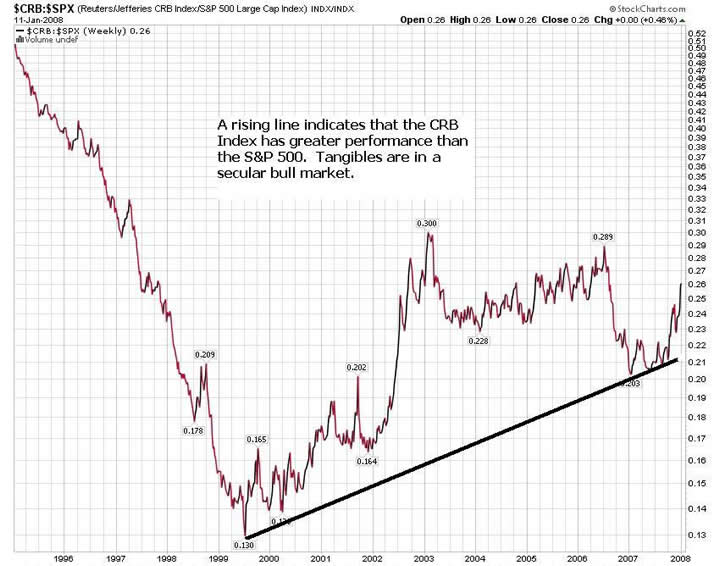
The rebirth of the secular bull market of commodities beginning in 2000 can be mainly contributed, first to the cresting and eventual decline of the U.S. dollar and second, the mounting economic expansion of China and India. Combined, these two forces have propelled raw material prices into a long-term uptrend.
The current extended rise in natural resources is best measured against a broad equity market. In Chart 1, the Commodity Research Bureau Index (CRB) and the S&P 500 are compared for performance over the past 12 years. During most of the 1980s and all of the 1990s, paper-based equities (S&P 500) greatly outperformed raw materials (CRB).

Bottom line: Bull markets in commodities historically run for 14 to 21 years. As this market has started in 2000, upward growth can be expected for another six years or more.
Investment approach: As the secular bull market in commodities shows no indications of weakening and long-term performance still favours raw materials over the S&P 500, growth portfolios should continue to be overweighted in tangibles and underweighted in paper-based industries.
Base Metals Stockpiles & Prices 3 |
"Now the reason I mentioned earlier that most base metals were running tight inverse correlations with their LME stockpile levels is because not all of them are currently doing so. And zinc is one base metal that is exhibiting some peculiar behavior.
Zinc’s major upleg lagged copper’s a bit in that its initial large LME stockpile draw remained on a linear descent through the end of 2006. But this also led to zinc outperforming copper in the second half of 2006 as it didn’t hit its apex until the end of November.
And 2006 was an incredible year for zinc. After rising 64% in 2005, it soared another 142% in 2006. This was of course on the heels of zinc stockpiles that were just obliterated, falling 78% on the year alone. The inverse correlation worked beautifully in 2006.
But 2007 has certainly been a different story. Looking at what the price of zinc has done in 2007 you would think LME stockpile levels were soaring. But this is hardly the case. Now when zinc stockpiles leveled in December 2006 it makes sense that some of the speculative risk premium built into its lofty price would be shed. And this is what we saw. It then also makes sense that when stockpile levels started to fall once again in April 2007 that zinc would rally.
But this rally only lasted for one month before zinc gave up its ghost and started falling to the levels we see today. This has been quite odd price behavior as there never really was a sizeable build in stockpile levels since the flattening one year ago. In fact, from April 2007 to the end of October 2007 LME zinc stockpiles fell another 48% to record lows! At only about 60k metric tons, the markets were faced with the equivalent of only two days of daily global consumption.
And these disturbingly-low stockpile levels don’t seem to phase the zinc market one bit. I honestly cannot figure out why. From a technical perspective we do see a classic head-and-shoulders pattern in this chart. And this type of pattern is typically bearish, usually leading to a trend-reversal pattern. A technician would look at zinc’s price chart and not be surprised to see it decisively break its neckline. But in my experience fundamentals often trump technical noise. Not so with zinc.
But like copper we need to look at zinc in a strategic context. Zinc is still 214% above its 2003 low of $0.34. As for LME zinc stockpile levels, as recent as 2004 they were nearly 800k metric tons! Still below 100k today, they are vastly lower than just a few short years ago. Ultimately I am long-term bullish on zinc, but I am a little worried about its near-term price if there is a big build in its stockpile levels. We’ll have to wait and see."
SourceWednesday, January 16, 2008
TSX slammed again a triple-digit drop for a second session
Market News: After the Bell
TSX slammed again
RTGAM
The Toronto stock market was slammed with a triple-digit drop for a second session Wednesday as investors sold off energy and mining stocks on worries about the degree that demand for commodities will suffer in an economic downturn.
The S&P/TSX composite index closed off the lows of the day, losing 241.92 points to 13,074.86 after losing more than 300 points at one point during the morning.
"We know the stuff is bad, there is likely more to come and it ain't going to be pretty - it's going to be ugly in fact," said Adrian Mastracci, portfolio manager at KCM Wealth Management in Vancouver.
The loss is the latest in a long string of declines this month that have left the TSX just 166 points away from where it started 2007.
The energy sector led the losses, falling 2.88 per cent as oil prices continued to register steep declines.
The February crude contract on the New York mercantile Exchange fell $1.06 (U.S.) to $90.84 a barrel after the U.S. government said crude oil supplies jumped unexpectedly last week.
The gold sector was down 3.55 per cent as the February bullion contract in New York fell $20.60 to $882 on a strengthening U.S. dollar.
The TSX Venture Exchange was down 45.61 points to 2,724.21.
The Canadian dollar was also a casualty of the volatility on equity markets, moving down 0.77 of a cent to 97.6 cents.
New York indexes settled down following steep losses Tuesday even as investors dealt with earnings disappointments from investment bank JPMorgan Chase and chip giant Intel.
They also took in a reading from the Federal Reserve confirming that damage from the contracting housing sector and the credit crisis are making consumers and businesses more cautious.
The Dow Jones industrials slipped 34.95 points to 12,466.16. The Nasdaq composite dropped 23 points to 2,394.59 while the S&P 500 index edged 7.75 points lower to 1,373.2. The Canadian Press
Copyright 2001 The Globe and Mail
"Keep your emotions out of it. It is going to be a bumpy ride."
Tom Yew
Rita Trichur
Business Reporters
Just hang on.
If yesterday's steep stock market slide wasn't quite steep enough for you, there's likely more where that came from, veteran market watchers say.
The market gyrations are just part of investors coming to grips with the sour notion that growth in the behemoth U.S. economy is tapering off.
The latest bit of bad news came yesterday with figures from the U.S. commerce department showing that retail sales fell 0.4 per cent in December – the biggest decline in six months and far below the 0.1 per cent growth that economists had been crossing their fingers for.
Evidence that U.S. shoppers may finally be running out of steam – consumer spending accounts for two-thirds of the economy – came as Wall Street giant Citigroup Inc. became the latest to announce huge losses for the quarter along with a massive writedown to deal with bad subprime mortgage investments.
Brace yourself for more today: Adrian Mastracci, a portfolio manager at KCM Wealth Management Inc. in Vancouver, said he expects more market turbulence because of Intel's earnings announcement, which came after markets closed yesterday.
The semiconductor company's latest quarterly profit rose 51 per cent to $2.3 billion (U.S.) but the results missed Wall Street's expectations.
Following the announcement, Intel shares fell more than 14 per cent during after-hours trading.
"The economics in the U.S. are obviously changing for the worst. The earnings expectations are being reduced as we see the economy stumble here," said Aron Gampel, deputy chief economist at Scotiabank.
In Toronto yesterday, the S&P/TSX composite index lost 381.50 points to end the day at 13,316.78. That's a decline of 2.79 per cent on the day – one of the worst one-day losses ever for the premier Canadian market.
In New York, the blue-chip Dow Jones industrial average closed at 12,501.11, down 277.04 points, or 2.17 per cent.
The market has digested a lot of bad news in recent days, leaving investors rattled, said Irwin Michael, a portfolio manager at ABC Funds.
"A lot that goes on in the market now has nothing to do with fundamental analysis. It is strictly psychological," he said. "The more the market goes down, the more people think it is going to go down. It is like a dog chasing its tail."
Faced with America's deepening subprime crisis and lingering uncertainties surrounding this country's market for non-bank asset-backed commercial paper, people are finding it hard to resist the compulsion to panic, he said. The current chill is the flip side to the "white heat" that overtook markets during the first half of last year.
"Now you are facing the other side of the coin," Michael said. "They are just selling willy-nilly, just to get out."
In Toronto, big bank stocks – particularly that of the Canadian Imperial Bank of Commerce – pulled the benchmark index lower. CIBC shares were down $2.07 (Canadian) to $70 on the announcement the bank will sell shares to raise $2.75 billion to shore up its balance sheet.
"Investors have really rediscovered flying away from risk," Mastracci said. "But the reality is it's the risk part that ultimately delivers a return." Panicky investors, he said, ought to take a longer-term approach instead of bailing out of the market completely, because key indexes will eventually rebound.
"Keep your emotions out of it. It is going to be a bumpy ride."
Breakwater and Virginia Provide Further Drill Results on Coulon JV Project
ccnm
TORONTO, ONTARIO--(Marketwire - Jan. 16, 2008) - Breakwater Resources Ltd. (TSX:BWR) and Virginia Mines Inc. report on the last results of their 2007 drilling program on the Coulon JV property (Breakwater 50% - Virginia 50%), located 15km north of the Fontanges airport, Quebec middle-north.
The exploration program that ended mid-December 2007 also included a VTEM heliborne survey as well as borehole InfiniTEM surveys. The 18 new holes tested lenses 44 (7 holes), 43 (7 holes), 9-25 and 08 (1 hole) as well as other geological and geophysical targets (3 holes). In addition, 4 old holes were extended to test lenses 08 and 43.
LENS 9-25 EXTENDED BY 50m TOWARDS THE NORTH WITH 4.05% Zn, 7.68% Cu AND 118.7 g/t Ag / 3.6m AND 3.14% Zn, 1.15% Cu AND 17.03 g/t Ag / 4.75m
Drilling resumed recently on lens 9-25 and a new hole was completed in December 2007 (longitudinal 9-25). Hole CN-07-123 confirmed the extension of the mineralization at depth towards the north with two massive to semi-massive sulphide zones, which yielded values of 4.05% Zn, 7.68% Cu and 118.7g/t Ag over 3.6m and 3.14% Zn, 1.15% Cu and 17.03 g/t Ag over 4.75m. These two closely spaced intersections are located at a vertical depth of 530m and extend the known limit of lens 9-25 towards the north by 50m.
Lens 9-25 is in general north-south oriented and is steeply dipping (85 degrees) towards the west. It is now confirmed over more than 200m laterally and over nearly 400m vertically. It remains open at depth and will be tested by several additional drill holes in the winter of 2008.
LENS 08 BLOSSOMS AT DEPTH WITH VALUES OF 2.87% Zn, 1.22% Cu AND 27.61 g/t Ag / 20.15m AND 2.25% Zn, 1.92% Cu AND 41.13 g/t Ag / 13.5m
In December 2007, three holes testing the extension of lens 08 at depth yielded very encouraging results (longitudinal 44/08). Holes CN-07-53B and CN-07-67, drilled in the summer of 2007 to test lens 9-25, were extended recently to crosscut the geological contact corresponding to lens 08 at depth. Hole CN-07-53B intercepted a thick massive sulphide zone that graded 2.87% Zn, 1.22% Cu and 27.61 g/t Ag over 20.15m, including a richer section grading 5.08% Zn, 1.25% Cu and 25.59 g/t Ag over 8m. This massive sulphide zone is followed a little further down the hole by another thick zone of semi-massive to disseminated sulphides grading 1.23% Zn, 0.9% Cu and 12.65 g/t Ag over 19m. These two large mineralized intervals correspond to the extension of lens 08, to a vertical depth of 475m. On the same section, hole CN-07-67 was also lengthened for the same reasons and it intercepted a massive sulphide zone grading 2.25% Zn, 1.92% Cu and 41.13 g/t Ag over 13.5m, to a vertical depth of 660m. On another section located 150 m further north, the new hole CN-07-123 drilled in December to test lens 9-25, also reached the contact hosting lens 08 where it intercepted a semi-massive sulphide zone that yielded 1.25% Zn, 1.76% Cu and 65.45 g/t Ag over 4.3m. This mineralized intersection is located at a vertical depth of over 700 m, which is, as of now, the deepest intersection in lens 08.
Lens 08 is located directly to the west of lens 9-25 and is parallel to it. It has a north-south general direction and is dipping subvertically to steeply to the east. Near the surface, both lenses are 150 to 200m apart but because of their opposite dip, both mineralized zones are closer at depth. Results obtained from recent drilling extend the mineralization by over 300m vertically and confirm that lens 08 becomes more important at depth where it remains open. Additional drilling will be carried out in the winter of 2008.
LENS 44 YIELDS OTHER GOOD RESULTS
Seven new holes tested lens 44 in the recent period (longitudinal 44/08). Best results were obtained with holes CN-07-126 and CN-07-127, which tested the south extension of lens 44 to a vertical depth of 230m. Hole CN-07-127 intercepted a thick massive sulphide zone grading 2.22% Zn, 1.16% Cu and 19.66 g/t Ag over 13.53m. Hole CN-07-126, located 60m further south, also intercepted a massive sulphide zone that yielded values of 2.73% Zn, 1.58% Cu and 18.1 g/t Ag over 5.05m. The other five holes tested the north extension of lens 44. Hole CN-07-116 intersected a semi-massive to massive sulphide zone to a vertical depth of over 300m that graded 2.89% Zn, 1.01% Cu and 17 g/t Ag over 6m. On another section located 75m further north, holes CN-07-112, CN-07-118 and CN-07-122 intercepted massive to semi-massive sulphide zones, in metric thicknesses, which returned values of up to 6.41% Zn, 0.7% Cu and 40.89 g/t Ag over 1.65m. These intersections are located at vertical depths of 350m to 600m. Finally, hole CN-07-125 was drilled on a section located 150 m further north in order to test at depth (550m) the area between lenses 44 and 08. This hole did not intercept significant mineralization but the borehole InfiniTEM survey conducted subsequently detected a good off-hole conductor that will be modeled in order to identify its exact position.
Lens 44 is north-south oriented and is dipping vertically to steeply to the west. It is now confirmed over a lateral distance of 400m and to a vertical depth of 600m. Lens 44 remains open at depth and will be the object of additional drilling in 2008.
LENS 43 RETURNS SEVERAL HIGH GRADE, THIN INTERSECTIONS
Seven new holes were drilled and two old ones (CN-07-43 and CN-07-59) were deepened to test lens 43 (longitudinal section 43). Overall, these holes intersected intense alteration zones hosting, in many cases, thin massive to semi-massive sulphide zones sometimes very rich in base metals. Best results include 2.99% Zn, 21.5% Cu, 140 g/t Ag over 0.4m and 3.29% Zn, 9.69% Cu, 67.8 g/t Ag over 0.5m (hole CN-07-107C), 3.26% Zn, 0.17% Cu and 13.35 g/t Ag over 2.2m (hole CN-07-111) and 0.78% Zn, 4.27% Cu and 61.7 g/t Ag over 2m (hole CN-07-115).
Despite a lack of wide intersections, recent drilling better defined the geology of the area. Lens 43 seems to be folded and many of the holes testing its NE portion intercepted two distinct alteration and mineralization zones that represent, according to our current knowledge, the same mineralized horizon on both sides of the fold. The axial plan of this fold seems to be NE-SW oriented with a variable dip towards the NW. For now, all mineralized intersections of lens 43 are reported on the same longitudinal section while awaiting a more detailed geological interpretation.
In 2008 Lens 43 will be the object of several additional holes, more particularly in its SW extension, which will be accessible from the surface of a frozen lake.
OTHER TARGETS
Three holes were drilled outside the areas of the known mineralized lenses. Hole CN-07-110 tested the fertile volcanic sequence approximately 250m north of lens 9-25. It intercepted an alteration zone with disseminated sulphides including a small, centimetric sphalerite horizon. The borehole InfiniTEM survey carried out subsequently indicates a probable extension of the alteration and mineralization zone towards the south.
Holes CN-07-113 and CN-07-117 tested the InfiniTEM anomalies situated in the area of the Tension showing, located SW of lens 43. In both cases, the target was missed but borehole InfiniTEM surveys indicate the proximity of good off-hole conductors. Additional drilling is planned in 2008 as a follow-up to these three holes that yielded interesting results.
VTEM HELIBORNE SURVEY
A VTEM heliborne geophysical survey of more than 6000 linear kilometres was recently completed on the Coulon JV project. This survey identified a great number of new EM conductors of which many are directly located in the immediate extensions of the fertile Coulon volcanic belt. The VTEM anomalies, associated with the most promising geological settings, will be the object of ground geophysics at the beginning of the winter of 2008 and will then be drill tested.
Both Breakwater and Virginia are encouraged by the recent results obtained and most generally by the important progress made on the Coulon JV project in the course of year 2007. In order to keep up with its momentum, Breakwater and Virginia will spend over C$20 million on the project in 2008. This budget will finance an important drilling program that will commence in February 2008 and will continue throughout the year, jointly with ground geophysical surveys, prospecting and geological mapping.
New drill results are reported in the annexed table. All samples have been analyzed at the certified laboratory ALS Chemex in Val-d'Or.
------------------------------
Hole Line Length
Forage Ligne Station Azimut Dip Longueur
------------------------------
GRILLE PRINCIPALE/ MAIN GRID
------------------------------
Lens 9-25 Lentille
------------------------------
CN-07-123 20+25N 14+20E N267 -62 864
------------------------------
Lens 08 Lentille
------------------------------
CN-07-053B 18+25N 13+74E N268 -56 707
------------------------------
CN-07-123 20+25N 14+20E N267 -62 864
------------------------------
CN-07-067 19+00N 14+80E N264 -62 906
------------------------------
Lens 44 Lentille
------------------------------
CN-07-112 15+40N 7+20E N084 -59 740
------------------------------
CN-07-116 14+75N 8+80E N088 -58 462
------------------------------
CN-07-118 15+45N 8+20E N084 -55 630
------------------------------
CN-07-122 15+40N 6+60E N081 -60 810
------------------------------
CN-07-125 16+50N 6+88E N080 -60 869
------------------------------
CN-07-126 11+50N 9+75E N088 -62 360
------------------------------
CN-07-127 12+25N 9+42E N087 -56 366
------------------------------
Lens 43 Lentille
------------------------------
CN-06-043 7+50N 1+00W N135 -55 447
------------------------------
CN-07-059 7+12N 1+34W N135 -55 474
------------------------------
CN-07-107C 6+69N 3+86W N125 -61 498
------------------------------
CN-07-111 7+50N 3+50W N121 -61 572
------------------------------
CN-07-114 7+50N 3+50W N134 -63 534
------------------------------
CN-07-115 8+35N 1+83W N135 -59 550
------------------------------
CN-07-119 7+78N 2+72W N131 -57 453
------------------------------
CN-07-121 7+89N 0+38W N134 -56 405
------------------------------
CN-07-124 7+23N 2+18W N134 -57 321
------------------------------
Regional Targets / Cibles Regionales
------------------------------
CN-07-110 23+50N 10+20E N230 -50 309
------------------------------
CN-07-113 11+60S 19+20W N120 -50 552
------------------------------
CN-07-117 25+25S 23+50W N330 -50 258
------------------------------
------------------------------
Hole From To Length Thickness Cu Zn Pb Ag Au
Forage De A Long- Epaisseur % % % g/t g/t
ueur vraie
------------------------------
GRILLE PRINCIPALE/ MAIN GRID
------------------------------
Lens 9-25 Lentille
------------------------------
605.60 609.20 3.60 2.16 7.68 4.05 0.01 118.70 0.24
------------------------------
CN-07-123
------------------------------
614.90 619.65 4.75 2.85 1.15 3.14 0.01 17.03 0.11
------------------------------
Lens 08 Lentille
------------------------------
574.60 594.75 20.15 12.25 1.22 2.87 0.14 27.61 0.24
------------------------------
inc.
578.60 586.60 8.00 4.86 1.25 5.08 0.23 25.59 0.27
CN-07-053B ------------------------------
634.00 653.00 19.00 13.5 0.90 1.23 0.02 12.95 0.13
------------------------------
inc.
643.30 653.00 9.70 6.9 0.87 2.15 0.02 14.11 0.14
------------------------------
CN-07-123 819.45 823.75 4.30 2.50 1.76 1.25 0.02 65.45 0.21
------------------------------
CN-07-067 810.50 824.00 13.50 9.75 1.92 2.25 0.21 41.13 0.43
------------------------------
Lens 44 Lentille
------------------------------
CN-07-112 647.00 648.65 1.65 1.10 0.70 6.41 0.54 40.89 0.09
------------------------------
CN-07-116 366.50 372.50 6.00 4.60 1.01 2.89 0.02 17.00 0.12
------------------------------
CN-07-118 475.60 476.10 0.50 0.35 1.01 0.64 0.03 14.70 0.71
------------------------------
477.70 478.75 1.05 0.70 1.41 0.76 0.06 17.40 0.40
------------------------------
CN-07-122 770.55 771.1 0.55 0.45 0.45 1.27 0.04 20.00 0.23
------------------------------
CN-07-125 NSA
------------------------------
CN-07-126 255.90 260.95 5.05 4.60 1.58 2.73 0.01 18.10 0.10
------------------------------
CN-07-127 271.97 285.50 13.53 11.00 1.16 2.22 0.02 19.66 0.19
------------------------------
inc.
271.97 278.80 6.83 5.55 1.40 3.37 0.02 22.74 0.25
------------------------------
Lens 43 Lentille
------------------------------
CN-06-043 351.35 352.30 0.95 0.90 1.21 0.22 0.01 20.40 0.08
------------------------------
360.00 362.35 2.35 2.25 0.11 1.87 0.62 55.83 0.11
------------------------------
416.90 417.75 0.85 0.80 0.02 1.87 0.00 1.40 0.01
------------------------------
CN-07-059 NSV / PVS
------------------------------
CN-07-107C 415.60 416.00 0.40 0.40 21.50 2.99 0.01 140.00 0.34
------------------------------
420.90 421.40 0.50 0.50 9.69 3.29 0.01 67.80 0.96
------------------------------
CN-07-111 436.00 438.20 2.20 2.10 0.17 3.26 0.08 13.35 0.05
------------------------------
CN-07-114 NSV / PVS
------------------------------
CN-07-115 443.70 445.70 2.00 2.00 4.27 0.78 0.01 61.70 1.40
------------------------------
CN-07-119 NSV / PVS
------------------------------
CN-07-121 NSV / PVS
------------------------------
CN-07-124 278.30 279.10 0.80 0.65 0.37 2.90 0.03 6.60 0.03
------------------------------
Regional Targets / Cibles Regionales
------------------------------
CN-07-110 NSV / PVS
------------------------------
CN-07-113 NSV / PVS
------------------------------
CN-07-117 NSV / PVS
------------------------------
NSV: no significant value
PVS : pas de valeur significative
Work is carried out by the personnel of Virginia Mines Inc, under the supervision of Mr. Paul Archer, geological engineer. Mr. Archer is a Qualified Person (as defined by National Instrument 43-101) and has more than 25 years of experience in exploration. Mr. Archer reviewed and approved the content of this press release.
FOR FURTHER INFORMATION PLEASE CONTACT:
Breakwater Resources Ltd.
Ann Wilkinson
Vice President, Investor Relations
(416) 363-4798 Ext. 277
Tuesday, January 15, 2008
BWR+ Kaminak News
Kaminak Commences Airborne Geophysical Surveys on Quebec Nickel Properties
ccnm
VANCOUVER, BRITISH COLUMBIA--(Marketwire - Jan. 15, 2008) - Kaminak Gold Corporation (TSX VENTURE:KAM) has commenced high-definition airborne geophysical surveys over priority nickel-copper-platinum group element (PGE) targets in Quebec, Canada. Kaminak intends to survey a total of 4,050 line kilometres over five separate properties. This program is being funded solely by Kaminak's joint venture partner Breakwater Resources Ltd. (TSX:BWR).
Aeroquest International Limited will complete the surveys using their AeroTem II electromagnetic helicopter-borne system. This high-definition time-domain system is designed to identify conductive bodies, including nickel sulphide deposits to a depth of 250 metres in electrically resistive environments. All interesting anomalies will be followed-up by detailed ground geophysical surveys in the spring of 2008 in order to prioritize diamond drill targets.
Initial field work on the properties by Kaminak's technical team in 2007 identified mafic ultramafic rocks exhibiting magmatic sulphide segregation. A total of 12 grab samples were collected for geochemical analyses and the program's most significant assay result came from a surface outcrop sample that yielded anomalous values of nickel, copper, cobalt as well as PGE's and gold (Sample# CFP-605; 0.53% Ni, 2.84% Cu, 0.12% Co as well as 0.75 g/t Au, 0.35 g/t Pt and 0.55 g/t Pd). Additionally, nine of the eleven remaining grab samples each assayed greater than 0.1% Ni and greater than 0.1% Cu. Collectively, these are important indicators of process and suggest a favourable environment for the formation of nickel-copper-PGE deposits.
Kaminak - Breakwater Agreement
In the spring of 2007, Kaminak and Breakwater entered into a strategic alliance targeting primarily nickel-copper-PGE deposits over parts of southern Quebec. Kaminak's in-house technical team generated several priority targets which resulted in the staking of five separate properties which became subject to a joint venture agreement between Kaminak and Breakwater. As part of this joint venture agreement, Breakwater is funding the first $1 million of exploration costs in exchange for a 51% interest in the project. Breakwater can increase its interest to 60% by funding the next $2 million in exploration across all joint venture blocks (see Kaminak news release dated September 10th, 2007 for further details of the joint venture agreement).
ALS Chemex Analytical Technique
A total of 12 grab samples were collected and shipped to ALS Chemex for geochemical analyses. Rock samples are weighed, dried and finely crushed with a split of up to 250 g pulverized. The prepared sample is subjected to four acid digestion (0.4g is digested with nitric, perchloric, and hydrofluoric acids with hydrochloric acid subsequently added for further digestion. This solution is analyzed by inductively coupled plasma - atomic emission spectrometry. Results are corrected for spectral inter element interferences. QA/QC consists of the insertion of one method blank, two standards and one duplicate sample. Gold and PGE's were analysed by fire assay with an ICP-MS finish.
Kaminak's disclosure of a technical or scientific nature is prepared under the supervision of Rob Carpenter, Ph. D., P.Geo., Kaminak's President and CEO. Craig Finnigan, Ph. D., P.Geo. is Kaminak's Chief Geologist and is the Qualified Person under the definition of National Instrument 43-101.
About Kaminak
Kaminak Gold Corporation is a prospect generator employing a joint venture strategy that maximizes opportunities for discovery while attempting to minimize exploration risk to Kaminak. A critical component of Kaminak's business model is working with strong project partners to advance Kaminak's exploration projects. Covering several million acres, Kaminak holds one of the largest land positions in Canada devoted to metallic mineral exploration. Kaminak's projects offer world-class exploration potential and present exposure to strategic commodities including, gold, uranium and nickel.
On behalf of the Board of Directors
Rob Carpenter, Ph. D., P. Geo., President and CEO
Kaminak Gold Corporation
Petrolifera confirms activation of Puesto Morales North waterflood
Petrolifera confirms activation of Puesto Morales North waterflood; Provides salient details
cnw
CALGARY, Jan. 15 /CNW/ - Petrolifera Petroleum Limited (PDP - TSX) confirmed today that its waterflood pressure maintenance project at Puesto Morales North in the Neuquen Basin, Rio Negro Province, onshore Argentina commenced continuous operations on January 11, 2008, following a period of commissioning and line testing which started in late December, 2007.
The purpose of the project is to enhance reservoir pressure in the prolific and high quality Jurassic Sierras Blancas oil-bearing reservoir at Puesto Morales. It is anticipated that there will be a period of approximately six months of water injection before meaningful response will be discernible in overall crude oil production levels and that it will take approximately eighteen months from startup of injection to achieve optimum production response, based on initial simulation studies of the reservoir. The high quality reservoir, characterized by excellent porosities and significant measured permeability, should facilitate excellent transmissibility of fluid and the project is expected to have a material and favorable impact on the ultimate recovery factor for the field.
The first injection stage in the Sierras Blancas formation will occur in 2008 and is expected to reach a total water injection rate of 18,000 barrels of water per day with approximately thirteen injector wells, including new wells and conversions. Future waterflood developments and optimizations will increase the injection rate to the capacity of 25,000 barrels of water per day.
The water injection plant is now operating with initial injection of approximately 5,000 barrels of water per day in four wells, PMN-1025, PMN-1011 and PMN-1037 in the northern part of the field and PMN-1035 in the central portion of the field. Over time, additional injectors will be tied back to the plant to realize the final injection rate of approximately 25,000 barrels of water per day. Fresh water is supplied to Petrolifera's water treatment plant, situated in the northern portion of the field, through a six kilometer ten-inch pipeline from facilities situated near the Casa de Piedra dam on the Rio Colorado River, resulting in the reservoir or embalse in the region.
Petrolifera's Puesto Morales water treatment plant filters the water with a targeted efficiency exceeding 90 percent on particle sizes exceeding five microns. Also, a target of 90 percent efficiency in oxygen removal is anticipated.
The activation of the water injection plant is a significant milestone for Petrolifera. It was constructed against a backdrop of energy and equipment shortages in Argentina and its completion is a credit to the company's operational staff and external advisors and consultants. More importantly, it is anticipated the waterflood will consequentially impact on Petrolifera's light crude oil production in Argentina during 2008 and beyond.
Corridor Reverts to Over-Balanced Drilling to Complete McCully E-67 Deep Test
Jan 14, 2008 08:30 ET
HALIFAX, NOVA SCOTIA--(Marketwire - Jan. 14, 2008) - Corridor Resources Inc. (TSX:CDH) reported today that under-balanced drilling operations at the McCully E-67 well have been terminated in favour of completing the drilling of the well using a conventional over-balanced drilling fluid. While drilling with an under-balanced drilling fluid, the E-67 well encountered a section of highly fractured and faulted shale in the upper 150 m of the Frederick Brook formation at a depth of approximately 2630 meters. Following two failed attempts to drill through the highly fractured shale section, it was concluded that the instability of the well-bore would prevent further deepening of the well using an under-balanced drilling process. Only minor gas flow was recorded while drilling under-balanced through the fractured Frederick Brook section, indicating that the fractured shale was incapable of significant rates of gas production in this well. Corridor has plugged back the well with cement into the shoe of the 9-5/8" casing and has reverted to an over-balanced mud system in an attempt to drill through the unstable hole section in the upper Frederick Brook shale formation. Corridor's objective is to penetrate and evaluate the deeper dolomitic shale section encountered in the Frederick Brook formation near the bottom of the F-58 well where higher formation pressures and significant gas shows were encountered in early February, 2007. Corridor also plans to drill the E-67 well to a total depth of approximately 4500 meters in an attempt to reach and evaluate the sandstone reservoirs of the Dawson Settlement formation. Results from an evaluation of this deeper section of the E-67 well are expected to be available towards the end of February, 2008. Potash Corporation of Saskatchewan is a joint venture partner with Corridor in the E-67 well.
Other Activities
Corridor is currently drilling the McCully K-48 well (please refer to the map below) and has just set the 9-5/8" intermediate casing at a depth of 1548 m. Corridor plans to drill and evaluate the Hiram Brook formation at this location, with results expected to be available in February, 2008.
The map of "McCully Drilling Program" is available at the following address: http://www.ccnmatthews.com/docs/map_corridor.jpg
Gross McCully natural gas production for the month of December averaged approximately 30 mmcf/day (20 mmcf/day net to Corridor).
An additional update, including frac and flow test results for wells at McCully and New Harmony (PEI), will be provided later this month, as well the 2008 drilling plans, production forecast and operating budget.
Retirement
Corridor also announced today the retirement of Paul J. Hopkins as Vice President and a director of the Corporation, effective January 18, 2008. Paul is one of the founders of the Corporation and has made considerable contributions to its growth and development. The Board of Directors expresses gratitude to Paul for his contributions, and extends best wishes for his retirement.
The strategic hiring of key managers over the past two years has ensured an effective transition of operational management. Larry Huskins will continue to be responsible for the implementation of the Corporation's drilling and well completion operations and Doug Bailey will continue to manage all of the Corporation's field construction and production operations in New Brunswick. Dena Murphy will continue to manage all of the Corporation's matters relating to health, safety and the environment.
Corridor Resources Inc. is a Halifax, Nova Scotia based company focused on exploring and developing natural gas resources in the McCully Field and surrounding areas of southern New Brunswick. The Company has completed construction of a field gathering system, a gas plant, and a pipeline lateral connecting the McCully Field to markets through the Maritimes & Northeast Pipeline (M&NP). The Company initiated natural gas production to M&NP on June 28, 2007 and has a continuous development drilling program underway to add reserves and production capacity as field development expands. Corridor also has a number of potentially high impact exploration projects planned in New Brunswick and elsewhere in eastern Canada.
For more information, please contact
Corridor Resources IncNorman W. Miller, President
902-429-4511
902-429-0209 (FAX)
www.corridor.ca
Monday, January 14, 2008
TSX Today + BWR TA Chart
Gold and oil trigger TSX gains
RTGAM
Higher gold and oil prices boosted Canada's benchmark equity index Monday while U.S. stocks got a lift from International Business Machines Corp.'s earnings.
The S&P/TSX composite index added 65.71 points to 13,698.28. Energy, mining and gold stocks were the among the biggest gainers on Monday, while financials lost ground.
Crude oil for February delivery jumped $1.51 (U.S.) to close at $94.20 a barrel on the New York Mercantile Exchange. Bullion futures climbed $5.70 to $903.40 an ounce after touching a record high $915.90 an ounce earlier in the session.
Among individual stocks, Yamana Gold Inc. and Barrick Gold Corp. logged strong performances, as did Potash Corp. and Research in Motion Ltd.
On Wall Street, indexes recovered from last week's losses. After falling nearly 250 points on Friday, the Dow Jones rose more than 170 points Monday to close at 12,778.15.
In the broader U.S. market, the Nasdaq added 38.36 points while the S&P 500 rose 15.23 points.
IBM provided the lift south of the border, rising the most in five years after releasing fourth-quarter preliminary earnings that were 24 per cent higher than a year ago. They also topped analyst targets.
The results triggered some hope that earnings season, which has just kicked off, will not be as bad as some fear. Citigroup Inc. is slated to release its financial results on Tuesday, followed by Merrill Lynch & Co. on Thursday.
National Bank Financial economist Stefane Marion said analysts are calling for a consensus 8.5 per cent contraction in fourth-quarter S&P 500 earnings, a sharp change from the 10.2 per cent increase that was forecast at the start of the quarter on Oct. 4th.
"Looking ahead, however, the consensus remains very optimistic on the prospects for a sharp rebound in earnings growth...during calendar 2008," Mr. Marion wrote in a note Monday. "Needless to say, current profit expectations are still far from integrating a sharp economic slowdown."
Copyright 2001 The Globe and Mail


Petrolifera Petroleum provides activity update
cnw
CALGARY, Jan. 14 /CNW/ - Petrolifera Petroleum Limited (PDP - TSX) hereby provides an update on the company's activity during calendar 2007.
Petrolifera had a productive if somewhat challenging year in 2007. The company drilled at total of 47 wells, all on its Puesto Morales/Rinconada Concession in the Neuquen Basin, Argentina, during the year. This drilling resulted in 33 oil wells, two natural gas wells, three water injector wells, two dry holes, four non-productive or suspended wells and three wells were being completed at year end.
At Puesto Morales, a total of 35 wells were drilled, resulting in 25 oil wells, two natural gas wells, three water injector wells, two dry holes, one suspended well and two wells were on completion at year end. At Rinconada, a total of twelve wells were drilled, resulting in eight oil wells, three non-productive or suspended wells and one well was being completed at year end. This brings to over 60 the number of wells drilled on the Concession since first drilling was initiated in late 2005.
A major undertaking during 2007 was the design, construction and activation of the company's infrastructure and production facilities. This included gathering lines, water treatment facilities, water disposal facilities, a high pressure natural gas pipeline and initiation of a waterflood at Puesto Morales North. The timetable for these projects was frustrated during the year by energy shortages in Argentina, especially during their winter months, which delayed access to requisite parts and equipment for the various component parts needed by Petrolifera to activate its pressure maintenance program. There were also delays encountered in securing pumps and certain high pressure valves for the company's natural gas pipeline and related facilities.
Petrolifera's sales grew considerably during 2007. All sales were of production in Argentina. Crude oil sales increased 45 percent over 2006 levels, to average 8,657 barrels per day. Much of the improvement occurred during the early part of the year, when flush production from new Sierras Blancas discoveries at Puesto Morales contributed to record quarterly sales, cash flow from operations before changes in working capital and near-record earnings. Subsequently, production curtailments for natural gas conservation purposes, water incursion at a key high productivity well (1013), pressure depletion awaiting the waterflood and delays and equipment shortages affected production levels.
Natural gas sales were stronger at modestly better prices during 2007, awaiting the startup of the waterflood and completion of the company's high pressure natural gas pipeline to Medanito. Sales rose 97 percent to average 2.3 mmcf/d in 2007.
On an equivalent basis, Petrolifera's 2007 sales rose 47 percent to average 9,047 boe/d compared to only 6,171 boe/d in 2006, the company's first full year of operations. Again, full year results were reflective of the influence of oil production declines during the year, awaiting activation of the company's pressure maintenance scheme which is now underway. Fourth quarter sales were 7,042 boe/d, slightly below third quarter for similar reasons. During November, production was curtailed due to field activities associated with the startup of certain key facilities, pump installations and the like, well in excess of the impact of natural declines. This was evidenced by the fact that December sales exceeded November levels by 23 percent and early January 2008 levels were even higher.
Petrolifera expects robust growth in production and sales in 2008 as increased natural gas volumes are marketed at improved average prices and as new drilling and the impact of the company's recently activated pressure maintenance or waterflood program at Puesto Morales is felt. Also, the company is optimistic about the risk adjusted potential of its planned exploration program in Argentina during the current year as it continues to evaluate new Jurassic Sierras Blancas and Loma Montosa prospects at Puesto Morales as well as Cretaceous Centenario opportunities on its Puesto Morales block as well as at its Gobernador Ayala II concession, on which a 3D seismic program was recently completed. This latter block lies just east of and on trend with an area being developed by another Canadian company.
Petrolifera has already announced a 69 well, $76 million capital budget for Argentina during 2008. This planned program will include extensive drilling at Puesto Morales/Rinconada, seismic and drilling on Vaca Mahuida, drilling on the Gobernador Ayala II concession and 3D seismic and drilling on the recently confirmed Puesto Guevara Concession in Rio Negro Province, Argentina. Petrolifera now owns 493,310 net acres of oil and gas rights in Argentina, the equivalent of 21 townships in Western Canada. The total does not include any interest which Petrolifera may ultimately hold in the Salinas Grande concession in La Pampa Province. Currently, the company is operating with three rigs and four service rigs.
The company's Argentinean budget will continue to be evaluated in the context of the actual outcome of exploratory drilling results and the evolving policy framework for the country. Recently announced price controls for crude oil and continuing control of natural gas prices below fair value will impact on anticipated cash flow, especially if refineries attempt to transfer imposed burdens on to producers. It is apparent that if increased deregulation was to occur, improved cash flow from operations before changes in working capital would likely result in higher levels of reinvestment in Argentina. Since Petrolifera commenced drilling operations in late 2005, the company has invested approximately $100 million in the country.
Plans are advancing for early drilling in Colombia. Petrolifera has identified three prospective drillable prospects on its Sierra Nevada I License in the Lower Magdalena Basin. Discussions to secure a drilling rig for a July/August commencement of activities are continuing. A seismic program is also anticipated in 2008 on the company's Turpial Block in the Upper Magdalena Basin. Staffing is underway and an office has been established in Bogota, Colombia. Petrolifera controls over one million acres of petroleum and natural gas rights in Colombia, fast becoming one of the exploration hotspots in South America for the oil and natural gas industry. An initial 2008 capital budget of $8 million has been established for Colombia; this may be expanded depending upon results and as mentioned, developments in Argentina, although regardless the company has the wherewithal to expand its Colombian budget as warranted by opportunities that develop.
Petrolifera's 2008 Peru capital budget has been established at $56 million, to cover the cost of extensive seismic programs on both Ucayali Block 107 and on Maranon Block 106 and for the drilling of the company's first well on Block 107. These are both jungle blocks with attendant high costs of exploration, including for access and when drilling, for helicopter support. Petrolifera's seismic program on Block 107 is proceeding very favorably, with 62 percent of lines cut at year-end 2007; 60 percent of shot holes have been drilled and 24 percent of lines have been shot. Early indications from received data are considered excellent and the company is proceeding with preparation of its Environmental Impact Assessment ("EIA") applications for a number of drilling locations. The data will be received, interpreted and reviewed for selection of the preferred prospects, which are anticipated to have considerable potential.
As with Colombia, discussions for a suitable heli-transportable rig are advancing to the contract negotiation stage, initially for a two-well commitment. Drilling is tentatively anticipated for approximately October 2008, subject to regulatory approval of the company's drilling EIA.
Petrolifera continues to await clarification with respect to its significant $37.7 million face value investment in Asset Backed Commercial Paper ("ABCP"). It will be recalled the company recorded a book impairment of this investment during the third quarter 2007 and recategorized the investment from a short term asset to long term on its balance sheet. We continue to seek ways to recover the full amount of our investment into what was rated as R-1 High by a recognized bond rating agency in Canada. Included in this process is a continuing dialogue with the chartered bank whose investment arm sold the investment to Petrolifera and awareness of the initiatives of the Montreal Accord. This has been a slow and arduous process with limited free flow of information. We will advise shareholders and the investment community of any developments directly affecting Petrolifera or its holdings to the extent we are apprised of same.
In the interim, Petrolifera has sufficient cash flow from operations before changes in working capital and access to available credit to be able to fund its capital program without undue difficulty. Obviously, the company would prefer to receive its funds from its ABCP on a timely basis to avoid accessing available credit arrangements for its activities, but fortunately is in a position where it does not have to compromise its growth programs as a consequence of the mid-2007 disappearance of liquidity for these short-term, highly-rated instruments.
In late January 2008 Petrolifera is hosting a visit by invitation of numerous Canadian investment analysts and some portfolio managers from Canada and the United States. These individuals will visit the company's facilities at Puesto Morales and will be provided insight into the opportunities and challenges facing the oil and gas industry in South America by a number of regional experts. Additionally, the company will be reviewing its assets and activities. Accordingly, in conjunction with this press release we will be posting an updated Investor Presentation on our website at www.petrolifera.ca. Click on the link Investor Info and then on Investor Presentations to access the January 2008 Power Point slides.
The company has commissioned GLJ Petroleum Consultants of Calgary, Alberta to prepare its year-end 2007 reserve report. This report is anticipated to be received during the month of February 2008 and will be released to the public after it has been reviewed by the company's Reserves Committee and accepted by its Board of Directors.
The company's audited financial and operating results are anticipated to be released to the public by way of press release on or about March 8, 2008.
In summary, Petrolifera made considerable progress in 2007. Crude oil sales were up 45 percent over 2006. Natural gas sales were up 97 percent over 2006. On an equivalent basis, sales were up 47 percent year over year to 9,047 boe/d, compared to sales of 6,171 boe/d in 2006. During 2007 Petrolifera drilled a record 47 wells in Argentina, resulting in 33 oil wells, two natural gas wells and three injectors, with only two dry holes (the first dry holes since activation of drilling in 2005), four suspended wells and three wells being completed at year end. Major expenditures were made during 2007 on field facilities including for water treatment and disposal, a waterflood or pressure maintenance facility and a high pressure natural gas pipeline to Medanito from Puesto Morales. Over $100 million of capital expenditures are anticipated for the full year. These investments are expected to result in restoration of the company's production and sales growth during 2008, aided by continued drilling activity in Argentina (including on new blocks at Gobernador Ayala II, Vaca Mahuida and Puesto Guevara) where the company controls over 493,000 net acres of petroleum and natural gas rights. Seismic and drilling is also anticipated in 2008 in Colombia and in Peru on what are anticipated to be high potential prospects. The company is financially self-sufficient with adequate cash, anticipated cash flow and available credit to fund an anticipated $140 million capital program in 2008.
Petrolifera is a Calgary-based crude oil and natural gas exploration, development and production company with activities in Argentina, Peru and Colombia. The company has branch offices in Buenos Aires, Argentina; Bogota, Colombia and Lima, Peru. Its common shares are listed for trading on the Toronto Stock Exchange under the symbol PDP. There are presently 50.1 million common shares outstanding (54.4 million fully-diluted). The company's growth from a modest startup base in late 2005 when it went public has been organic, through successful drilling programs in Argentina. Since that time the company has expanded into both Colombia and Peru, and controls approximately 6.5 million net acres of exploration and production rights in these three South American countries. Petrolifera operates with a very small head office staff of three full-time professionals, two part-time individuals and solely employs nationals in all of its foreign offices. The company prides itself on its efficiency of operations, low finding and development and on stream costs, low operating costs and its efficient use of capital.
Sunday, January 13, 2008
Inside a stock fraud
Business Reporter
The future didn't look bright for serial swindler and parolee Michael Lee Mitton when RCMP officers frisked him at Vancouver International Airport on a cloudy June day in 2004.
Inside his suitcase, they found diagrams and calculations on deals involving companies with names like Pender International, IMM Investments Inc., Kamposse Financial Corp. and Firestar Capital Management Corp.
There was a fax from a financial adviser named Michael Ciavarella, a technical report on a gold mining project and documents relating to Bahamian investment firms.
Police discovered blank fax sheets containing the letterhead of "Tree Valley Garden Centre," a handwritten note with the words "to be done Neil," and contact information for Cosimo Commisso, whom police claim to be the head of an organized crime family in Toronto, as well as Johnny and Raymond Commisso.
Mitton was carrying four cellphones, and had cheques worth more than $13,000 in his wallet.
For years, he had prospered on the then-Vancouver Stock Exchange, a noted playpen for stock hustlers, of which Mitton was one of the most notorious. By the end of 2000, he had already piled up 103 convictions in Canada, primarily related to his specialty – stock fraud.
Last March, Mitton pleaded guilty to fraud and money laundering, and received a seven-year prison sentence plus a $2.6-million restitution order payable to HSBC Bank. In an agreed statement of facts filed in court, Mitton confessed to being the "architect" of an elaborate stock fraud involving several companies.
In piecing together the tale of Mitton's fraud scheme, the Star has relied on Mitton's agreed statement of facts when he pleaded guilty, and on more than 1,000 pages of RCMP affidavits filed with the court in support of search warrants. These contain allegations that have not been proven in court.
The Star further relied on transcripts of wiretaps and interviews conducted by the RCMP, which are also filed in court, National Parole Board reports and documents filed with the Ontario Securities Commission and U.S. Securities and Exchange Commission. In addition, the Star interviewed people involved in or familiar with RCMP operations.
Police have also charged Michael Ciavarella with fraud, conspiracy, money laundering, possession of the proceeds of crime and two counts of extortion. The allegations have yet to be proved in court. Ciavarella's lawyer did not return calls seeking comment.
Also charged – with fraud, conspiracy, robbery, assault and two cases of extortion – is Anneillo (Neil) Peluso, whom the RCMP describe in court affidavits as being "a high-ranking member of Cosimo Commisso's organized crime group." The allegations have not been proved in court.
Peluso, who has no criminal record, owns Tree Valley Garden Centre in Richmond Hill. A quiet businessman, he also sponsored and managed minor hockey teams in the area.
Alan Gold, Peluso's lawyer, has said that allegations about his client's ties to Commisso are groundless. "They're not worth the search warrant paper they're written on."
Gold said he would not comment on the charges because the case is still before the courts.
On the day he was picked up at Vancouver's airport, Michael Lee Mitton was scarcely an unknown figure to the RCMP. A career criminal, the diminutive man with hazel eyes and curly hair had strong connections to the Montreal, Toronto and Vancouver underworlds.
He routinely ignored trading bans, fines and restitution orders. Prison was a temporary inconvenience. Sometimes he didn't wait to finish a sentence. While on parole, he would work on details of his next fraud.
His signature moves involved purchasing public shell companies and manipulating their shares in what the industry calls a "pump and dump" operation. The scheme, one of the oldest forms of stock market fraud, is a favourite of con artists.
In Mitton's version, he would find a shell company, set up a personal network of buyers and sellers, release "news" and then direct the network's trading in company shares. The idea was to artificially create investor interest and trigger a jump in the company's stock price.
Network players would unload any shares they held and pocket the profits before regulators, brokerages and average investors realized anybody had duped them. In the aftermath, Mitton usually left a trail of misery for victims who suffered everything from financial ruin to family breakups and humiliation.
But Mitton, a man of many aliases, also had another unusual calling card – sometime undercover RCMP agent. His second stint as an agent – while on parole for an earlier stock fraud – had just ended a few weeks before his airport encounter with the RCMP. He had pulled out of a Mountie money-laundering sting, claiming police had put his life in danger.
According to police affidavits, one of the targets of that sting operation had been Cosimo Commisso and his group, although no charges were ever laid.
After going through Mitton's luggage at the Vancouver airport, the RCMP arrested him on suspicion of criminal activity.
At the time, police had a tip that Mitton might have skimmed cash during his earlier role as a phony, money-laundering salesman for the RCMP sting operation. What police didn't know then, was that earlier in the week, Mitton had been setting up an integral piece of his newest venture back in Ontario.
At the RBC Dominion Securities branch in Richmond Hill, representatives of Kamposse Financial Corp. – another name from Mitton's suitcase – had opened an account. Among the representatives was someone calling himself "Michael Douglas," a name he just happened to share with the actor who portrayed corporate raider Gordon Gekko in the movie Wall Street. The representative's real name: Michael Lee Mitton.
After his arrest in Vancouver, Mitton languished in jail for two months. At a subsequent hearing, Mitton's parole supervisor recommended that the parole board revoke his release because what police had found in Mitton's suitcase was "consistent with past fraudulent behavior."
But the board released Mitton, saying police had not provided enough information to support their suspicions.
Mitton was back on the street and, despite parole restrictions, he turned his attention to a company called Pender International.
Incorporated in Delaware in the 1990s, Pender had moved to Markham in early 2004. Pender was listed on the over-the-counter market of the U.S.-based National Association of Securities Dealers, but the firm was dormant, with no real assets and its shares traded at less than a dime each.
That would soon change dramatically, with a series of announcements and transactions during Mitton's summer sojourn in jail. In a news release, Pender said it was abandoning its previous business of importing furniture to become a merchant bank for small firms.
Mitton and others had paid about $900,000 to buy most of the shares in Pender, according to regulatory filings with the U.S. Securities and Exchange Commission. It turned out to be just part of a complicated series of transactions.
The money to buy Pender had come from another company – Armistice Resources Ltd. – which had raised more than $2 million from investors in a private placement. Armistice owned a non-working gold mine near Kirkland Lake in Northern Ontario.
Pender then bought IMM Investments, which in turn held a minority stake in Armistice. Among IMM's key executives were Kalano Jang and his son, Kalson Jang. According to filings with the SEC, a Kalano Jang holding company received roughly one third of Pender's shares as part of the sale of IMM.
Kalson Jang, who is chief operating officer at Trillion Financial Corp., also became Pender's chairman. Kalano Jang is Trillion's president.
In an affidavit filed with the court, the RCMP say Elisa and Patrick Perl of Toronto invested $235,000 in Armistice after meeting with their advisers at Trillion. The Perls were instructed to make their cheque payable to Firestar Capital Management, a company controlled by Ciavarella. The Perls say in the affidavit that they never received any money back.
The Jangs did not respond to requests for an interview. No charges have been laid against any Trillion officials.
As a result of the deals involving Armistice and IMM, Pender was transformed. It now had an indirect interest in a mining company, Armistice. It also gained new management when Ciavarella became Pender's chief executive officer in July.
By then, however, Pender was already coming under RCMP scrutiny. According to affidavits filed with the court, the police say they were by then tapping the phones of Pender insiders. In one affidavit, the RCMP alleges that Ciavarella told Peluso that so-called market makers – who facilitate the buying and selling of stock – needed to agree to trade Pender shares at $5 apiece, much higher than the pennies at which the stock then traded.
In one call, police say, Ciavarella recommended changing Pender's name, but then decided the process would take too long. Ciavarella, according to the RCMP transcript, then tells Peluso: "We'll just trade it among ourselves for five bucks and then we'll put news out."
Despite the shakeup and changes at Pender, the stock price languished at 6.5 cents (U.S.) with no trading on the over-the-counter market until almost mid-October, a few weeks after Mitton had popped out of jail.
Without warning or a single news development, Pender took off on Oct. 14 to 30 cents. The stock price doubled to 60 cents a day later and broke through the $1 mark for the first time on Oct. 20. It surged past $2.50 on Oct. 26.
About a dozen investment accounts were actively involved in trading Pender shares, according to police, including the Kamposse account at RBC that Mitton had set up posing as Michael Douglas. Also trading actively in Pender stock were accounts held by Ciavarella and two of his companies, Firestar Capital and Firestar Investment Management, according to RCMP affidavits citing OSC trading records.
In a four-week period in October and November, Kamposse sold 376,000 Pender shares for proceeds of $2.74 million, far more than the $475,000 Kamposse had originally paid for them. Meanwhile, Firestar Capital's account bought 392,000 shares in November alone for $3.55 million.
In his agreed statement of facts, Mitton admits to employing numerous techniques to bolster Pender's stock price, including "wash trading," in which Pender's shares were simultaneously bought and sold through different brokers to create the impression of market action.
Mitton also orchestrated so-called "high closings" – bidding up the price of Pender stock at the very end of a day's trading.
In late October, Pender put out a news release about its investment in Armistice that showed a certain kind of resourcefulness. Normally, firms such as Armistice announce estimates of the gold content in their mines and the cost of extracting it. But the mine owned by Armistice, a company with $29.6 million (Cdn.) of debt, also contained something else: water. Lots of it.
So Pender announced that Armistice had hired a firm to pump the water out of the mine and reactivate it. In a news release, Pender CEO Ciavarella promised the job would be completed within four months and "production" at the "flagship acquisition" would start in early 2005.
Within a few days, Pender stock hit $5.75 (U.S.). By Remembrance Day, it had topped $10 before hitting a peak of $11.35 on Nov. 18.
In the span of just 35 days, the number of Pender shares traded had reached 2.1 million, and their value had shot up by 3,783 per cent. For some investors, it was a lucrative run.
According to OSC trading records cited in RCMP affidavits, Ciavarella personally bought 15,500 Pender shares in early November for an average price of roughly $5.80, or $91,545. Within two weeks, he had sold the shares for $161,391.
Trading records also show that Giovanni (Johnny) Commisso generated a gross profit of $125,855 in four weeks of trading in Pender shares, while Raimondo (Raymond) Commisso earned a profit of $5,890 in less than two weeks.
There were other transactions that November, the affidavits revealed. In one, Firestar Capital deposited $243,991 into the trust account of a Toronto lawyer. According to police, that money was then transferred to a bank account belonging to Mitton's wife, Janet, in British Columbia.
A few days after Pender stock reached its peak, Firestar Capital used its account at HSBC to buy $2.6 million-worth of Pender shares. Before Firestar's cheque had cleared, HSBC advanced the money to the seller of the stock – Mitton's Kamposse trading account at RBC.
After Firestar's cheque bounced, according to Mitton's agreed statement of facts, HSBC was short $2.6 million. And because HSBC had become suspicious about the transaction, under securities law it was precluded from reselling the Pender stock to recover the loss.
At the same time, RBC was expressing similar concerns about the Kamposse account. As Pender stock approached its peak, Kamposse had delivered certificates for 3.4 million Pender shares to RBC. Those certificates were by then valued at roughly $34 million, far more than the $340,000 they would have fetched a few months earlier. Kamposse asked that the certificates be cleared – and its account credited with that amount – as soon as possible.
But an RBC official noticed something odd. The telephone number and address for Pender was the same as Kamposse. RBC immediately suspended trading in the Kamposse account and alerted the Ontario Securities Commission.
Pender shares started tanking. Just two weeks after reaching their peak, Pender stock had lost half its value.
That helped spark a new RCMP probe, code-named Project Nemesis – a reference to Mitton's long criminal record. The probe included other police forces and staff from the OSC, which by mid-December had frozen more than a dozen trading accounts with alleged links to Pender.
The OSC also ordered Ciavarella, Mitton, Kamposse and the Firestar companies to cease all trading in Pender stock.
By Christmas, 2004, Pender's stock price had stablilized in the $6 range, even though the task of pumping water out of the Armistice mine had come to a halt because the company had run out of money.
But Mitton, according to his agreed statement of facts, wasn't going to be idle. He was busy developing plans to crank up the amount of "news" emanating from Pender. Early in the new year, that included the appointment of a new CEO to replace Ciavarella, who resigned.
In a securities filing a few weeks later, a bullish Pender claimed it was similar to Onex Corp., the big Toronto conglomerate, except that Pender was looking to acquire smaller companies "in the advance stages and near profitability."
The company was still calling its only asset, the flooded mine near Kirkland Lake, "our flagship gold project."
Mitton was also transforming himself. In a webcast to discuss Pender's prospects with investors, Mitton assumed an alias, "Michael Hennesey," posing as "a Pender investor."
A few weeks later, Pender issued another news release, saying the company had switched gears and would now be considering real estate projects. Pender followed that with "news" that it had gained a $100-million equity line of credit.
A subsequent news release claimed that Pender had concluded the purchase of Montebello Development, with construction starting soon on a Mexican resort.
"We continue to evaluate some very interesting properties in Europe, as well as a 400-acre resort and casino in the Caribbean," the company gushed. "We would expect the Pender property portfolio to exceed $350 million in value by the end of the second quarter."
And yet, Pender shares continued to fall, sliding to $1.05 by early February, 2005, and to 30 cents a month later.
On April 1, Pender announced it had "cancelled negotiations" for a "final agreement" on its $100-million line of credit, only to bounce back a few days later with news of "final talks" for an even bigger credit line.
Then came an announcement that Pender's new subsidiary, Montebello, had reached a deal to buy the Sheraton Fallsview Hotel and Conference Centre in Niagara Falls, along with another news release claiming the dewatering of the Northern Ontario mine would take four to six weeks.
But there was no line of credit. No resort construction. No hotel acquisition. No work at the flagship gold mine.
Mitton himself, however, was busy. Ignoring the trading freezes, he used other companies with names like Wonderland Capital to shuffle Pender shares. According to trading records, Mitton still managed to generate a profit of nearly $1.1 million in the first quarter of 2005.
He certainly didn't show any signs of personal financial difficulty. He had a penthouse in Markham in the same building as Ciavarella, a house in Ottawa, and drove around in a Mercedes E320.
And all the while, the RCMP were tracking his movements. They would soon be executing a series of search warrants.
At Mitton's house, they seized hundreds of computer files, emails, financial data, press releases, shareholder lists.
But even this didn't appear to faze Mitton. Posing as Hennesey, now a Pender "consultant," Mitton spun a tale of more pending "good news" to a prospective investor, including the purchase of the hotel in Niagara Falls.
Like Hennesey, the investor was really someone else. He was an RCMP corporal.
Friday, January 11, 2008
A weak employment report helped knock Canada's benchmark stock market lower
U.S. markets skid
RTGAM
A weak employment report helped knock Canada's benchmark stock market lower Friday while U.S. stocks plunged after fears that the credit-related trouble in the financial sector is far from over.
A Canadian government report showed that the economy unexpectedly shed 18,700 positions last month after seven straight months of job creation. It was a sharp contrast to November, when the economy added a whopping 42,600 positions, and further evidence the economy is losing steam.
The S&P/TSX composite index fell 10.08 points to 13,632.57. The gold sector climbed 2 per cent as bullion futures rose to a record $900.10 (U.S.) an ounce on speculation that U.S. interest rates are going down.
Research in Motion Ltd. stock was actively traded Friday, dropping 6 per cent in Toronto after the company was both upgraded and a downgraded by separate analysts.
On Wall Street, the Dow industrials plummeted 246.79 points lower to close the week at 12,853.09. In the broader U.S. market, the Nasdaq dropped 48.58 points while the S&P 500 lost 19.31 points.
"Equity markets continued to face the stiff headwinds of a struggling U.S. economy and subprime-related writedowns this week," said Robert Kavcic, an economist with BMO Nesbitt Burns Inc.
"Indeed, equity markets are now screaming recession," he said. "While the S&P 500 is down year-over-year for the first time since 2003, the Dow, S&P 500 and TSX have all experienced the often fatal death cross - the 50-day moving average falling below the 200-day moving average."
U.S. credit-card company American Express Co. set an early negative tone Thursday with a lower-than-expected profit forecast that increased concerns that tighter credit may be reducing consumer spending and crippling economic growth. The stock tumbled 10 per cent on Friday, the biggest decliner among the 30 stocks on the Dow.
A media report that Merrill Lynch might take a $15-billion (U.S.) hit from its exposure to soured subprime mortgage investments added to the general unease among investors. Merrill, Citigroup and JPMorgan Chase & Co. are all slated to release their earnings next week.
Shares of Countrywide Financial fell 18.32 per cent after Bank of America stepped in with a $4-billion rescue bid to buy the largest U.S. mortgage lender. Investors were disappointed that the takeover bid was not higher.
With files from wires.
Copyright 2001 The Globe and Mail
Bernanke signals U.S. central bank will move to stave off a recession
New York Times
Washington–U.S. Federal Reserve Board chair Ben Bernanke sent a strong signal yesterday that the central bank will lower interest rates again this month as it attempts to stave off a recession.
Bernanke said the downturn in the credit and housing markets posed substantial risks to economic health and predicted that consumer spending and overall growth would slow in 2008.
"We stand ready to take substantive additional action as needed to support growth and to provide adequate insurance against downside risks," Bernanke said in a speech in Washington.
Calling monetary policy the "Fed's best tool" for regulating the economy, Bernanke said that "additional policy easing may well be necessary" to maintain growth levels as consumer spending and home values face a steep decline next year.
His remarks lifted the expectations of investors that Fed officials will lower the overnight lending rate by as much as half a point at their next policy meeting on Jan. 29 and 30. Stock markets rallied after the remarks were released, erasing morning losses but quickly falling back. The Standard & Poor's 500-stock index closed up 11.2 points, or 0.79 per cent, to 1,420.33 and the Dow Jones industrials showed an increase of 117.78 points to 12,853.09.
Investors typically cheer rate cuts, which grease the wheels of the economy by making it easier for banks and businesses to lend to consumers and one another. But Bernanke's starkly negative forecast for 2008 may have trumped investors' short-term hopes by raising the spectre of a long-term slowdown in spending.
Some analysts have expressed concern that rising core inflation would hinder the Fed's ability to lower rates, even amid the current financial turmoil. In his remarks, Bernanke acknowledged that the Fed was closely monitoring inflation levels and that a flare-up in prices would reduce its ability to stimulate growth through monetary policy.
But he appeared more focused on the coming risks to overall growth, and he said that the Fed would be "prepared to act in a decisive and timely manner" to maintain economic stability.
He cited high oil prices, plummeting home prices and the struggling stock market as factors that "seem likely to weigh on consumer spending as we move into 2008."
A lacklustre employment report in December, which showed the unemployment rate rising by 0.3 of a percentage point, also appeared to give the chair pause. He called the report disappointing and noted that the labour market had previously been a source of stability amid a difficult economic situation.
"It would be a mistake to read too much into any one report," Bernanke said. "However, should the labour market deteriorate, the risks to consumer spending would rise."
The Fed has tried to counter the credit crunch by starting a system of anonymous auctions, which allow banks to borrow money from the government without the stigma of appearing desperate for credit. Bernanke said the new program, known as the Term Auction Facility, has been successful and "may thus become a useful permanent addition to the Fed's toolbox," pending a public vetting.
Economist predicts $1.50 a litre for gasoline
Energy Reporter
Maverick economist Jeff Rubin, who is at the top of his game these days, says Canadians shouldn't be surprised to see gasoline at $1.50 a litre and oil at $150 (U.S.) a barrel within the next four years – possibly much sooner.
Oil depletion from existing fields is outpacing new supply, argues the chief economist of CIBC World Markets, and what supply the International Energy Agency and other tracking bodies are optimistically counting on involves complex and costly "mega-projects" that are likely to see major delays.
And this, according to a CIBC report released yesterday, doesn't even account for the unpredictable: escalating geopolitical tensions and extreme weather events.
"What we don't appreciate is that the oil-sands delays (we've seen) are not a unique story. It's happening in the very fields where the world is expecting to get its future supply," Rubin told the Toronto Star.
"Don't think of today's prices as a spike. Don't think of them as a temporary aberration. Think of them as the beginning of a new era."
The impact on the Canadian dollar will also be felt, he said. "Notwithstanding what's happening to the dollar now, if oil goes to $150 and the Canadian oil sands become the marginal barrel of oil (the dollar) is going up."
It wouldn't be Rubin's first break-from-the-pack forecast. For more than a decade the 53-year-old economist has sparked controversy by calling economic outcomes that most of his peers have dismissed as long shots.
He supports the peak oil theory and believes we've already passed the peak in conventional production. He sees carbon priced at $30 a tonne and a continental cap on emissions within three years. And he says if we're serious about fighting climate change, consumers should face higher energy prices to spark meaningful conservation.
Sometimes he nails it. He correctly predicted in 2000 that oil would average $50 by mid-decade and, two years ago, was right when he said oil would hit $100 by the end of 2007 (though Goldman Sachs made the prediction a year earlier).
Rubin also suggested back in 2005 the Canadian dollar was on its way to parity with the greenback, and last June predicted it would happen before year's end. It did.
"I think my calls have been pretty good," said Rubin, who first grabbed the spotlight in 1989 when he went against the grain and correctly predicted a collapse in the Toronto real estate market.
But sometimes his calls have fallen flat.
In 1992, Rubin forecast an economic recovery from the 1990-'91 recession and for several years nothing much happened. And in 1995 he called for more aggressive cuts to the federal deficit, only to backtrack a year later and blame the deficit payoff for sluggish economic growth.
More recently, he predicted the S&P/TSX composite index would hit 15,000 by the end of 2007, but reality came nowhere close. And now he is locked into a prediction it will reach 16,200 by the end of this year at a time when the economy is slowing.
He stands by it.
"The TSX call isn't looking good right now, but we'll see if that's a one-quarter head fake," he said, adding that merger and acquisition activity in the energy sector will carry his prediction.
David Detomasi, a professor of international business at Queen's School of Business, called Rubin's track record "pretty good" but calls his oil analysis a "bit of an exaggeration."
"We should get a moderation in the price, because we're getting a bit more of a build-up in the system," said Detomasi, pointing out that $60 a barrel is a more realistic long-term projection. Many economists, expecting oil demand to drop alongside a U.S. economic slowdown, also see the price falling. "I'm not saying prices will drop significantly, but they ought to drop," he said.
Though he admitted a lot could happen by 2012. "There are quite a few ifs, ands and buts between now and $150."
Hot
In 1989, amid a booming real-estate market, Rubin predicted the ensuing big tumble in prices.
In late 2000, he said the Canadian dollar would fall to about 61 cents (U.S.) over the next year or so; the loonie bottomed at 61.79 cents in January 2002.
Two years ago, he predicted $100 per barrel oil by the end of 2007. It topped $99 last November and then hit $100 last week.
Not so hot
In May 2000, he said the Canadian dollar was on a "path to extinction" and later predicted the Canadian economy could be (U.S.) "dollarized."
In late 2002, he predicted $18 to $20 oil for 2003. Oil prices stayed around or above $30.
In April 2004, he predicted the Canadian dollar would retreat to 72 or 73 cents (U.S.) by year-end. It ended the year at 83 cents.
The path to $150 oil
Economist Jeff Rubin offers some of the particulars behind his oil-price prediction:
Supply delay: Delays and cost overruns on complex "mega-projects" in Kazakhstan, Venezuela, Nigeria and Canada will delay new oil production. This will result in 5 million barrels a day less oil than the International Energy Agency is expecting between 2008 and 2012.
Other deep-water and oil-sands projects, which account for virtually all increases in global oil production, are facing technical and financial challenges. Production timelines between now and 2012 are "far too optimistic," based on an analysis of nearly 200 new projects.
Supply depletion: Accelerating "cliff-like" depletion at existing oil fields will add to the problem. Conventional oil production has apparently peaked at 2005 levels of 67 million barrels a day. This rapid depletion, combined with delays in new projects, will mean supply will only increase by 3 million barrels a day by 2012, well below the IEA's "10 million barrel" projection.
Skyrocketing demand: Oil consumption is soaring in places like China, India and Russia. More importantly, it's soaring in the world's largest oil-producing countries themselves. These countries will take what they need and then export the rest, where developed countries must compete on the market against China and India for the leftovers. Chinese and Indian consumers, many having never owned a car before, are more likely to tolerate higher prices than OECD countries such as Canada and the United States.
The final analysis: $150 oil within four years and skyrocketing pump prices. "I think it's going to mean people are going to travel less, and use their cars less," Rubin says. "Transport costs are going to be more and more important in defining trade patterns."
Merrill and Citi scramble for offshore help
Jan 11, 2008 04:30 AM Joe Bel Bruno
Associated press
NEW YORK–Two of the biggest names on Wall Street are scrambling again to secure major cash infusions from foreign governments to offset billions of dollars in losses from risky subprime mortgage securities, analysts said yesterday.
Citigroup Inc. and Merrill Lynch & Co., the top U.S. bank and largest brokerage house, are facing potentially $25 billion (U.S.) worth of losses when they report earnings results next week.
Both companies – led by new CEOs eager to make their mark – are expected to turn overseas for another injection of capital.
Wall Street's biggest banks and brokerages have been lining up investments from foreign governments to cushion against losses from bad investments in subprime mortgages, which are made to people with less-than-stellar credit, or in securities backed by subprime mortgages.
Sovereign wealth funds, which are investment pools backed by governments, already have invested about $27 billion in Merrill, Citi, Switzerland's UBS AG and Morgan Stanley.
The fact Merrill and Citi are going back for seconds indicates the credit crisis might be taking a bigger toll on Wall Street than initially expected.
"The bottom line is that their losses are much more sizable than first thought, and they need capital to shore up their balance sheet," said Richard Bove, an analyst with Punk Ziegel & Co. "It's why they're out there looking for more.''
Spokespeople for Citi and Merrill did not immediately return calls seeking comment.
The search for more foreign cash infusions by Citigroup and Merrill was disclosed yesterday by The Wall Street Journal.
This time, Citi is said to be looking for about $10 billion worth of capital, the Journal said. Abu Dhabi's state-run investment fund in November agreed to buy a 4.9 per cent stake in the bank for $7.5 billion.
Merrill Lynch is looking to arrange up to $4 billion of new capital, most likely from a Middle Eastern government, the Journal said. The brokerage previously secured a $4.4 billion investment from Singapore's state-run Temasek Holdings.
"Writedowns and losses will continue to mount," Goldman Sachs analyst William Tanona said in a research report, adding that getting more money from sovereign funds will be "capital raising for some, preservation for others."
Citi's board was expected to meet on Monday to discuss cutting the bank's dividend in half. Though the bank has denied speculation about cutting the dividend, analysts said it could save about $5 billion.
Layoffs at both Citi and Merrill also have been bandied about Wall Street during the past few weeks.
Staff reductions, along with the sale of non-core assets, are among ways analysts believe Citi CEO Vikram Pandit and Merrill CEO John Thain can shore up balance sheets.
Both institutions have said they expect big writedowns, but analysts now think the losses might be bigger than originally anticipated. Citigroup, right before ousting CEO Charles Prince, projected an $11 billion writedown – though some say it could be as high as $20 billion.
Merrill Lynch did not make any predictions about how much it might write off during the fourth quarter, though analysts project it could be up to $11.5 billion. Stan O'Neal, the former CEO, was ousted shortly after the company took an $8.4 billion writedown.
Global banks have booked almost $110 billion of writedowns since last year because of bad bets on subprime mortgage securities, and the ensuing credit crisis.
The additional foreign investment could provoke more scrutiny in Washington, depending on its size. Generally, passive ownership stakes that don't include board seats or other levers of control and that are below 10 per cent don't require approval by a federal government panel that reviews foreign investment for security concerns.
Christopher Dodd, the Democratic U.S. senator from Connecticut and chair of the Senate banking committee, said yesterday he supports foreign investments in the U.S. "so long as they do not compromise our national security or pose a threat to our economic stability."
The committee may hold hearings on the subject later this year, a Senate aide said. The aide spoke on condition of anonymity because she wasn't authorized to speak on the record on the subject.
Dodd's committee spearheaded legislation last year that strengthened the foreign investment review process. The action came after several high-profile deals, including a planned investment in U.S. port operations by a Dubai government-owned company, sparked major controversy.
Shares of Merrill Lynch rose $1.55, or 3.07 per cent, to $52.03, while Citi added 62 cents to close at $28.11 on the New York Stock Exchange yesterday.
Thursday, January 10, 2008
What Google , Yahoo + MSN Don't Want You To Know
A new breakthrough secret is all you now need in order to get your Google AdWords pay-per-clicks FREE!
A gentleman from New York discovered what he calls an "oversight" on the part of 99.9% of all marketers that allows him to get otherwise paid-for advertising at Google as well as all other search engines that allow sponsored ads.
And no, nothing about his "secret" is illegal - nor does it require that you know someone on the "inside" at Google, Yahoo, MSN, Overture and others.
Instead, the New Yorker boasts proudly "...this is something that I caught onto just before 2000 when there was so much search engine craze running around, and started doing small just to test things at first ... but which I later expanded on after getting the hang of it."
This same fellow went on to start and operate sixteen separate online companies selling everything from pet food, DVDs, children's toys & games, books, software, and sold not only his own manufactured products but became an affiliate for other web businesses - all the while applying his mastermind secret.
Over the course of nearly eight years the New Englander confesses "I've actually gotten over $87 million in advertising that using my secret I never had to pay for ... and the largest share of which was more recently in Google pay-per-clicks as well as other forms of pad advertising at search engines ... all of which I got for free ..."
So powerful is his secret that he's able to monopolize any niche online, and can always secure the top premium spots just above the usual organic results featured at most search engines.
He still has to set up an account with the search engines - but after applying his secret he is removed from having to pay for all the costs otherwise involved.
Again, nothing about his secret is either illegal or robs from the search engines.
One spokesperson from one of the most popular search engines said chuckling after being made privy to this amazing secret "Wow! Ha! This is really unique ... and in my expert opinion it would only serve to enhance and bring more business to us at [name of search engine withheld for legal & confidentiality reasons] and not cause us to lose business in the slightest. Amazing!"
The northerner revealed that in this nearly eight years' period of time since applying his secret he's done well over $300 million in sales revenue with a most diverse line of products, and most recently in the last two years netted nearly $166 million after really "buckling down and pressing my secret to its fullest potential."
Now to everyone else's fortune, the city slicker is releasing his secret for getting an unlimited amount of pay-per-click ads to the general public. But he's not promising any of us for how long.
A bit of an eccentric, the gentleman says "We'll see just how long I can make it available before it saturates things."
One famous public web guru pointed out that although this man may gain economically more so as a result of the publication of his secret "he's already so amazingly rich that whether he continues or discontinues its sale will neither make nor break the man, but not grabbing it for yourself while it's still available could prove disastrous for you as you may only have one chance, and a very limited one at that, to get this."
It is currently available at: Click Here
...so you may want to head on over there now and get it.
It's in a very easily readable format and is quickly and readily understood and mastered by anyone with even a 4th grade reading level.
While you're there, why not scroll down and review for yourself the huge successes others are now having with this incredible breakthrough in targeted advertising now made freely available to the rest of us?
Stock markets rose Thursday as investors speculated the U.S. may cut interest rates
Bernanke, Countrywide boost stocks
RTGAM
Stock markets rose Thursday as investors speculated the U.S. may cut interest rates and a report suggested Bank of America Corp. is close to buying struggling Countrywide Financial Corp.
Shares of Countrywide, the largest U.S. mortgage lender, surged 51 per cent after several media reports said Bank of America was in advanced talks to buy it. Countrywide has been hit hard by the U.S. housing slump, with foreclosures and late payments on home loans rising to records in December.
U.S. Federal Reserve boss Ben Bernanke also played a hand in the market optimism after he promised to keep slashing interest rates to keep the U.S. economy from being shoved into recession by housing and credit woes.
"In light of recent changes in the outlook for and the risks to growth, additional policy easing may be necessary," Mr. Bernanke said. "We stand ready to take substantive additional action as needed to support growth and to provide adequate insurance against downside risks."
Economists welcomed the Fed Chairman's words, especially given mounting concerns that the U.S. economy is headed for - or already is in the grips of - a recession.
"Bernanke gave about as clear a signal as possible in his speech on Thursday ... no special Fed decoder ring needed there," said Sherry Cooper, chief economist at BMO Nesbitt Burns Inc.
The S&P/TSX composite index climbed 62.69 points to 13,642.63, with the mining and gold sectors adding ground as bullion prices surged.
Canada's big banks were among the day's biggest risers, with Bank of Nova Scotia up 3.4 per cent, Canadian Imperial Bank of Commerce adding 3.4 per cent, Royal Bank of Canada up 2.2 per cent and Toronto-Dominion Bank up 1.8 per cent.
On Wall Street, the Dow industrials closed 117.78 points higher at 12,853.09. In the broader U.S. market, the Nasdaq climbed 13.97 points while the S&P 500 rose 11.20 points.
With files from wires.
Copyright 2001 The Globe and Mail
Wednesday, January 9, 2008
Oil Rises U.S. data shows crude inventories drop, but gasoline stocks up
NEW YORK – Oil prices rose today after a U.S. government report showed crude oil stockpiles fell for the eighth consecutive week but gasoline supplies swelled.
Fears of further violence in Nigeria, the world's eighth-largest oil producer, also supported prices.
Crude inventories fell by 6.8 million barrels, or 2.3 per cent, to 282.8 million barrels during the week ended Jan. 4, the Energy Department's Energy Information Administration said in its weekly report.
The drop was more than eight times the 800,000 barrels analysts predicted, according to a survey by Dow Jones Newswires. However, gasoline inventories beat expectations, rising sharply by 5.3 million barrels, or 2.6 per cent, to 213.1 million barrels. Analysts forecast stockpiles would climb by only 1.6 million barrels last week.
"This was really a mixed report, not a bullish report," said Tim Evans, an analyst at Citigroup Inc. in New York.
Contributing to the drop in crude oil stocks were efforts by Gulf Coast refineries to minimize their inventories, which are subject to year-end taxes, he said. Crude supplies also tend to rebound early in the year, he said.
"When we have weak gasoline demand, as we do now, and when we have swelling gasoline inventories, as we do now, it's hard to make the case that the overall petroleum market is critically tight," Evans said.
Light, sweet crude for February delivery added $1.36 to US$97.69 a barrel on the New York Mercantile Exchange.
Gasoline prices in the United States climbed 0.66 cent to $2.4805 a gallon.
At the pump, gas prices dipped 0.1 cent overnight to a national average of about $3.10 a gallon today, but remain well above the year-ago average of $2.30 a gallon, according to AAA and the Oil Price Information Service. The Energy Information Administration on Tuesday said gas prices are expected to average more than $3 a gallon through 2009 and peak near $3.50 this spring.
In London, February Brent crude rose $1.04 to $96.58 a barrel on the ICE Futures exchange.
The weekly report also showed that inventories of distillate fuel, which includes diesel and heating oil, rose by 1.5 million barrels to 128.7 million barrels. Analysts had expected a drop of 300,000 barrels.
Heating oil futures rose by 3.06 cents to $2.6669 a gallon. Natural gas prices jumped 11.5 cents, selling at $8.082 per 1,000 cubic feet.
U.S. refineries ran at an average 91.3 per cent of total capacity, an increase of 1.9 percentage points, beating the expected 0.1 percentage point gain, the report said.
Reports that Nigerian militants are planning attacks on the nation's oil facilities also sent prices higher. In a research note, Vienna's PVM Oil Associates noted that the country had "already lost some 15 per cent of crude output capacity" due to violence. Still it forecast increased production of around 2.35 million barrels a day for this year, up from last month's 2.22-million barrel daily output.
Oil was also being supported by a surge in the price of gold, analysts said. Gold futures surged above $880 an ounce Tuesday to their highest level ever, not accounting for inflation.
A monthly EIA report Tuesday predicted oil supplies will be tight this year but ease in 2009. The EIA predicted oil prices will average $87 a barrel this year, up from a previous estimate of $85. The average price will then fall to $82 a barrel in 2009, it said.
A barrel of light, sweet crude surpassed $100 a barrel on the New York Mercantile Exchange for the first time last week.
Canada A slowdown, but no recession?

OTTAWA — Canada and the U.S. are heading for the worst economic performance in five years and may already be in the midst of a mild recession, says a report from an economic forecasting group.
Global Insight Canada has increased the chances of Canada experiencing a recession during the first half of 2008 — two consecutive quarters of negative growth — to 25 per cent.
The chances of the U.S. being in a slump during the same period are even greater, at 40 per cent, the economic forecasting firm said today.
While the report still forecasts both economies to stay above water — if barely — Global Insight’s managing director Dale Orr said last week’s “quite discouraging” employment numbers in the U.S. and weaker industrial production make “us more concerned than we were a month ago.”
On Friday, the U.S. reported that hiring practically stalled in December, driving the country’s unemployment rate up to a two-year high of five per cent. Canada’s next jobs report will be released Friday.
Global Insight says the most likely scenario is that Canada’s economy will grow 2.2 per cent this year, a little better than the U.S.’s 1.9 per cent. Both would be the worst economic performances since 2003.
In that forecast at least, the Toronto-based firm is in line with views presented by Canada’s five big banks at the annual outlook breakfast at the Economic Club of Toronto today.
Economists from the banks agreed that while Canada’s economy will slow from last year’s anticipated 2.8 per cent advance, the retreat won’t be all the way to the negative side.
But Global Insight also argues that the chances of what it calls the “pessimistic scenario” becoming reality are increasing. That would happen if the U.S. housing and financial sectors, already hit hard by the subprime mortgage crisis, weaken further, business productivity and investment slows, and oil prices remain at record levels.
“In this scenario, the U.S. economy declines by 1.7 per cent in the first quarter, 0.5 per cent in the second quarter and moves up to no growth in the third quarter of 2008,” the report says.
Canada will be sideswiped by such a development south of the border, the report says, because of lower demand for exports of softwood lumber, autos and auto parts, resulting in higher unemployment to 6.2 per cent from the current 5.9 per cent.
Even in the pessimistic scenario, however, Canada does not fall into recession, although growth will be microscopic in the first half of 2008 and only reach 1.4 per cent for the year as a whole. The 25 per cent risk of a Canadian recession is based on the U.S. economy performing worse than in the pessimistic scenario.
“If a person wants to be an optimist and think there will be no recession, they can be,” said Orr. “But if you want to be a pessimistic, there is evidence there to support that view as well.”
Orr notes that the odds of Ontario, Canada’s manufacturing heartland, falling into a recession this year are the same as the U.S. at 40 per cent because of the province’s disproportionate dependence on exports.
But even Alberta would suffer under the pessimistic scenario, due to reduced demand in the U.S. for its energy exports.
MARKET SNAPSHOT: U.S. Stocks Down Again As Market Mulls Earnings Ahead
| January 9, 2008 1:49pm ET |
By Kate Gibson
U.S. stocks bounced around Wednesday as a recession forecast from Goldman Sachs and concern about profit reports ahead offset cheer fueled by a raised 2008 forecast from chemicals giant and Dow industrials component DuPont.
"It is going to be tough to spot bargains when the tone for the U.S. economy and financial stocks is this negative," said Kevin Giddis, fixed-income trading managing director with Morgan Keegan & Co. Inc.
But given the increasingly negative sentiment, a turnaround could be close, Giddis said.
"The recent data suggest that the U.S. economy is falling into recession," Goldman Sachs said in a note early Wednesday, in which it also predicted the Federal Reserve would cut interest rates further in response.
The Dow Jones Industrial Average (DJI) was off 39.4 points at 12,549.7, with 19 of its 30 components trading lower. General Motors Corp. (GM) fronted the blue chip bleeding, its stock off 5.1%.
The Dow's financial stocks also fared poorly, with JPMorgan Chase (JPM) down 1.8% and Citigroup Inc. (C) off 1.7%.
The index's biggest gainers included E.I. du Pont de Neumours & Co. (DD), which gained 4.7%. .
The S&P 500 (SPX) fell 3.68 points to 1,386.51, while the Nasdaq Composite (RIXF) dropped 13.76 points to 2,426.75.
Heavy metal
On the New York Mercantile Exchange, gold futures edged higher after surging to a new record high of $894.40 in electronic trading early on. .
Crude-oil futures reversed earlier losses after news that U.S. inventories had declined for an eighth week, with crude for February delivery recently up 60 cents at $96.93 a barrel. .
Volume on the New York Stock Exchange topped 1 billion shares, and declining stocks ran ahead of those advancing nearly 2 to 1. On the Nasdaq, more than 1.5 billion shares exchanged hands, and decliners beat advancers 2 to 1.
As economic worries roiled the equities market, the Bush administration was reportedly considering a rebates and tax breaks to stimulate the economy. .
St. Louis Federal Reserve President William Poole offered a more optimistic view of the economy in an address early Wednesday, predicting a recession would be avoided. .
Federal Reserve Chairman Ben Bernanke is slated to speak Thursday.
Tuesday's washout
On Tuesday, fears that Countrywide Financial would file for bankruptcy -- denied by the mortgage lender -- and AT&T's pessimistic outlook triggered a renewed battering for U.S. stocks, with the Dow industrials falling 238 points, the Nasdaq Composite dropping 58 points for its eighth consecutive fall, and the S&P 500 losing nearly 26 points.
Countrywide (CFC) stock, which on Tuesday fell 8.8%, declined further Wednesday, and was recently down 15%.
"Housing is driving the bus right off the cliff and taking most financial-related companies with it," said Giddis.
For the Dow Jones Wilshire 5000, which lost 266.64 points or 1.8%, Tuesday's close capped the worst five-day start of a year in nearly three decades, with the index down 5.78%, or $1.0 trillion, so far this year.
The bell tolls
After the close of trade, Alcoa (AA) is expected to report a 55% drop in earnings per share, excluding restructuring charges.
Shares of Alcoa were off 1.8%. .
E-Trade Financial (ETFC) jumped 1.3% after saying it will exit its institutional trading desk and that it sold $3 billion in available-for-securities, taking a loss of less than $5 million.
And, shares of MBIA (MBI) fell 13.3% after the bond insurer said it was slashing its quarterly dividend from 34 cents to 13 cents to strengthen its capital.
Overseas, European shares touched a 15-month low, as dismal quarterly sales from one British retailer heightened worries about consumer spending trends. .
In Asia, several markets rebounded from early lows amid bargain-hunting. .
(END) Dow Jones Newswires 01-09-08 1348ET Copyright (c) 2008 Dow Jones & Company, Inc. |
Wellington West Announces 2008 Top Picks
| January 9, 2008 1:35pm ET |
TORONTO (Dow Jones)--Wellington West Capital Markets Inc. announced its top picks for 2008, highlighting nine stocks from five segments of the Wellington West coverage universe that have "potential to outperform their benchmark indices and peers over the year." In a research report Monday, several Wellington West analysts discussed stocks from the energy, mining, technology, agriculture, and "special situations" segments. Energy Analyst Malcolm Shaw cited Calgary oil and gas company Antrim Energy Inc. (AEN.T) as a top pick, saying he believes Antrim is on-track for production of about 30,000 barrels of oil a day by the fourth quarter of 2009. He maintained the stock at strong buy with a C$9.50 target price, but noted that the company's potential 2009 cash flow could drive its share price up to C$16. Shaw also recommended Sterling Resources Ltd. (SLG.V), which trades on the TSX Venture Exchange, at speculative buy with a C$4.50 target. Analyst Kim Page recommended Calgary oil and gas producer Breaker Energy Ltd. (WAV.A.T) at strong buy with a C$8.50 target, noting that drilling at the company's Irricana project is driving "extraordinary" light oil volume gains. The company's light oil mix is increasing, Page said, adding that its oil/gas ratio should be 50% or more oil by the middle of 2008. Mining Leonie Soltay recommended Toronto resource sector royalty and investment company Franco-Nevada Corp. (FNV.T), rating it at buy with a C$20 target. Soltay's 2008 royalty revenue estimates are supported by strong 2008 commodity outlook, and the company's diversified royalty portfolio and limited costs support a 2008 cash-flow estimate of 98 U.S. cents a share, the analyst said. Analysts Catherine Gignac and Robertson Velez recommended Inter-Citic Minerals Inc. (ICI.T), citing drilling results from the company's Dachang project in China, which continues to return consistent grades and widths. They rate the Toronto mining company's stock a buy with a C$3.25 target. "Special Situations" Analyst Greg Colman recommended Arctic Glacier Income Fund (AG.UN.T), a Winnipeg-based distributor of packaged ice products, at strong buy with a C$15.50 target. He said the company should start to realize synergies in mid-2008 from acquisitions completed in 2007, noting that Arctic Glacier's steady growth story offers "attractive free cash flow generation stemming from seven years of successful industry consolidation." Analyst Robert Winslow recommended COM DEV International Ltd. (CDV.T) at strong buy with a C$6 target, citing "healthy" macro tailwinds such as the ongoing satellite replacement and HDTV rollout. He added that high U.S. space defense spending is also a positive for COM DEV product demand. COM DEV, Cambridge, Ont., makes space hardware components and subsystems. Agriculture and Technology Winslow also recommended agriculture company Cervus LP (CVL.UN.V), which trades on the TSX Venture Exchange, at strong buy with a C$24 target. Greg Reid recommended technology company IPICO Inc. (RFD.V), which also trades on the TSX Venture Exchange, at strong buy with a C$2.50 target. Wellington West has investment-banking relationships with all the companies recommended save for Cervus L.P. None of the analysts own shares in the companies they covered. Company Web sites: http://www.antrimenergy.com, http://www.sterling-resources.co.uk, http://www.breakerenergy.com, http://www.franco-nevada.com, http://www.inter-citic.com, http://www.arcticglacierinc.com, http://www.comdev.ca, http://www.cervuslp.com, http://www.ipico.com
-Tara Zachariah, Dow Jones NewsWires; 416-306-2100
(END) Dow Jones Newswires 01-09-08 1334ET Copyright (c) 2008 Dow Jones & Company, Inc. |
PDP IS Going To Explode Soon - Buy Cheap Today
This Is A Double Within 3 mths


AN PDP INTERVIEW WITH ANDY GUSTAJTIS,
ANALYST WITH DOMINICK AND DOMINICK
(As of November 28, 2007)
D.P: There is an interesting play in South America after
what you have mention about Latin America – Petrolifera
Petroleum, which has had a little bit of problems in Argentina,
but for anyone who has seen the seismic on their
projects in Peru gets excited.
A.G: With Peru's Camisea Gas Project, Peru is now on
the radar screen as a country that has the potential for
elephant discoveries.
There is a pipeline into the Pacific Coast; there are moves now underway to bring this gas by
LNG into North America.
I think Petrolifera has a very competent, technical team running the Company.
They have been very successful in Argentina, they hand-picked
the two licenses they got in Peru. They obtained those
licenses before the global oil industry woke up to the opportunities
in Peru. The early seismic is confirming they
have a huge opportunity which will take time but I am not
long the stock for a short term flip.
With success Petrolifera could be a multi-billion Company.
These type opportunities are extremely hard to land.
A.G: Being a little bit of a gambler, I would basically think that Pacific Energy (if they could get this refinancing accomplished and out of the way) could prove to be quite an exciting story. I would put them as my number one favorite. I’m hopeful that we are going to see some new contracts being announced from Sustainable Energy in the next few weeks,
if not months and if that happens, I think the stocks could get some momentum and move to new highs. And I still think that Connacher is so unbelievably undervalued in relationship to what it offers, that I would have to put Connacher as a strong buy here.
Andy Gustajtis is an Officer and Managing Director of D&D Securities Company which is a member of the IDA and the Canadian Investor Protection Fund. His comments are believed to be reliable but we cannot represent that the information is accurate or complete and it should not be relied on as such. D&D Securities Company, its officers, directors or employees from time to time may hold shares, options or warrants on any issue included in this interview. D&D Securities Company has actively participated in financing of ARISE Technologies, Corridor Resources, Connacher Oil & Gas, Sustainable Energy and Pacific Energy. Comments made should not be construed as an offer or solicitation to buy or sell and securities.
From the Stock Bullboards- Curveball Does Your Homework
| SUBJECT: To buy or not to buy ... | Posted By: Curveball | |||
| Post Time: 1/8/2008 22:54 | ||||
| » | ||||
Definetly not a stock for the faint of heart or the exicitable. Good thing they produce Gold Thought I had better take another Turns out Q3 was quite good for I was wondering if it's possible ZINC 65M lbs /qtr @ $1.10/lb = $71M Total works out to 106M in sales If direct costs and treatment and I believe the fully diluted share BWR also holds around $30M of Not sure if what they are doing with |
Tuesday, January 8, 2008
Breakwater To Buy Metco Resources
djones
DOW JONES NEWSWIRES
Breakwater Resources Ltd. (BWR.T) has reached an agreement with Metco
Resources Inc. (MKO.V) whereby Breakwater will purchase 100% of Metco for 7
million common shares of Breakwater.
Brekawater said this agreement is subject to normal closing conditions
including the approval of regulatory authorities and Metco shareholders at a
special and general meeting expected to be held mid-March.
In Lebel-sur-Quevillon, Metco and Breakwater have a 50/50 joint venture on
properties extending over 15 kilometers in the same deformation corridor as
Breakwater's current deposits. The companies also share the Orphee Deposit.
Breakwater, Toronto, is a mining, exploration and development company that
produces zinc, copper, lead and gold.
-Tara Zachariah; 416-306-2100; A
Rising metals and oil prices could help push Canadian stock markets higher Tuesday
Signs point to market gains in U.S. and maybe Canada
RTGAM
Rising metals and oil prices could help push Canadian stock markets higher Tuesday after they kicked off the week with another dismal loss on Monday, when oil in particular was greasing the skids. Stock index futures in the United States meanwhile are pointing to gains on Wall Street for the second day in a row.
After falling by $2.82 (U.S.) to finish yesterday at $95.09 a barrel, light sweet crude oil for delivery next month is currently up $1.08 to $96.17 in electronic trading on the New York Mercantile Exchange.
As well, copper has regained some strength, climbing more than 2 per cent in London trading, where three-month futures on the red metal rose $165 to $7,065 a tonne. "The move is mostly driven by the rebalancing of commodity indexes," Commerzbank analyst Eugen Weinberg told Reuters. "Because industrial metals didn't perform well last year, they are performing well now."
The price also was drawing support from expectations of strong, continuing demand from China.
In New York, the March contract on the Dow Jones industrial average has been climbing this morning and at 7.40 a.m. (EDT) was up 58 points at 12,870. The S&P 500 future was at 1,421.80, ahead 9.7 points and the Nasdaq 100 March contract was up 12.25 at 1,976.
Seven of Europe's nine major indexes are also ahead so far today.
Among U.S. stocks showing unusual gains in European trading are coffee-shop giant Starbucks Corp. and investment bank Bears Sterns Cos., both driven, it seems, by top-level executive changes.
At Seattle-based Starbucks, whose shares have taken a grinding in the past year, founder and chairman Howard Schultz said late Monday that he is taking over as CEO. As for Bear Sterns, the Wall Street Journal is reporting that James Cayne will give up the CEO's post although stay on as chairman, making him the latest high roller unseated by the subprime mortgage debacle.
Copyright 2001 The Globe and Mail
Monday, January 7, 2008
TSX takes another hit
The 2008 trading year continued to deteriorate Monday as the Toronto stock markets sustained another sharp loss on worries about the depth of an economic slowdown in the United States following the release of a dismal U.S. employment report on Friday.
New York markets managed to eke out some gains on hopes of substantial interest rate cuts.
"I think today there's a continuation of what we saw last week that there's worries about how much growth will slow down," said Kate Warne, Canadian market specialist at Edward Jones in St. Louis.
"It's affecting all of the things that are tied into global growth and we're likely to see this continue for a while until people remember that even if things slow down, there is still value in many of these stocks and we'll see a bounce back at some stage."
The S&P/TSX composite index tumbled 159.71 points to 13,618.87 on top of a 200-point fall on Friday. The TSX Venture Exchange moved down 38.68 points to 2,819.98.
The Canadian dollar declined further after a weak Ivey Purchasing Managers Index reading and the December U.S. jobs report helped sink the currency by more than one U.S. cent on Friday.
On Monday, the currency declined 0.43 of a cent (U.S.) to 99.44 cents.
New York's Dow Jones industrials ticked 27.31 points higher to 12,827.49 after plunging 464.64 points in the first three days of 2008 trading.
The Nasdaq composite index was down 5.19 points to 2,499.46 while the S&P 500 index inched 4.55 points higher to 1,416.18.
On the TSX, the energy sector was off 1.14 per cent as oil prices continued to slide from the $100 a barrel mark reached twice last week. The February crude oil contract on the New York Mercantile Exchange moved down $2.82 to $95.09 a barrel. The Canadian Press
Copyright 2001 The Globe and Mail
The year of 'hollowing out' is over
Gwyn Morgan
Monday, January 07, 2008
It was the year when the "hollowing out" of Canadian-controlled business became a front-page issue. In 2007, the hotel sector saw Fairmont and Four Seasons go to Saudi Sheiks. Canada's long leadership in global mining moved to a rump position with the loss of Inco, Falconbridge, and Alcan; joining the fate of most of Canada's famous forest products companies.
In full-page ads, Thomas Caldwell of Caldwell Securities lamented: "The loss of head offices and industrial leadership is one of the great corporate tragedies of our time." Industry leaders including the Royal Bank's Gordon Nixon, Manulife's Dominic D'Alessandro and Suncor's Rick George expressed their concern.
Finance Minister Jim Flaherty appointed former BCE CEO Red Wilson to chair a group of eminent Canadians to examine changes aimed at encouraging the retention of head offices, and Industry Minister Jim Prentice signalled that takeovers by agencies of foreign governments would be subject to special scrutiny.
These are all understandable responses, but neither business nor government wants to go back to the dark days when Canada's Foreign Investment Review Agency practically destroyed access to foreign capital markets.
In past commentary, I acknowledged that much of my personal motivation for the merger that created EnCana was the continuing series of foreign takeovers in the energy industry. But there is something even more important than keeping big companies Canadian: having a robust stable of enterprises working their way from startups to the corporate champions of tomorrow. One of the two partners that created EnCana was but a fledging startup when I joined it in 1975. And Research In Motion, which built BlackBerry into Canada's most globally recognized brand, was also a fledgling startup just over a decade ago.
In the circle of corporate life, most of today's leading corporations will eventually reach the end of their journey. Rather than mourning the loss of companies at the mature end of their corporate lifecycles, our prime focus should be on fostering the creation of the new startups that will eventually take their place. So the question is: What can we do to encourage the growth of new enterprises?
Clearly it starts with education. In a world where technology pervades almost every aspect of our daily lives, scientific research combined with innovative engineering is crucial. Yet our secondary schools are neither preparing nor inspiring enough kids to pursue the myriad of opportunities in science and engineering.
The next thing needed is entrepreneurship. Junior Achievement volunteers put thousands of hours into stimulating high-school students to think entrepreneurially, but more advanced business experience is needed to prepare for the real world. Great ideas are hatched every day, but most fail from a combination of flawed business plans and poor execution.
Business schools help, but role models and mentorship are crucial. Successful business people are ideal mentors for aspiring entrepreneurs, but the reality is that active business leaders are often hard-pressed by business and family obligations.
This is where uniting the ideas and passion of the young with the experience of the mature is a noble calling for retired business people.
The next big challenge for startups is seed capital. Many successful entrepreneurs tell stories of getting their start by tapping family and friends or mortgaging their house and cashing in the RRSP. Commercial debt is unavailable, and even if it were, taking on debt payments is a bad idea when you can barely keep the lights on. Startups need patient capital.
Enter the "angel investor."
Angel investors need faith in the idea combined with confidence in the entrepreneur. Even then, being an angel requires a sense of humour about the odds. I tell my friends that my record as an angel investor has to get better, because it can't get worse.
Unfortunately, Canada's tax laws are highly negative to investment in risky startups because losses can't be offset against other income. Since the failure rate of new ventures is high, the chance to offset losses may never occur, creating a big deterrent to critical early-stage seed capital. Changes to this part of Canada's tax code may well be the most important thing the federal government can do for our economic future.
There are also the "organized angels," such as the Canadian Youth Business Federation (CYBF). With participation by volunteer business leaders, a small but passionate staff, and funding support coming equally from business and government, CYBF provides both the seed capital and the mentorship needed to nudge new ventures over the starting line. Their theme is lending based on character, not collateral, and both the success and payback rate is very high ... an innovative way of stimulating innovation.
For a company or for a country, the key is having the vision to focus on the right things. The right thing for Canada to focus on is creating an environment where today's young leaders have the best chance of building the Canadian-headquartered business champions of the future.
Gwyn Morgan is the retired founding CEO of EnCana Corp.
© Copyright The Globe and Mail
Canadian oil producers a long way from $100 oil

By Jeffrey Jones
CALGARY, Alberta (Reuters) - World oil prices have broken the magic $100 a barrel mark but Canadian oil producers will have to wait for much of their own fast-growing but lower-quality production to fetch such a lofty sum.
More than 40 percent of western Canadian oil is classified as heavy, and so it is slapped with varying price discounts to benchmark West Texas Intermediate to account for the extra processing it requires and other market forces.
Recently, the discount has been steep.
"Overall, as world crude prices increase, so do the prices here, but they are fully dependent on what that differential is," said Steve Fekete, a Calgary-based analyst with consultants Purvin & Gertz.
In December, the spread between WTI, the marker grade for the New York Mercantile Exchange, and Western Canada Select, the region's blend of heavy oil, averaged a gaping $40 a barrel, Fekete said.
A BP Plc (BP.L: Quote, Profile, Research) refinery in Toledo, Ohio, a major buyer of Canadian heavy oil, completed a lengthy maintenance shutdown last month and pipeline space allocation issues also affected the market in December, he said.
Today, the discount is about $25 a barrel.
Canada is the largest oil supplier to the United States, topping such others as Saudi Arabia and Venezuela, and companies are in the midst of a spending spree to retool refineries to run more heavy crude, especially in the Midwest.
That is in concert with the expansion of Canadian oil sands output, a pricey and technically difficult effort that now involves most of the world's oil majors. It has brought with it investments in new pipelines and blending techniques to make the bitumen from the oil sands more versatile as a feedstock.
According to National Energy Board estimates, Canada produced about 2.8 million barrels of oil a day in 2007. Of that, 1.02 million was heavy oil or extra-heavy bitumen from Alberta's oil sands, and another 707,000 was upgraded bitumen from Syncrude Canada Ltd, Suncor Energy Inc (SU.TO: Quote, Profile, Research) and Royal Dutch Shell Plc (RDSa.L: Quote, Profile, Research) oil sands plants.
A series of operational mishaps at upgrading plants run by the oil sands producers in late 2007 pushed up prices for the synthetic crude.
Newfoundland's three offshore projects, Hibernia, Terra Nova and White Rose, produced 388,000 barrels a day.
That leaves just over 500,000 barrels of light oil production, the highest quality crude, in Western Canada, and that number is projected to keep dropping as reserves are tapped out.
This week, benchmark light oil hit, then topped, $100 a barrel for the first time, driven by a combination of falling inventories in the United States, the world's biggest consumer, and geopolitical tension.
It settled down 44 cents at $99.18 a barrel on Thursday, but many analysts do not expect upward pressure to ease soon.
Much of Canada's heavy crude will likely fetch 65 percent to 70 percent of price, due to the lower quality and high fixed costs, EnCana Corp (ECA.TO: Quote, Profile, Research) spokesman Alan Boras said.
His firm produces 134,000 barrels a day of crude, some of it as part of an oil sands production and refining joint venture with ConocoPhillips (COP.N: Quote, Profile, Research), aimed at matching supply with markets. Others firms have forged similar deals.
"We have thick, heavy barrels that are buried in sand, and they need a lot of capacity and capital investment to get them out, additional blending to get them to market and then we're a ways away from those markets, so there's transportation on top of that," Boras said.
"So $100 isn't exactly as it appears."
(Reporting by Jeffrey Jones; Editing by Rob Wilson)
© Reuters 2007. All rights reserved. Republication or redistribution of Reuters content, including by caching, framing or similar means, is expressly prohibited without the prior written consent of Reuters. Reuters and the Reuters sphere logo are registered trademarks and trademarks of the Reuters group of companies around the world.
Sunday, January 6, 2008
Girding for bear market

Business Reporter
Meet one of Bay Street's biggest bears.
David Chapman, an outspoken investment adviser and technical strategist with brokerage Union Securities Ltd., is a consummate gold bug who has ruffled more than a few feathers over the years with his doom and gloom forecasts.
He admits that being "ornery" and "contrarian" has often been his gimmick. Nevertheless, some of his calls have been right on the money.
Now he says the time has come to talk turkey about the global credit crunch and the uncertainty plaguing financial markets. His advice for investors? Fasten your seatbelts, folks, because Toronto's S&P/TSX composite index could plunge to 10,500 some time this year. That is even as gold prices appear set to soar to $1,000 (U.S.) an ounce.
"I get accused of being and have been called a `perma-bear.' I've been called all sorts of names," Chapman said in a recent interview from the home office where he has worked since the late 1990s. The space is tight but the commute is short.
Surrounded by a jumble of papers, books and newspapers, he hunkers down each day using charts as the basis for his technical analysis of market movements.
Chapman is intensely passionate about his work but for the novice investor, his methodology can be hard to follow. As a result, he breaks it down like this: "Charts tell you where you've come from and can give you clues as to where it (the market) is going just by looking at a picture."
And when it comes to the nitty-gritty of technical analysis, he explains that only 14 basic patterns exist. All the rest are variations.
Chapman concedes that not everyone buys his prediction that the S&P/TSX composite index, which has enjoyed a five-year bull run, could sink to a potential target of 10,500 this year. Poised to lead the decline are financial stocks, along with consumer, industrials, information technology and real estate issues, he said.
There are, however, no guarantees. It largely depends on how steep the correction gets. "A breakdown down below 13,400 will help target 10,500 for me," he said.
Yesterday, the S&P/TSX composite index fell 199.62 points to close at 13,778.58. It ended 2007 with a 7 per cent gain, a far cry from the double-digit returns generated in recent years. And while more subprime fallout is expected this year, many of Chapman's peers have more bullish outlooks.
Bob Gorman, chief portfolio strategist at TD Waterhouse, has said a bear market is unlikely in 2008 because the subprime crisis is already "embedded in current market prices." He is calling for single-digit returns for both Canadian and American equity markets this year.
Chapman – while bullish on gold and other precious metals along with some energy stocks and agricultural issues – believes the broader market will continue to weaken through the first part of 2008.
He says folks such as him, people who candidly call for market tops and bottoms, are a relatively small minority. "We're looked on as charlatans," he said. "In markets, everybody wants to feel good."
That's because those on the Street have a "vested interest" in pushing the market higher and keeping their clients in it. Consequently, many choose to be "more nuanced" in their commentaries, he said.
"Because that is what they are in business for. They don't make any money with people sitting with their funds parked in cash," Chapman added. ". . . They would never come out and say there is going to be an outright bear market in 2008."
Stock-market bears are the unloved outliers of the financial game. Bears are often dismissed or derided by the many more bullish market players as curmudgeonly naysayers who blindly fixate on the bad side of every economic statistic or corporate earnings report while losing sight of general economic prosperity.
Bill Carrigan, an independent stock-market analyst and Toronto Star columnist, says most people take Chapman's predictions tongue-in-cheek. "Gold bugs perpetually like gold and they are always forecasting the end of the financial system and the free world as we know it . . . which is what he always does," he said. "So he's been a bear in the market for as long as I've known him, about 15 years."
When asked about Chapman's worst call in that time, Carrigan said: "He's been wrong on the market for 15 years. The market has gone up for 15 years. Gold has done nothing for 15 years. Gold just recently hit the high that it hit back in 1980."
Chapman, of course, isn't the only vocal pessimist these days. Merrill Lynch economist David Rosenberg has frequently warned of a deteriorating outlook for the economy and corporate profits, the result of soaring energy costs, tumbling real-estate values and tightening credit.
Seattle hedge-fund manager Bill Fleckenstein, pointing to the credit crisis and the rising risk of recession, has long been warning of a stock-market wipeout on his website and in his MSN.com column.
Robert Prechter is another well-known stock market analyst who wrote the 2004 bestseller Conquer the Crash. In 1987, he predicted the Dow Jones industrial average would peak at 3,600 in 1988.
Websites dedicated to bear forecasts, such as prudentbear.com, provide a drumbeat of dour predictions about a financial system run amok and bound to implode.
A report by Russell Investments earlier this week suggested that bears "now dominate opinion for the first time in several quarters," noting that bullishness toward Canadian broad market equities has dropped from 42 per cent of investment managers to just 28 per cent.
Nonetheless, 77 per cent of those surveyed still expect Canadian equities to post "flat to positive returns" in 2008, the report said. Those same managers, however, remain uneasy with respect to the credit crunch.
"It seems that many managers are cautiously waiting to see how the subprime credit crunch and rumours of a U.S. recession will unfold, while at the same time betting that the Canadian market will be in a position to move ahead over the next 12 months," Timothy Hicks, chief investment officer of Russell Investments Canada, said at the time of the report's release.
He added: "The shift to a more bearish stance on equities comes amid not only the credit crunch, but also a string of negative indicators. This includes evidence of a slowing global economy, downward earnings growth revisions in both Canada and the U.S., and a diminished corporate profit picture.
"Despite aggressive measures by central banks to cut key lending rates and inject liquidity into the market, investment managers appear to be approaching the market with caution."
Chapman, however, has been bearish for years. When he predicted that Nortel's stock would fall to $10 at the height of the tech boom in 2000, some people laughed. Others were outraged.
His analysis at the time, when Nortel's stock was trading well above $100, was that it had formed a classic pattern called a "parabolic runaway." Typically, such movements involve a stock's price soaring to a great peak before collapsing, over time, to where it started. At the time of his Nortel commentary, he advised that money would be better spent on energy, metals and precious metals stocks. Just over two years later, Nortel's stock fell to 69 cents.
"I jokingly issued an apology," Chapman said. "Sorry, I got it wrong. It was worse than I thought."
Saturday, January 5, 2008
Friday, January 4, 2008
Toronto stocks slide as resource issues ease
(Updates numbers, adds details, quotes)
TORONTO, Jan 4 (Reuters) - The Toronto Stock Exchange's main index was down sharply on Friday morning, pulled lower by soft oil prices and worries over the prospect of a recession in the United States.
The index's materials and energy sectors led the way down, slipping 1.3 percent and 0.9 percent respectively, as gold and oil prices eased back from Thursday's highs.
Barrick Gold (ABX.TO: Quote, Profile, Research) was off 58 Canadian cents, or 1.2 percent, at C$47.85, while the gold-mining subsector as a whole was down 1 percent. In the energy group, Canadian Natural Resources (CNQ.TO: Quote, Profile, Research) slipped 88 Canadian cents, or 1.2 percent, to C$74.48.
The key S&P/TSX composite index .GSPTSE was down 131.19 points, or 0.94 percent, at 13,847.01 with all of the TSX's 10 main sectors in negative territory shortly after the open.
The selloff came after two days during which record high oil and gold prices supported the resource-laden Toronto index. Spot gold advanced on Friday, but was still off Thursday's record high of $869.05.
Crude oil was down $1.03 at $98.15 a barrel after briefly touching a record $100.09 the day before.
Weaker-than-expected data on U.S. December job growth also helped undercut the Toronto index, due to heightened concern about the U.S. economy.
"It's all economic data this week," said Paul Taylor, chief investment officer at BMO Harris Investment Management Inc. "So it's really a question of how strong or how weak the underlying economy is."
"Where on Wednesday the U.S. market was strongly down on the (Institute for Supply Management), at least strong commodity prices, principally oil and gold, held (Canada) in, but today that trend is reversing itself," Taylor said.
On Wednesday, the Institute for Supply Management reported that factory activity in the United States shrank unexpectedly in December, raising worries of a recession or stagflation.
The financials sector dropped 0.7 percent on Friday morning. Bank of Montreal (BMO.TO: ) was down 76 Canadian cents, or 1.4 percent, at C$55.28, and Bank of Nova Scotia (BNS.TO: dipped 60 Canadian cents, or 1.2 percent, to C$48.40. ($1=$1.00 Canadian) (Reporting by Leah Schnurr; Editing by Peter Galloway)
Beware Of Boiler Rooms + How They Work
SEC target Theodore denies boiler room allegations
2008-01-03 17:00 ET - Street Wire
Also Street Wire (U-*SEC) U.S. Securities and Exchange Commission
by Mike Caswell
George Theodore, the former chairman of Infolink Technologies Inc., denies allegations that he ran a boiler room in Florida that improperly raised $1.05-million. Mr. Theodore had previously asserted his Fifth Amendment privilege against self-incrimination in response to the charges. (All figures are in U.S. dollars.)
In a Sept. 13, 2007, civil complaint, the U.S. Securities and Exchange Commission said Mr. Theodore, 40, was the directing mind behind a 13-person boiler room that sold shares of University Lab Technologies Inc., an unlisted company that purportedly developed dietary supplements. One week after it filed the charges, the SEC secured an emergency injunction freezing University Lab's assets.
In October, Mr. Theodore pleaded the Fifth. He said he was aware of a federal criminal investigation into his activities and, on the advice of his lawyer, he refused to answer the allegations. Since then, no criminal charges have been filed.
In Nov. 23, 2007, Mr. Theodore filed an amended answer to the SEC's case, in which he drops his Fifth Amendment defence. He acknowledges that University Lab raised $1.05-million, but he denies allegations that the company employed salesmen who earned commissions of up to 55 per cent.
He is now discussing a possible settlement with the SEC on undisclosed terms.
SEC's complaint
Mr. Theodore's trouble with the SEC began on Sept. 13, 2007, when the regulator filed a civil complaint against him and University Lab in Florida. The SEC said Mr. Theodore, who also goes by the name George Theodoropoulous, used a Boca Raton boiler room to raise money from 46 investors in the U.S. and Canada. Salesmen under his direction cold-called potential investors, and offered them units of University Lab at 50 cents each. The salesmen said the company had contracts to place dietary supplements in 5,000 stores.
Some investors received a private placement memorandum that the SEC says misrepresented the investment. It failed to disclose that salesmen received stock representing up to 30 per cent of the units they sold, and, although it stated that the minimum investment was $25,000, that University Lab accepted investments of one-eighth of that amount.
On top of a $400-per-week salary, salesmen received commissions between 2 and 55 per cent, depending on their job, the SEC said. Fronters received 2 per cent, closers 7 to 15 per cent and loaders 35 per cent. Salesmen who sold shares to existing investors received the top commission, 55 per cent.
The SEC is seeking an order banning Mr. Theodore from penny stocks and banning him from serving as an officer or director of a public company.
Concurrent with the charges, the SEC secured an emergency order freezing University Lab's assets and appointing a receiver. On Sept. 17, Florida District Court Judge Linnea Johnson ordered Fort Lauderdale lawyer Michael Goldberg to take charge of the company's assets and to begin any legal proceedings necessary to recover investor money. Mr. Goldberg has not yet reported on his progress.
In announcing the case, the SEC acknowledged the help of the Saskatchewan Financial Services Commission and the Alberta Securities Commission. On Dec. 19, 2007, the ASC began a related administrative action against Mr. Theodore. It alleges that he improperly raised $250,000 from 15 Alberta residents for University Lab.
Theodore's answer
In his amended answer, dated Nov. 23, Mr. Theodore denies any wrongdoing. He admits that University Lab raised over $1-million from 46 investors between December, 1999, and May, 2007, but he claims that he did nothing wrong.
Most of his answer contains general denials, with no specifics. For example, his response to the allegation that University Lab paid commissions of up to 55 per cent, only says, "Defendant Theodore denies the allegations as they pertain to him."
Mr. Theodore says the SEC is not entitled to ban him from penny stocks, because the allegations cover a limited time period, they were not egregious, he did not benefit from the alleged fraud and he is not a recidivist violator. Mr. Theodore also says he relied on advice from University Lab's lawyer.
He is asking the court to dismiss the charges.
Since filing his answer, Mr. Theodore has started discussing a possible settlement with the SEC. On Nov. 26, Judge Johnson ordered both sides to agree upon a mediator, and to inform the court of their choice within 15 days. Three weeks later, the SEC filed an unopposed motion for an extension on the deadline for choosing a mediator, saying it is discussing a settlement with Mr. Theodore. The judge extended that deadline to Jan. 28, 2008.
Theodore at Infolink
In 2002, Mr. Theodore was the chairman of Infolink Technologies Inc., a junk voice-mail company that collapsed after media reports that its chief executive officer, Cesar Correia, did not disclose his criminal record. He had been convicted in 1984 for manslaughter, after he killed his abusive father.
Mr. Theodore left the company on Jan. 31, 2003, saying he needed to devote more time to his family and other business interests. He has since moved to Florida, where he now owns a $2.1-million home with his wife.
Infolink, which once traded at 50 cents, went private in December. Mr. Correia bought its shares for 4.72 cents each.
Thursday, January 3, 2008
Grenville Gold's chairman sues Bullboard posters
2008-01-02 16:24 ET - Street Wire
by Stockwatch Business Reporter
The chairman of Grenville Gold Corp. is suing three anonymous posters to an Internet bulletin board for defaming him. In a lawsuit filed in B.C. Supreme Court on Dec. 4, 2007, Leonard DeMelt claims that the posters, with the pseudonyms dedere, serod and birdy1, wrote a series of defamatory postings about him on a Stockhouse Bullboard starting on Jan. 19, 2007. In the postings, the defendants accuse Mr. DeMelt of insider trading, high closing, lying and incompetence, among other things.
The first poster, dedere, wrote over 40 posts between Jan. 19, 2007, and Oct. 16, 2007, according to the lawsuit. Throughout his work, there is a theme of scepticism about the company and about Mr. DeMelt's fitness for his job as chairman. He harps on three main issues. He claims that Rakesh Dhir owns a large position in the company, a fact which he says the company should disclose but has not. He accuses Mr. DeMelt of high closing. He also berates Mr. DeMelt for not having an NI 43-101 report for Grenville's properties in Peru.
For example, on Jan. 21, 2007, he wrote: "When someone not listed as an insider or control person owns ten million shares of an issue, directly or indirectly it is the responsibility of the management to see that this fact is disclosed to the public, which in the case of Rakesh Dhir, Anita Dhir and Dhir Enterprizes has not been done with respect to their holdings in GVG. Other members of the De Melt family are also large shareholders, which would normally require insider reporting limitations."
On March 21, he wrote, "GVG promoters have issued themselves and their close friends approximately 15M..that's fifteen million shares and warrants and options at an average price of ten and twenty cents per shares while promoting the company to the public at prices as high as .76 cents per share before even one of their acquisitions has been formally approved NI-43-101 by the TSX."
On April 4, dedere wrote several posts. In one, he said: "It would be difficult to find anyone more inept than DeMelt when it comes to getting the paperwork done. he just doesn't get it. he is impulsive, sloppy and careless. consequently i would bet that HRR has it right." In separate post from the same day, he said: "High saling is a contravention of TSX regulation and policy. Don't do it again. It is pointless as well as dangerous, and another example of the impulsive, careless and sloppy management of this company's affairs."
Mr. DeMelt complains only about one post by the second defendant, serod. This poster does not mention Mr. DeMelt. Instead, he accuses Grenville Gold of being a scam, and raises two concerns. The first is that "Grenville doesn't have any 'mine' to speak of in the Silveria project area." The second is that the company, despite its claims, is not in the process of listing on the stock exchange in Lima.
The third defendant, birdy1, is not as prolific as dedere, but he makes many of the same accusations. Like dedere, he connects Mr. Dhir to several million shares of the company. Like dedere, he writes that Mr. DeMelt is incompetent. On Sept. 13, 2007, he wrote: "These are all 'dirt farms' as far as i can tell. in other words, all the properties are all worthless junk. the only thing that matters is can the promoters arrange a blowoff of their cheap stock?" In the same post, he added, "The delays caused by len demelt and his incompetence have basically run out the clock."
Birdy1 makes other accusations. He calls someone in management, presumably Mr. DeMelt, a "half breed metis cave dweller." He says the police are investigating this cave dweller for stalking a former business associate, that the BCSC is investigating the cave dweller for "activities while defacto control person for Andresmin" and that the cave dweller made "property transactions which contravene securities regulations."
He says that a Toronto broker informed him that Mr. DeMelt had a temper tantrum during a meeting with the broker's firm and "embarrassed everyone in the room." Supposedly, the Toronto people at the brokerage told the Vancouver people to not bring Mr. DeMelt to them again.
Finally, on Nov. 29, birdy1 wrote: "These management people will never have anything to do with any future production on this or any other projects to do with Grenville Gold Corp. Obviously Len and crew chose such a project to allow them to unload their shares on an unsuspecting public."
Mr. DeMelt claims that the postings defame him because they either say or mean that he is a liar, a fraudster, incompetent and untrustworthy. The postings also say he has not reported insider trading and has disobeyed securities regulations. Adding to the libel, all of the above is allegedly well known in the investment and mining communities.
He adds that he will submit evidence at trial about the entire content of the postings "as illustrative of important context in support of the Defamatory Meanings."
Oddly, Mr. DeMelt only claims damages from dedere and birdy1, not serod, and wants an injunction preventing those two from making any more defamatory statements.
Michael Bromm of Lang Michener LLP represents Mr. DeMelt. None of the allegations have been proven in court.
Wednesday, January 2, 2008
Copper gained on Wednesday with buyers returning to the market
LONDON — Copper gained on Wednesday with buyers returning to the market after selling in the last days of 2007, but doubts about global economic growth dampened sentiment, analysts said.
Other commodity markets hit records, with gold rising to an all-time high of more than $850 (U.S.) per ounce and oil touching $100 per barrel, but positive sentiment in these markets did not spill over into industrial metals.
“There is a bit of bargain hunting ... volumes are much better than New Year's Eve but the markets are still pretty subdued,” analyst Leon Westgate at Standard Bank said.
Copper for delivery in three months on the London Metal Exchange was up $85 at $6,755 per tonne at the end of the day after it earlier traded up to $6,820.
MF Global's technical charts for copper were neutral at these levels with prices drifting in a range with support at $6,430 and resistance at $7,080, analyst Edward Meir said in a report.
“The bias could resume towards the downside, especially if U.S. numbers disappoint this week,” he said.
On Monday the metal, used widely in sectors such as construction and power, fell about 2 per cent to close at $6,670.
The U.S. Institute for Supply Management index for December, a key gauge of U.S. economic performance, was at its lowest since April, 2003, data which knocked the dollar, but metals prices did not immediately react.
The U.S. Federal Reserve at 19:00 (GMT) will release minutes from its last rate setting meeting in which it cut rates by 25 basis points.
“The market will take this week to assess the situation and then it will pick up next week,” Westgate said, pointing to the reweighting of fund indices.
Between January 8 and 14, the Dow Jones AIG commodity index
will adjust the weighting of many commodities including zinc, nickel, copper and aluminum.
The adjustment is likely to involve the purchase of about 250,000 tonnes of zinc.
“Zinc would likely be the main beneficiary,” Mr. Westgate said.
Zinc ended the day $85 higher at $2,400/2,402 a tonne, after shedding around 45 per cent in 2007.
However, the impact of the reweighting was expected to be short-lived as the markets looked sluggish due to concerns about the health of the world's economies and future metals demand, Standard Bank's Westgate said.
Economic growth in China, copper's top consumer, is expected to slow moderately this year as cooling policies take effect, the State Information Centre said.
Gross domestic product growth is projected to ease to 10.8 per cent in 2008 from an estimated 11.4 per cent last year.
Copper rallied 5 percent during 2007, its sixth straight annual increase, but well short of the 44 per cent gain in 2006.
Concerns about slowing Chinese demand growth as well doubts about the U.S. economy weighed on base metals in the latter part of 2007, prompted by credit worries and a spate of dismal data, which helped drag copper down from above $8,300 in October.
Despite that, LME stocks ended the year at 197,450 tonnes, equivalent to around four days of world consumption, and only 7,000 tonnes higher than at the end of 2006. Shanghai stocks were at 25,597 tonnes, down around 5,700 tonnes from the end of 2006. On Wednesday, LME stocks rose 1,475 tonnes to 198,925.
LME aluminum picked up $31 to $2,451.
The lightweight metal could be a strong performer in 2008 after it fell 14 per cent in 2007, buoyed by high energy prices.
Nickel, the key ingredient in stainless steel, closed at $27,200 per tonne, up from its previous close of $26,350.
Tin was untraded but quoted at $16,350/16,400 per tonne, down $50. Earlier it fell 4 per cent to an intraday low of $15,750 on option related selling which triggered stops, traders said.
Three-months lead gained $65 to $2,615 per tonne.
| © Copyright The Globe and Mail |
Fed rate cut prompted by worries about housing, credit problems
WASHINGTON — Worsening problems in the housing, credit and financial markets drove the Federal Reserve to do an about-face in December and slice its key interest rate yet again with the hope it would help bolster an economy that was losing speed, according to meeting minutes made public Wednesday.
All those problems also greatly increased uncertainty about the economy's outlook, prompting Fed policy makers to keep all their option open about their next move, the minutes of the closed door meeting on Dec. 11 revealed.
“Although members agreed that the stance of policy should be eased, they also recognized that the situation was quite fluid and the economic outlook unusually uncertain,” the minutes said.
Fed Chairman Ben Bernanke and all but one of his colleagues agreed to trim the Fed key rate by one-quarter percentage point to 4.25 per cent, a two-year low. The central bank ordered its key rate to be lowered three times last year; the December reduction was most recent one.
The decision to cut rates essentially marked a reversal for the central bank, which had hinted at its previous meeting in October that the Fed's two rate cuts probably would be sufficient to help the economy survive the housing and credit stresses. But the economy's problems intensified after that meeting, forcing the Fed to change its stance.
“Members judged that the softening in the outlook for economic growth warranted an easing of the stance of policy at this meeting,” the minutes said. “In view of the further tightening of credit and deterioration of financial market conditions, the stance of monetary policy now appeared to be somewhat restrictive,” according to the minutes.
The 9-1 decision for a quarter-point reduction in December was opposed by Eric Rosengren, president of the Federal Reserve Bank of Boston. He preferred a bolder, half-percentage point cut.
In Mr. Rosengren's view, the worsening housing slump, high energy prices and more cautious spending by individuals and businesses raised the risks of continued economic weakness, the minutes stated. “In light of that possibility, a more decisive policy response was called for to minimize that risk,” the minutes said, explaining Mr. Rosengren's concerns.
However, the other Fed policy makers also had concerns that rising energy prices could spread inflation through the economy. That concern figured into the Fed's decision to cut rates by a modest one-quarter point cut in December, the minutes suggested.
“Inflation pressures and risks remained,” according to the minutes.
To bolster the economy, many economists predict the Fed will slice rates yet again at next meeting, on Jan. 29-30, the first regularly scheduled gathering of 2008. The economy is believed to have slowed sharply in the October-to-December, probably to a pace of just 1.5 per cent or less, according to analysts' projections. Economic growth in the first three months of this year also is expected to be weak.
The big worry among economists is that individuals will clamp down on spending and businesses will become reluctant to hire workers, throwing the economy into a tailspin. The odds of a recession have grown, with some economists putting it just under 50 per cent.
| © Copyright The Globe and Mail |
Oil hits $100 a barrel
ROMA LUCIW
Wednesday, January 02, 2008
Oil prices surged to $100 a barrel (U.S.) for the first time on record Wednesday, kicking off the New Year by hitting the key psychological mark.
Crude futures for February delivery jumped $4.02 to $100 a barrel at 12:09 EST on the New York Mercantile Exchange, the highest since trading there began in 1983, then eased back down to $99.29. The previous record of $99.29 was reached on Nov. 21, 2007.
Wednesday's surge to $100 marks a nominal record for oil. Prices are also within their range of inflation-adjusted highs set in early 1980. Depending on how the adjustment is calculated, $38 a barrel then would be worth $96 to $103 – or more – today.
Phil Flynn, an analyst at Alaron Trading in Chicago, said the $100 mark is significant only in that it is a big psychological milestone. “It is the number that we talked about back when oil was at $20. Everybody was obsessed with this number and now that we hit it, maybe we can get it out of our system and focus on fundamentals.”
Mr. Flynn expects that crude will pull back to the low $90s in the coming weeks. “In the last week, we have had every bullish oil story we could get. But a lot of these issues are likely not going to impact oil in the coming months.”
He noted that with many traders still off on holidays, volume levels were down by roughly half on Wednesday.
“Apparently there was one trade on the floor that pushed us through $100. We hit a little air bubble of buying and it came right back down,” Mr. Flynn said in an interview. “A lot of the big players in oil are still on holidays and with no one to step in with a cooler head, the market is getting pushed around.”
Crude oil prices have been on a tear and jumped more than 58 per cent in 2007, driven by rising demand in developing nations like China and India, tight inventories and U.S. dollar weakness. The most recent surge was triggered by violence in Nigeria and Pakistan, a spell of cold weather in parts of the United States and anticipation of further decline in U.S. crude stockpiles.
Bart Melek, global commodity strategist at BMO Nesbitt Burns, said that if supply-demand and geopolitical conditions warrant it, there is no longer any reason to think the world cannot cope with $100 a barrel oil. “Once these psychological barriers are broken, they can be broken again quite easily.”
Canadians should be prepared to dig deeper into their wallets for fuel and gasoline, since the surge in crude will translate into higher prices, he said. “People should expect fairly high prices.”
Higher crude might also increase inflationary pressures around the world, which would place the Bank of Canada and its global counterparts in a precarious situation, Mr. Melek said. “The banks must be worried that high oil prices may translate into inflationary pressures and that may slow down the rate at which they lower interest rates.”
Mr. Melek expects that a weakening U.S. economy will weigh on crude prices in 2008. His annual forecast calls for prices to average around $80 in 2008.
Meanwhile, the White House said Wednesday it would not release fuel from the nation's oil reserves to drive down soaring prices, unless there was a true emergency.
“Doing a temporary release of the Strategic Petroleum Reserve is not going to change prices very much,” said White House press secretary Dana Perino. “We know that from past experience.”
Analysts pointed to a myriad of short-term developments that were boosting oil prices on Wednesday, including violence in Nigeria, Africa's largest oil producer.
Bands of armed men invaded Port Harcourt, the centre of the country's oil industry, attacking two police stations and raiding the lobby of a major hotel. Four policemen, three civilians and six attackers were killed, and the increased tensions sparked concern of supply disruptions.
Separately, the Organization of Petroleum Exporting Countries indicated its member nations may not be able to meet their share of global demand as early as 2024, though OPEC also said that deadline could slide for decades if members increase production more quickly.
An ongoing dispute between the U.S. and Iran, OPEC's second-largest producer, also contributed to oil's rally.
On top of that, investors expect that U.S. crude inventories fell by 1.8 million barrels last week, which would be the seventh weekly decline in a row. Supplies of distillates, which include heating oil and diesel, are also forecast to drop on increased demand amid the wintry weather. The weekly government report will be delayed by one day because of the New Year's holiday, and is slated to be released on Thursday.
With files from The Associated Press
© Copyright The Globe and Mail